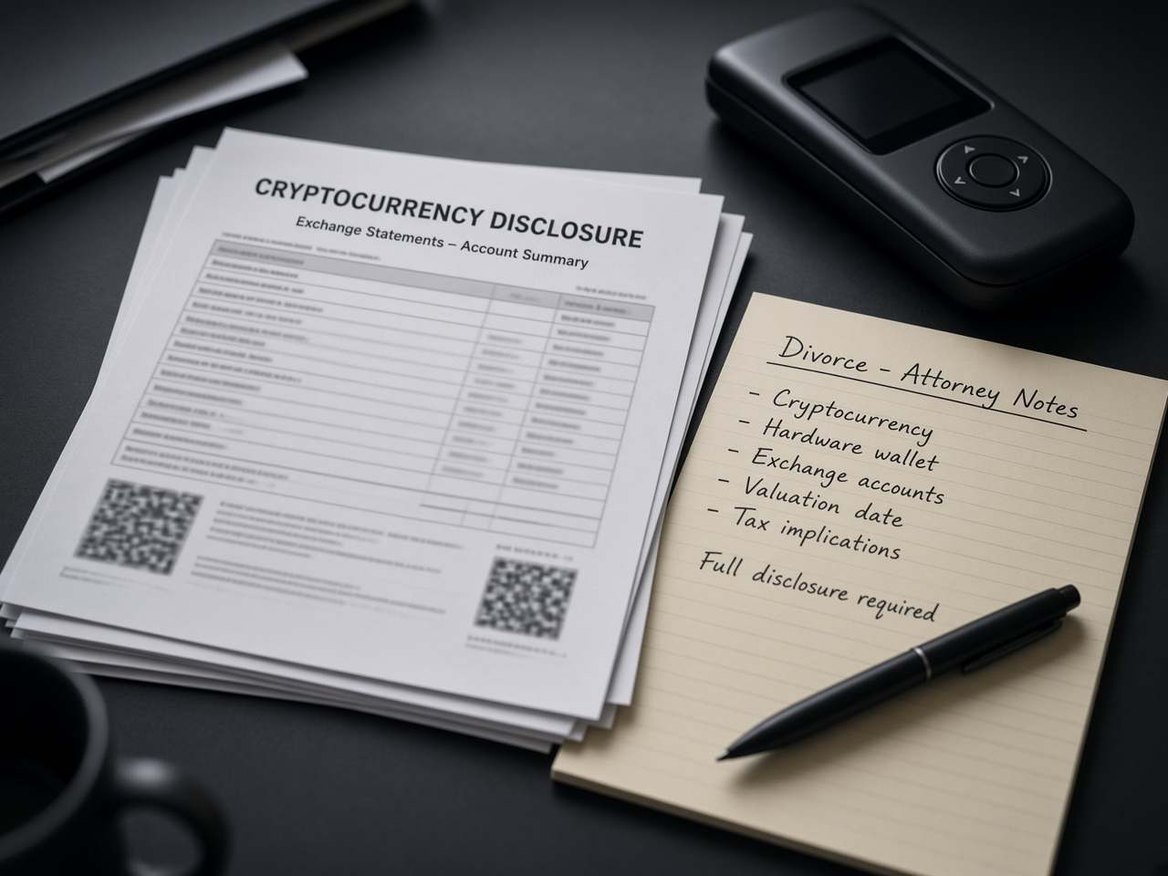
Cryptocurrency & digital assets.
Exchange accounts, hardware wallets, staking income and tokens held in other names are marital property if acquired during the marriage, and all of them leave a trail. The valuation date matters more here than anywhere else in the estate.
- 01Three things that decide these cases
- 02The blockchain forgives nothing
- 03Pick the date, or share the ride
- 04Pre-marital coins meet marital behavior
- 05A settlement you can't take custody of…
- →What people ask first
Talk to us about your case.
303-507-5529One call. A real person picks up, hears you out, and tells you how we would handle what you are facing and what to do first. No phone tree, no sales pitch, no obligation. Your first conversation is with our intake paralegal, who will get you to Aaron fast.
Rather write? Send a short note and during business hours we call you back within the hour.
The classification is settled; the work is practical.
Coins, tokens, NFTs, staking positions, and exchange balances are property subject to Colorado's marital/separate framework and to the same sworn Rule 16.2 disclosure duty as every bank account — acquired during the marriage, presumptively marital; concealed, sanctionable. The interesting questions aren't whether crypto divides, but how it's found, valued on a moving market, and transferred without losing it. Those are process problems, and process is what I do.
Digital assets have a reputation as the perfect hiding place. The reputation is out of date.
Three things that decide these cases.
U.S. exchanges are regulated businesses that respond to subpoenas; the federal return asks every filer, under penalty of perjury, whether they transacted in digital assets; bank statements show the transfers to Coinbase or Kraken. Once a self-custody wallet is linked to a person, every transaction it ever made is visible forever.
An asset that can move 20% in a week strains a process that values estates as of a hearing months away. Either fix a valuation date by agreement and let one party keep the position at that price, or divide in kind so both share the market risk. Pretending volatility away is what fails.
Paper divides crypto; keys deliver it. Settlement terms specify the mechanics, on-exchange transfer to an account in your sole name or on-chain to a wallet you control, verified before releases are signed, with the § 1041 basis carrying over.
The blockchain forgives nothing.

The search runs on rails: U.S. exchanges are regulated businesses that maintain account records and respond to subpoenas; the federal income tax return asks every filer whether they transacted in digital assets, under penalty of perjury; and bank statements show the fiat on-ramps — transfers to Coinbase or Kraken sitting in plain sight. For self-custody, the ledger itself is public and permanent: once a wallet is linked to a person, every transaction it ever made is visible forever. Cash forgets; the chain doesn't.
Pick the date, or share the ride.
An asset that can move 20% in a week strains a process that values estates as of a hearing months away. Two clean solutions: fix a valuation date by agreement and let one party keep the position at that price — or divide in kind, transferring coins rather than dollar values so both parties share the market risk equally. What fails is pretending volatility away. The right choice depends on who wants the exposure, and I negotiate it explicitly rather than by accident.
Pre-marital coins meet marital behavior.

Crypto bought before the marriage can support a separate-property claim — but wallets commingle as easily as bank accounts, and staking rewards, trading activity, and marital-fund purchases braid separate and marital strands together. The public ledger cuts both ways here: it can prove a pristine pre-marital position, or document precisely when marital dollars entered the wallet. The records-management discipline that governs separate-property claims applies with full force, timestamped.
A settlement you can't take custody of isn't one.
Paper divides crypto; keys deliver it. Settlement terms must specify the mechanics — on-exchange transfers to an account in your sole name, or on-chain transfers to a wallet you control, verified before releases are signed — along with responsibility for the tax character of the division (§ 1041's nonrecognition rules apply to crypto transferred between spouses incident to divorce, with basis carrying over). I close these the way I close every division: not when the order enters, but when the asset is actually in your hands.
What I tell every client about digital assets.
Five things, whichever side of the wallet you are on.
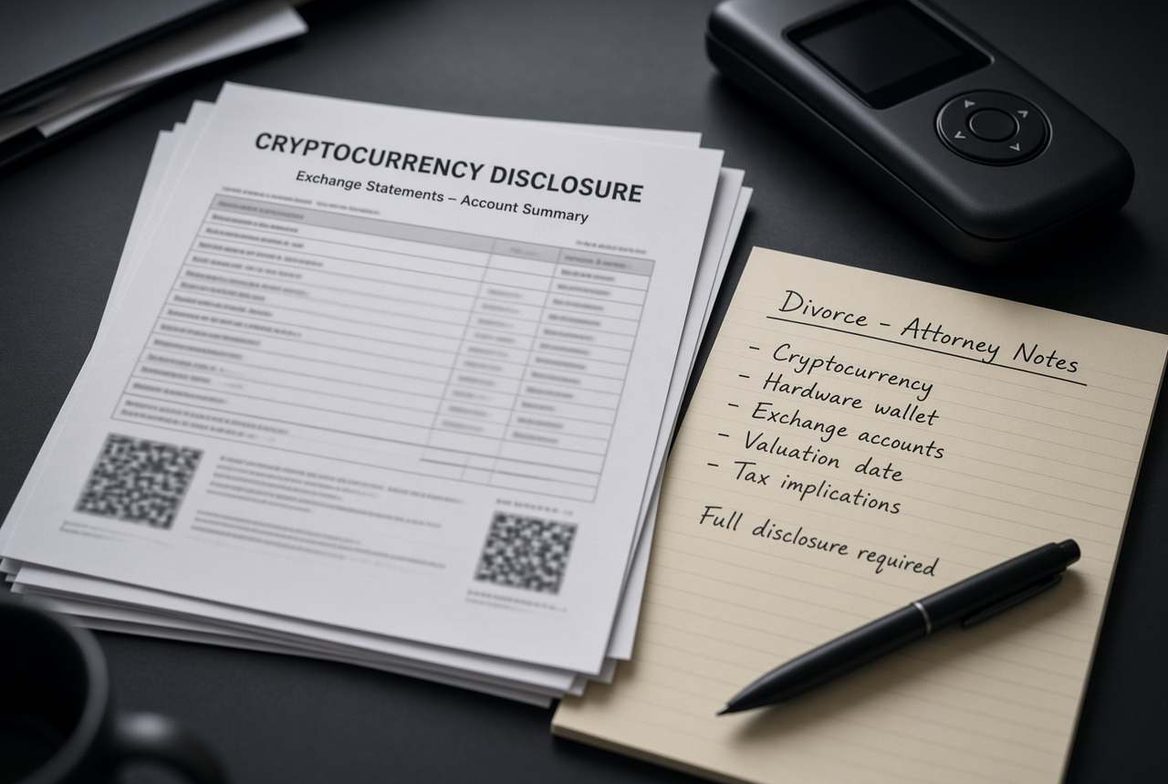
- The trail is on the bank side.
Fiat on-ramps, exchange statements, tax reporting and transfers from ordinary accounts are how holdings are found and proven.
- Disclose every wallet and address.
The disclosure duty covers digital assets. An address left off the sworn statement is an omission with a five-year tail.
- Fix the valuation date and the method.
A holding that moved thirty percent last month needs a date the court will accept and a source for the price.
- Draft the transfer mechanics.
A division that says half the coins without saying how, when and to which address is a division that does not happen.
- Do not move anything during the case.
The automatic injunction covers digital assets. A transfer to a new wallet after the petition is filed is evidence, not strategy.
Crypto is property like any other. The blockchain forgives nothing.
Start with a confidential conversation: tell me what is at stake →
The questions people ask about crypto in a divorce.
Is cryptocurrency marital property in Colorado?
Yes, on the same rules as everything else. Coins, tokens, NFTs, staking positions and exchange balances acquired during the marriage are presumptively marital, whichever spouse holds the keys, and they are subject to the same sworn disclosure duty as a bank account. Crypto bought before the marriage can be separate property, but the increase in its value during the marriage is marital, and wallets commingle as easily as accounts.
My spouse says the crypto is untraceable. Is that true?
No. U.S. exchanges are regulated businesses that keep account records and respond to subpoenas. The federal tax return asks every filer, under penalty of perjury, whether they transacted in digital assets. Bank statements show the transfers to the exchanges. And for self-custody, the ledger is public and permanent: once a wallet is linked to a person, every transaction it ever made is visible. Cash forgets; the chain does not.
Do I have to disclose wallets that hold almost nothing?
Yes. The mandatory disclosure duty covers digital assets, and every wallet and address goes on the sworn statement. An address left off is an omission, and a division built on a material omission can be reopened for five years after the decree. Disclose everything, including the positions that seem trivial.
How is crypto valued when the price moves twenty percent in a week?
Two clean solutions, and the choice is negotiated explicitly. Fix a valuation date by agreement and let one spouse keep the position at that price, with a source for the price the court will accept; or divide in kind, transferring coins rather than dollar values, so both spouses share the market risk equally. What fails is pretending the volatility away and valuing as of a hearing months out.
Can I move my crypto to a new wallet now that the case has started?
No. The automatic temporary injunction that takes effect on service covers digital assets like any other marital property: no transfers, no encumbrances, no concealment outside the usual course of business or the necessities of life. A transfer to a new wallet after the petition is filed is evidence, not strategy, and it is visible on the chain.
Is there tax when crypto is transferred between spouses in the divorce?
Generally not at the transfer. Section 1041 of the tax code makes transfers between spouses incident to divorce nonrecognition events, and the receiving spouse takes the transferor’s basis. The built-in gain travels with the coins, so a position with a low basis is worth less after tax than its market value, and the settlement is priced accordingly.
How is my share actually delivered to me?
By keys, not paper. The settlement specifies the mechanics: an on-exchange transfer to an account in your sole name, or an on-chain transfer to a wallet you control, verified before the releases are signed. A division that says half the coins without saying how, when and to which address is a division that does not happen.
What about staking rewards, mining income and tokens held in someone else's name?
Staking and mining rewards earned during the marriage are marital, and they are also income for support. Tokens held in a relative’s name or a nominee wallet are reached the same way any asset in another name is: through the bank-side trail, the exchange records and the chain, and through the disclosure duty that makes the omission itself an exhibit.
Where to go next.
The next page in this chapter, the pages that belong with it, and the blog posts on the same question.
From the blog, on this topic
Spousal Lifetime Access Trusts move wealth out of the taxable estate, with the marriage as the access mechanism. In a divorce, the donor loses the access,…
Sept 17, 2026Dividing Retirement Accounts in a Colorado Divorce Without Blowing Them UpRetirement accounts are often the largest marital asset and the most commonly mishandled. QDROs, Colorado PERA, the time-rule formula, and survivor benefits each…
Sept 16, 2026Value Depends on Definition: The Standard-of-Value Fight in Colorado Business ValuationColorado leaves the standard of value in divorce undefined, and that choice, not the percentage debate, is what decides whether marketability and control…
Digital assets are findable, valuable and divisible. Let’s do all three.
A consultation is a working session, in person in Greenwood Village or by video: we go through your situation and I tell you what I would do. Your note reaches my office directly; during business hours we call you back within the hour, run the conflicts check, and set the meeting.
Talk to us about your case.
303-507-5529One call. A real person picks up, hears you out, and tells you how we would handle what you are facing and what to do first. No phone tree, no sales pitch, no obligation. Your first conversation is with our intake paralegal, who will get you to Aaron fast.
Rather write? Send a short note and during business hours we call you back within the hour.