Emergency orders in Colorado family court.
When a child is in danger, or an asset is about to disappear, Colorado has fast tools: the motion to restrict parenting time with a hearing within days, civil protection orders, and the automatic injunction that takes effect the moment a case is filed. Each has its own standard and its own clock.
- 01Four tools, three clocks
- 02If an emergency motion has been filed…
- 03And which one fits
- 04Fourteen days, supervised in the meantime
- 05You already have an injunction. Sometimes…
- 06Exclusive use and possession
- 07In the Denver-area courts
- →What people ask first
Talk to us about your case.
303-507-5529One call. A real person picks up, hears you out, and tells you how we would handle what you are facing and what to do first. No phone tree, no sales pitch, no obligation. Your first conversation is with our intake paralegal, who will get you to Aaron fast.
Rather write? Send a short note and during business hours we call you back within the hour.
What the court treats as an emergency.
Judges grant emergency relief for harm that is recent, specific, and provable, and deny it for everything else. The court will act on a child exposed to violence, intoxication, or an unsafe person in the last days or weeks; a credible threat to take the children out of state; a parent who cannot safely care for the children because of a relapse or a psychiatric crisis; money being moved, borrowed against, or hidden in amounts that would be hard to recover; and a spouse whose presence in the home is causing physical or emotional harm. It will not act on incidents from years ago, on a parent you consider a poor one, on ordinary disagreements about bedtime or school, or on a fear you cannot document. The one sentence I repeat to every client: the court will be looking for tangible proof, and proving — or refuting — the immediacy of the harm is the whole case.
Family courts move on a schedule of months. A few things move in days: a child in danger, money leaving the marital estate, a spouse who has to be out of the house. They deny it for incidents from years ago, ordinary disagreements about bedtime or school, and fears you cannot document.
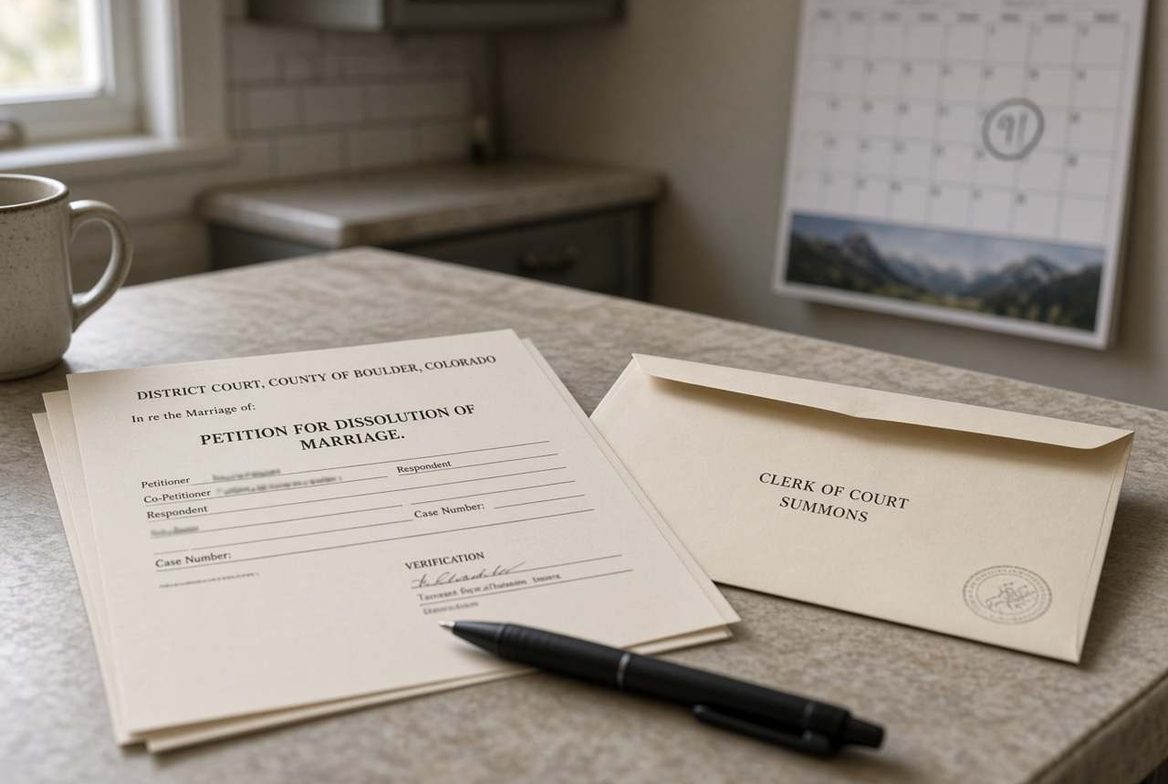
Four tools, three clocks.
A motion to restrict parenting time (C.R.S. § 14-10-129(4)) cuts the other parent’s time to supervised contact on filing and must be heard within fourteen days. A civil protection order (§ 13-14-104.5) issues the same day and is heard within fourteen. A frivolous motion costs its filer the other side’s fees.
Every Colorado divorce carries an automatic temporary injunction from filing (§ 14-10-107(4)(b)): no transferring, hiding or borrowing against marital property, no taking the children out of state, no cancelling insurance. When it is not enough, a Rule 65 restraining order on specific sworn facts can freeze a transfer the same day, for up to fourteen days, and goes to the bank the same afternoon.
Nobody has to move out when a divorce is filed. A spouse can be excluded through a protection order, or through temporary orders (§ 14-10-108(2)(c)), on a showing that physical or emotional harm would otherwise result. The spouse who stays usually keeps the children’s routine, which matters at the next hearing.
If an emergency motion has been filed against you.

Follow the order exactly, including the supervision, while I get the hearing set. Read the motion for the word that matters, imminent, and gather the evidence that answers it: the timeline of the weeks before the filing, the complete message threads, the people who were there, and the record of ordinary, uneventful parenting that continued right up to the day the motion appeared. Supervised time in the meantime is a bridge, not a verdict, and the supervisor’s notes become evidence too.
And which one fits.
| Motion to restrict parenting time | Civil protection order | Temporary restraining order | Expedited temporary orders | |
|---|---|---|---|---|
| Use it for | A child in imminent physical or emotional danger from the other parent’s time | Threats, abuse, or stalking of you or the children; getting a spouse out of the home | Money or property about to disappear | Support, the house, and a parenting schedule while the case is pending |
| Law | C.R.S. § 14-10-129(4) | C.R.S. § 13-14-104.5 | C.R.C.P. 65(b) with C.R.S. § 14-10-108(2) | C.R.S. § 14-10-108 |
| How fast | Time cut to supervised contact on filing; hearing within 14 days | Same-day temporary order; hearing within 14 days | Same day without notice if immediate and irreparable injury is shown; lasts up to 14 days | Weeks to months; the court can be asked to set it sooner |
| What must be shown | Imminent danger to the child | A risk or threat of physical, psychological, or emotional harm | Immediate and irreparable injury before the other side can be heard | Need, and for the home, that physical or emotional harm would otherwise result |
Fourteen days, supervised in the meantime.

A motion under C.R.S. § 14-10-129(4) alleges that the child is in imminent physical or emotional danger because of the other parent’s parenting time or contact. From the moment it is filed, the other parent’s time is limited to contact supervised by an unrelated third party the court finds suitable or by a licensed mental-health professional — not stopped, as some websites say, but supervised. The court must hear and rule on the motion within fourteen days. At the hearing the moving parent has to prove the danger with evidence: what happened, when, who saw it, and why it is likely to happen again. The outcomes range from denial, to a period of supervised time, to conditions such as sobriety monitoring or treatment, to an evaluation by a CFI or PRE. Colorado attached a price to misuse: if the court finds the motion was substantially frivolous, groundless, or vexatious, the parent who filed it pays the other side’s attorney fees.
You already have an injunction. Sometimes you need more.
Every Colorado divorce carries an automatic temporary injunction (C.R.S. § 14-10-107(4)(b)) from the moment the petition is filed, binding the filer immediately and the other spouse on service: no transferring, encumbering, concealing, or disposing of marital property outside the ordinary course of business or the necessities of life, with a duty to account for extraordinary expenditures; no taking the children out of state without consent or an order; no cancelling or changing health, home, auto, or life insurance without fourteen days’ notice and consent; and no disturbing the other spouse’s peace. Officers can enforce the last one on the spot.
When the injunction is not enough — a transfer already in motion, an account overseas, a business distribution about to be paid — I ask for a temporary restraining order under Rule 65 together with orders under C.R.S. § 14-10-108(2) restraining specific transfers. A restraining order can issue without notice to the other side only on specific sworn facts showing immediate and irreparable injury before the other side can be heard; it lasts no more than fourteen days, and the court sets a hearing as soon as possible on whether to extend it. In practice the order is only as good as the notice that goes with it: I send it to the bank, the brokerage, the company’s controller, and the title company the same day.
Exclusive use and possession.

Colorado does not require anyone to move out when a divorce is filed. A court can exclude a spouse from the family home in two ways: through a protection order, on a showing that physical or emotional harm would otherwise result, or through temporary orders under C.R.S. § 14-10-108(2)(c) on the same showing. The protection-order route is faster and does not require an incident to be violent; the temporary-orders route is the right one when the problem is a household that has become intolerable rather than dangerous. Either way the court looks at the children’s routine, who can realistically move, and the record of what has been happening in the house — and the spouse who stays usually keeps the children’s routine with them, which matters at the next hearing.
In the Denver-area courts.
A temporary protection order can be in hand the same morning. A temporary restraining order on money can issue the same day if the affidavit supports it. A motion to restrict must be heard within fourteen days, and the divorce courts keep that clock. Everything else — support, the house on a non-emergency basis, a first parenting schedule — comes through temporary orders, which in my experience the south-metro magistrates hear two to four months after filing, usually after mediation. A motion can ask the court to set a matter forthwith, and courts do it when the papers show why; the papers are the difference.
Comply, then fight.

Follow the order exactly, including the supervision, while I get the hearing set. Read the motion for the word that matters — imminent — and gather the evidence that answers it: the timeline of the weeks before the filing, the complete message threads, the people who were there, and the record of ordinary, uneventful parenting that continued right up to the day the motion appeared. Supervised time in the meantime is a bridge, not a verdict; use it well, because the supervisor’s notes become evidence too. And remember the fee provision: a motion filed as leverage rather than out of fear costs the parent who filed it. The full playbook is on the False Allegations page.
The court wants proof, not adjectives.
- A dated timeline of the incidents, with the most recent first.
- Photographs, video, and voicemails, with dates.
- Complete text and email threads, exported rather than screenshotted.
- Police reports and case numbers; medical, school, or daycare records.
- Names and contact details of witnesses.
- For money: account statements, screenshots of balances with dates, transfer confirmations, loan applications, and the business’s recent bank activity.
- The existing parenting plan, decree, or orders, if any.
Turning fast relief into a durable order.

Emergency orders are short-lived by design. What follows is the ordinary path — temporary orders, a CFI or PRE where the parenting dispute warrants it, treatment or testing conditions where substance use was the issue, and, when domestic violence is found, the safety conditions the custody statute now provides for. The work in the weeks after an emergency is converting a two-week order into a parenting plan and a financial structure that will hold, which is where the case is actually won: Temporary Orders.
What I tell every client in an emergency.
Five things, in the order they matter.

- Safety first, paper second.
If a child or you are in danger, call the police and get to safety. The motion is filed after, not instead.
- Use the right tool.
A motion to restrict, a protection order and the automatic injunction do different things on different clocks. The wrong one wastes days.
- Emergency means evidence.
A sworn statement with dates, messages, photographs and names. The court acts on facts it can see, not on fear.
- Expect a fast hearing.
The other side gets heard within days. Prepare for that hearing when you file, not after.
- Do not overreach.
A restriction the evidence does not support damages your credibility for the rest of the case. Ask for what you can prove.
A child in danger, money leaving the estate, a spouse who has to be out of the house: the court moves in days if the papers show why.
Start with a confidential conversation: tell me what is at stake →
The short answers.
Can I get an order without the other side being there?
Yes — a temporary protection order and, on the right sworn facts, a temporary restraining order on money both issue without notice. A motion to restrict takes effect on filing. In every case the other side gets a hearing within days, and the order survives only if the evidence holds up there.
Will a protection order decide custody?
No. It can award temporary care and control of the children for up to a year, but the divorce or custody court decides parental responsibilities, and that decision is made on the whole record.
Does calling the police first help?
A police report is evidence, and in a violent incident it is the right call. But a protection order does not require one, and a report that does not match the later story hurts more than no report at all. Tell the truth in both places.
The children are already out of state. What now?
If Colorado is the children’s home state, the court can order their return and the other parent’s compliance, and Colorado’s adoption of the UCCJEA gives it expedited enforcement tools. Speed matters; call the same day. More: Interstate & International Custody.
What does an emergency motion cost?
The court fees are small; the cost is the work of assembling proof in days rather than months. That is also why a weak emergency motion is expensive: it fails, and it can cost you the other side’s fees. I file them when the facts are there.
Where to go next.
The next page in this chapter, the pages that belong with it, and the blog posts on the same question.
From the blog, on this topic
Between filing and decree, somebody pays the mortgage, runs the company, and funds the case. Temporary orders govern that interval, and for business owners they…
Sept 7, 2026Maintenance After SB25-116: Colorado's No-Fault Rule Gets an AsteriskA 2025 amendment lets Colorado courts weigh domestic violence, coercive control, and economic abuse when setting maintenance, beside a statute that still says…
If it’s an emergency, the clock is measured in days. Call me today.
A consultation is a working session, in person in Greenwood Village or by video: we go through your situation and I tell you what I would do. Your note reaches my office directly; during business hours we call you back within the hour, run the conflicts check, and set the meeting.
Talk to us about your case.
303-507-5529One call. A real person picks up, hears you out, and tells you how we would handle what you are facing and what to do first. No phone tree, no sales pitch, no obligation. Your first conversation is with our intake paralegal, who will get you to Aaron fast.
Rather write? Send a short note and during business hours we call you back within the hour.