10%
Child support’s line
A recalculation that moves support by less than ten percent a month is deemed not substantial and continuing. Ten or more is the usual ticket in.

Every order from a divorce or custody case can be revisited except one, and each has its own test. A schedule changes on the child’s best interests; the parent the child lives with, or who decides, needs more; support and maintenance need a change that is substantial and continuing; the property division is final. Which door you knock on decides how hard it opens. This page is the map; each area has its own page below.
Talk to us about your case.
303-507-5529One call. A real person picks up, hears you out, and tells you how we would handle what you are facing and what to do first. No phone tree, no sales pitch, no obligation. Your first conversation is with our intake paralegal, who will get you to Aaron fast.
Rather write? Send a short note and during business hours we call you back within the hour.
Orders are built on a snapshot. Life keeps moving, and the statute knows it.
A decree describes the family as it was on the day the judge signed it: the incomes that year, the schedule that worked for a six-year-old, the house one spouse could afford. Three years later one parent has moved to Boulder, the company had its best year or its worst, the child is fourteen and has an opinion. Colorado lets the orders follow the facts. It does not do so on the same terms for every order, and never on the strength of a feeling that things have changed. Each order has a test, a burden and a clock.
I have filed and defended these motions for thirty years, and the pattern is stable. The parent or spouse who identifies the right standard before filing, and builds the record to meet it, usually gets the order changed or keeps it. The one who files a general complaint about fairness gets a denial, sometimes with the other side’s fees attached. This page sets out the standards by area, in the words the statute uses, and what the court has to see for each. The pages that follow it go deep on each one.

A recalculation that moves support by less than ten percent a month is deemed not substantial and continuing. Ten or more is the usual ticket in.
A motion alleging imminent danger to the child must be heard and ruled on within fourteen days, with parenting time supervised in the meantime.
No second motion to change the majority-time parent, or decision-making, within two years of the last such motion, unless affidavits show endangerment (or, for majority time, a relocation).
A modified support or maintenance order runs from the date the motion was filed, not from the day life changed.
Colorado does not say custody. It says the allocation of parental responsibilities, APR, and it splits them in two: parenting time, where the child lives and the schedule with each parent, and decision-making responsibility, who decides education, medical care, religion and the like. Each has its own rule for change, and the rule turns on how much you are asking for. The mistake people make is filing the easy motion when the facts call for the hard one, or the reverse. The full treatment, with the cases and the procedure, is on the Modifying Custody page.
| What you want to change | The standard | Who has to show what | Statute |
|---|---|---|---|
| Adjust the schedule — exchanges, holidays, a midweek overnight, summer, or the number of overnights — without changing which parent has the majority | Best interests of the child. The court may modify an order granting or denying parenting time whenever the modification would serve the child’s best interests, weighing the statute’s factors. Since May 2026 this includes a cut in overnights of any size: the Colorado Supreme Court held that reducing a parent’s time is a modification, not a restriction, unless the court stops the time or puts conditions on how it happens. | The moving parent shows the change serves the child. No changed-circumstances threshold, no two-year wait, no affidavit hurdle. How it is done → | C.R.S. § 14-10-129(1)(a)(I); C.R.S. § 14-10-124(1.5) |
| Change the parent the child lives with most of the time, or substantially change parenting time in a way that changes the majority-time parent | Changed circumstances, and one of four doors. The court must find, on facts that arose since the decree or were unknown to the court then, that the circumstances of the child or the majority-time parent have changed and that the change is necessary for the child’s best interests. Even then it keeps the existing schedule unless: the parents agree; the child has been integrated into the moving parent’s family with the other parent’s consent; the majority-time parent is relocating in a way that substantially changes the child’s geographic ties; or the present environment endangers the child’s physical health or significantly impairs emotional development and the harm of a change is outweighed by its advantage. | The moving parent, with an affidavit filed with the motion. The court must deny the motion without a hearing unless the affidavits establish adequate cause. No second motion of this kind within two years of the last one, unless affidavits show endangerment or the majority-time parent is relocating. The four doors → | C.R.S. § 14-10-129(2); C.R.S. § 14-10-129(1.5); C.R.S. § 14-10-132 |
| Restrict the other parent’s time — supervision, no overnights, limits on where, or no contact | Endangerment. The court shall not restrict a parent’s parenting time unless it finds the parenting time would endanger the child’s physical health or significantly impair the child’s emotional development, and the order must set out the specific findings. Best interests is not enough for a restriction; a restriction means stopping the time or attaching conditions to its manner, place or supervision. | The moving parent proves endangerment with evidence, not characterization. A motion alleging imminent danger must be heard and ruled on within fourteen days, with parenting time supervised in the meantime; if the court finds the motion substantially frivolous, groundless or vexatious, it must order the filer to pay the other side’s fees. The fourteen-day motion → | C.R.S. § 14-10-129(1)(b)(I); C.R.S. § 14-10-129(4); C.R.S. § 14-10-129(5) |
| Change decision-making — joint to sole, sole to joint, or one subject such as school, medical care or religion | Changed circumstances, and the court keeps the current allocation unless: the parents agree; the child has been integrated into the moving parent’s family with the other parent’s consent and the situation warrants it; a parenting-time modification warrants a matching change; the other parent has consistently consented to you making those decisions alone; or keeping the allocation would endanger the child’s physical health or significantly impair emotional development and the benefit outweighs the harm. | The moving parent, with affidavits establishing adequate cause. No motion within two years of any prior decision-making motion unless affidavits show that continuing the current order may endanger the child. Decision-making → | C.R.S. § 14-10-131; C.R.S. § 14-10-132 |
| Relocate with the child — a move that substantially changes the child’s geographic ties to the other parent | Decided on the relocation factors, with no presumption for or against the move: the reasons for and against it, each parent’s relationship with the child since the last order, educational opportunities, extended family at both locations, the advantages of the child remaining with the primary caregiver, the anticipated impact on the child, whether a reasonable schedule can be fashioned after the move, and the best-interests factors. Both parents share the burden of showing what serves the child. | The relocating majority-time parent gives written notice as soon as practicable: the intent to move, where, why, and a proposed revised plan. Either parent sets the matter for hearing; relocation hearings have priority on the court’s docket. The relocation page → | C.R.S. § 14-10-129(1)(a)(II); C.R.S. § 14-10-129(2)(c) |
| Change the plan by agreement | Best interests, on a stipulation. Parents may agree to a new plan or schedule; the court reviews it for the child’s best interests and enters it. Until it is entered, the old order is the one a judge enforces. | Both parents sign; a short filing; usually no hearing. Stipulated changes → | C.R.S. § 14-10-129(1)(a)(I) |
The child’s wishes are a best-interests factor, weighed more heavily as the child matures; they are evidence, not a standard. Since May 2026 a finding of domestic violence, which now includes coercive control and economic abuse, changes the analysis: the court must make findings on the record, may not order mutual decision-making over the abused parent’s objection without specific findings that it can happen without coercion, and must impose conditions on parenting time that keep the child and the abused parent safe. A parent’s military deployment is handled by interim orders under a separate act and is not itself a change in circumstances.

A parenting motion is decided on the record of the months before it was filed: who did the ordinary days, what changed, and what plan you propose.
The record of the ordinary days. Who does the pickups, the homework, the pediatrician, the calls to the school. A parenting motion is decided on the months before it was filed, not on the hearing. The calendar, the messages and the school’s records are the evidence.
Facts that are new. Facts the court knew at the decree do not count, and neither does a decree the parties should have negotiated differently. The motion has to say what changed, when it changed, and why the child needs the order to change with it.
A plan, not a grievance. The court modifies to a specific schedule or allocation. Propose it, with the overnights counted and the child support recalculated, because every overnight now moves that number.
Name the standard before you name the change. Which door you knock on decides how hard it opens.
Support is the most modified order in family law, and the one with the clearest test. A modification requires changed circumstances that are substantial and continuing, and the statute defines the floor: a guideline recalculation that moves the monthly amount by less than ten percent is deemed not to qualify. The worksheet is the argument. The Modifying Child Support page has the 2026 table, the imputed-income rules, the county review route and the out-of-state cases; When Child Support Ends covers nineteen and everything around it.
| What changed | Does it qualify? | How it works | Statute |
|---|---|---|---|
| Either parent’s income rose or fell | Yes, if the recalculated guideline moves the monthly amount by ten percent or more and the change is continuing, not a bad quarter. A recalculation that moves it less than ten percent is deemed not substantial and continuing; the only other ground is an order with no provision for medical support. | Run the worksheet on the new incomes; the difference is the showing. Voluntary underemployment is not a change: the court calculates support on potential income, except for a parent who is incapacitated, caring for a child under two, or serving a sentence of 180 days or more. Income changes → | C.R.S. § 14-10-122(1)(b); C.R.S. § 14-10-115(5)(b) |
| The parenting schedule changed | Yes if the schedule actually changed. Since March 1, 2026 every overnight moves the number, so a real change in overnights usually clears ten percent. A schedule that changed on paper only does not. | Support follows the schedule the child actually lives. Where physical care changed by court order, voluntarily or by agreement, the modification runs from the date care changed, but not more than five years back. The 2026 table → | C.R.S. § 14-10-122(5); C.R.S. § 14-10-115(8) |
| A child turned nineteen | Automatic for the last or only child. Support ends at nineteen without a motion, unless the child is still in high school (then through the end of the month after graduation), the child is disabled, or the parents agreed in writing to extend it. Marriage or active military duty also emancipates. | With more than one child the order does not fall to the next amount by itself; a motion is needed, and the reduction runs from its filing. Arrears that accrued before emancipation remain owed, and withholding continues until they are paid. When support ends → | C.R.S. § 14-10-115(13); C.R.S. § 14-10-122(3) |
| Daycare, health insurance or medical expenses changed | Yes, if the change moves the total by ten percent. An order with no provision for medical support is a ground on its own, whatever the percentage. | Bring the invoices and the premium statements; these are line items on the worksheet, and the court apportions them by income. Since 2025 there is no $250 threshold before uninsured medical costs are shared. | C.R.S. § 14-10-122(1)(a); C.R.S. § 14-10-115(10) |
| A new child, a new marriage | An input, not a motion. A legal duty to support another child adjusts a parent’s income on the worksheet; a new spouse’s income does not count. | It matters when it produces the ten percent, and it cannot be used to reduce an existing order below what the worksheet would otherwise give. | C.R.S. § 14-10-115(6) |
| The law changed — the 2026 guidelines | Not by itself. Any motion decided after March 1, 2026 is calculated under the new table and the new overnight credit; the statute’s test is still whether the recalculation moves support by ten percent or more. | Run both worksheets. Many orders move under the new formula; some do not. What changed in 2026 → | C.R.S. § 14-10-122(1)(b) |
| Support already owed | No. Each installment becomes a final money judgment as it comes due and is not retroactively modified. The court modifies installments accruing after the motion is filed. | The motion changes the future; what is owed is enforced, with interest, on the Enforcement page. | C.R.S. § 14-10-122(1)(c); C.R.S. § 14-14-106 |
Effective date: a modified support order should run from the date the motion was filed unless the court finds that would cause undue hardship or substantial injustice; the court cannot reach back before the filing except for a court-ordered, voluntary or agreed change of physical care, which runs from the date care changed. Interest on unpaid support is twelve percent compounded monthly on installments due before July 1, 2021, and ten percent compounded annually after.
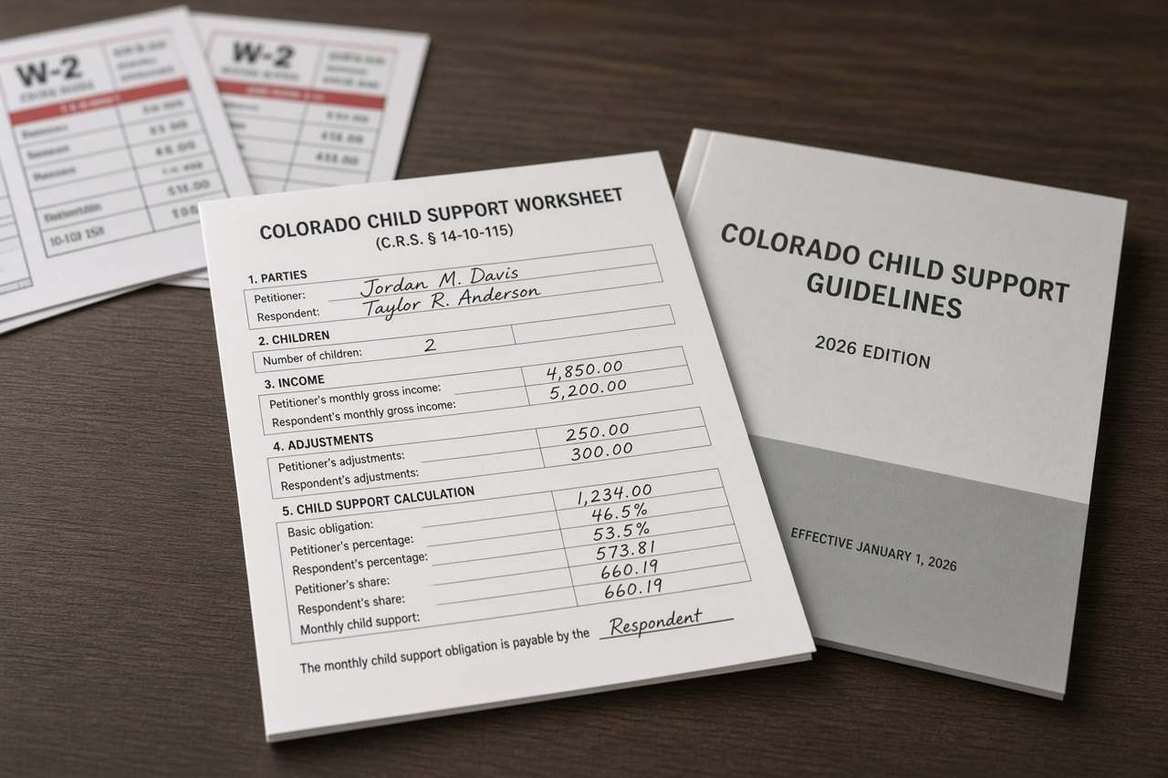
The worksheet decides it. Run it on both sides’ numbers before anyone files, prove the change is continuing, and file the day it becomes real.
The worksheet first, the motion second. Before anyone files, I run the guideline on the current facts and on the facts as the other side will argue them. If the difference is under ten percent the motion loses, and it may cost fees. If it is over, the worksheet is the exhibit.
Prove the change is continuing. A layoff with a job-search log is a change; a sabbatical is not. Six months of new pay stubs beat a letter from your employer, and an owner’s down year is proved with the company’s books, not a story about the market.
File on the day the change becomes real. Relief runs from the filing date. The disciplined sequence is document the change, establish that it is continuing, file, then negotiate. Waiting to see whether things improve is paid for at the old number.
Relief runs from the day you file. Every month between the change and the filing is a month at the old number.
Maintenance is modifiable unless the decree says it is not, and the test is harder than child support’s: the change must be so substantial and continuing that the original terms have become unfair. There is no ten-percent shortcut. The whole financial picture is re-examined, on both sides.
| What changed | Does it qualify? | How it works | Statute |
|---|---|---|---|
| The payor’s income fell | If the fall is substantial and continuing and makes the terms unfair: involuntary job loss, a business that is genuinely down, disability. Early retirement, or a drop the payor arranged, invites imputed income instead of relief. | The court re-examines both sides’ current incomes and needs against the original order. The ten-percent rule does not apply to maintenance. | C.R.S. § 14-10-122(1)(a) |
| The recipient’s income rose, or the need is gone | Yes, if the change is substantial and continuing: a career that took off, a large inheritance, self-sufficiency ahead of the term. | The payor moves; the recipient answers with current need. Discovery of the recipient’s finances is available and usually decisive. | C.R.S. § 14-10-122(1)(a) |
| The recipient remarried or entered a civil union | Ends automatically, unless the parties agreed otherwise in writing or the decree provides otherwise. | No motion is needed for the termination itself; one may be needed to stop income withholding or recover payments made after the wedding. | C.R.S. § 14-10-122(2) |
| The recipient is living with a partner | Not automatic in Colorado. Cohabitation is a changed circumstance when the partner’s contribution to the household means the recipient’s need has changed. | Proof of shared expenses, not just a shared address: the lease or deed, joint accounts, who pays what. This is built through discovery. | C.R.S. § 14-10-122(1)(a) |
| The payor retired | Retirement at a customary age, in good faith, can be a changed circumstance. Retiring early to shed maintenance is treated as voluntary underemployment. | Age, health, the norms of the profession, what the retirement income is, and whether the recipient planned on the payments continuing. | C.R.S. § 14-10-122(1)(a) |
| Either party died | Ends automatically, unless the decree provides for payments to continue; life insurance is the usual way an agreement secures them. | The estate is not liable for future maintenance absent an agreement. | C.R.S. § 14-10-122(2) |
| The order is “non-modifiable” or “contractual” | No. Where the parties agreed in writing that maintenance cannot be modified, the court cannot change it, however much the facts have changed. | Read the decree and the separation agreement first. The answer is usually written there. | C.R.S. § 14-10-122(1)(a); C.R.S. § 14-10-112(6) |
| The term is ending | Ends by its terms. A motion to extend must be filed before the term runs out and meet the substantial-and-continuing test; once the term has run, the court cannot revive it. | Calendar the end date. A payor confirms withholding stops; a recipient who needs more time files early. | C.R.S. § 14-10-122(2) |
The payor’s side of this in full: Ending or Reducing Maintenance. Before an order exists: Maintenance Defense. The formula, the term and how it ends: Spousal Maintenance. A recipient who needs the term extended or the amount raised files under the same sentence of the statute, before the term ends.

Read the decree first, then both sides’ finances today. The change has to make the original terms unfair, not merely inconvenient.
Read the decree before you hope. “Non-modifiable,” “contractual,” “the parties waive the right to seek modification”: three phrases that end the conversation. If they are not there, the order is open.
Both sides’ finances, now. A maintenance modification is a full re-examination: sworn financial statements, current returns, the recipient’s need today against the order, the payor’s real income today against the number the order assumed.
Unfair, not inconvenient. The statute requires that the change make the original terms unfair. It is a higher bar than support’s ten percent, and it is argued on the whole picture, including who has done what since the decree.
There is no ten-percent shortcut for maintenance. The whole picture is re-examined, on both sides, and the change has to make the terms unfair.
Property is final. Nearly everything else has a door, and the doors have different locks.
| The order | Can it change? | The rule | Statute or rule |
|---|---|---|---|
| The property division | No, with two narrow doors. | The court shall not revoke or modify the property disposition unless it finds conditions that justify reopening a judgment. Colorado’s civil rule allows relief for mistake, inadvertence, surprise or excusable neglect, and for fraud or misconduct of the other party, on a motion filed within 182 days; a void or satisfied judgment, or any other reason justifying relief, within a reasonable time; and an independent action for fraud on the court. Separately, an asset or liability misstated in or omitted from the mandatory disclosures can be reallocated on a motion filed within five years of the decree, with no fraud element. Reopening the division → | C.R.S. § 14-10-122(1)(a); C.R.C.P. 60(b); C.R.C.P. 16.2(e)(10) |
| Temporary orders | Yes, while the case is pending. | Temporary orders can be modified before the decree when the facts warrant it, and they end when the decree enters. A temporary maintenance order is a factor in the final award, so it is worth getting right the first time. | C.R.S. § 14-10-108 |
| A civil protection order | The protected person: any time. The restrained person: after two years. | The protected party may ask to modify or dismiss the order at any time. The restrained party may not move for two years after the permanent order, and two years after each denied motion, and must first obtain a fingerprint-based criminal-history check. The court weighs compliance, treatment, time passed, later incidents and whether the protected person’s safety still depends on the order. | C.R.S. § 13-14-108 |
| A separation agreement incorporated in the decree | Property and debt terms: no. Parenting, support and maintenance terms: yes, unless the agreement forbids it. | The decree may expressly preclude or limit modification of terms if the separation agreement so provides, except terms about the children. Otherwise the agreement’s terms change with the decree. | C.R.S. § 14-10-112(6) |
| The parenting plan’s mechanics — exchanges, communication, right of first refusal, travel notice | Yes. | The best-interests standard, as with any parenting-time change that does not alter the majority-time parent. Most plans also contain a dispute-resolution clause that must be used before the court is asked. | C.R.S. § 14-10-129(1)(a)(I) |
| A deploying parent’s time | Temporarily, under its own act. | Colorado’s Uniform Deployed Parents Custody and Visitation Act lets the court enter an interim order for a deployment of more than ninety days, including delegated time to a family member, on an expedited hearing if the motion is filed before the parent leaves. The interim order ends thirty-five days after the parent gives notice of return. Past or possible deployment cannot be the sole basis for deciding the child’s best interests. | C.R.S. § 14-13.7-107; C.R.S. § 14-13.7-302; C.R.S. § 14-13.7-404 |
Modification is not enforcement and it is not appeal. An order that is being ignored is enforced; an order that was wrong on the law when entered is appealed, on a short deadline. A modification motion cannot relitigate the facts the court already decided.
Modify when the facts changed. Enforce when the order is right and ignored. Appeal or reopen when the order was wrong the day it was entered.
Modify. The facts have changed since the order and the order should change with them. The standards on this page; filed in the same case; money relief from the filing date.
Enforce. The order is right and the other side is not following it. Income withholding, the parenting-time enforcement motion, contempt. On the Enforcement page.
Appeal, or reopen. The order was wrong when it was entered: the judge applied the wrong law, or the findings had no evidence, or something was hidden. The deadline to appeal is measured in days; a judgment is reopened under the civil rules on their own clocks. On the Appeals page and the Reopening page.
Five steps, and the first two decide the case. A motion filed before the standard is identified and the record is built is a motion the other side answers with a fee request.

Which order, which standard, whether the agreement forbids modification, whether a dispute-resolution clause requires mediation first, and whether a two-year clock is running. Half of the motions I am asked to file are answered by this step.

For a parenting motion, an affidavit with the facts that establish adequate cause; the court must deny the motion without a hearing if they do not. For support, the worksheet on both sets of numbers. For maintenance, sworn financial statements and the proof that the change is continuing.

The state’s forms exist for each motion; a contested case gets a drafted motion with the exhibits attached. The filing date fixes when money relief starts, so nothing waits for the other side’s reaction. A response is due twenty-one days after service.

The metro districts require mediation before a contested post-decree hearing by case-management order, and many modifications resolve here by stipulation once the worksheet or the affidavits are on the table. A stipulated order is entered without a hearing.

An evidentiary hearing on the moving party’s burden: witnesses, exhibits, cross-examination, the recalculated worksheet. The court can order one side to pay the other’s fees where the incomes differ, and must assess fees against an emergency motion that was substantially frivolous or brought to harass.
| Motion | In my experience | What stretches it |
|---|---|---|
| Stipulated change to a plan or support | Weeks | A court that sets a brief hearing; a support figure the court questions |
| Contested child support | Two to four months | Disclosure fights over an owner’s income; a vocational evaluation |
| Contested maintenance | Three to six months | Discovery into the recipient’s household; expert testimony on income |
| Parenting time without a majority change | Two to four months | Mediation scheduling; a child and family investigator |
| Majority-time or decision-making change | Four to nine months, longer with an evaluator | The adequate-cause screen; a parental responsibilities evaluation; the two-year bar |
| Relocation | Three to six months, longer with an evaluator | Docket priority helps; a CFI report is due at least thirty-five days before the hearing |
Ranges from my own cases in the Denver metro courts; the case management order and the court’s calendar control the dates.
Six things, in the order they come up. Not legal advice for your case; the mistakes I have watched for thirty years.

Best interests, endangerment, substantial and continuing, ten percent, final. Which one applies decides what evidence matters, and whether to file at all.
Paying less by agreement, trading weekends by text, letting a month slide: none of it changes the order. Support unpaid under the old order is a judgment with interest, whatever the two of you agreed.
Money relief runs from the filing. The instinct to wait and see whether the new job works out costs the difference every month.
The calendar, the messages written as if a judge will read them, the receipts. The disciplined record that won the case is what a later motion is built on, in either direction.
The court will not revisit what it already decided. A motion that reads like an appeal of the decree is denied on the pleadings.
When the worksheet or the calendar plainly supports the change, a stipulated order is faster, cheaper and entered without a hearing. The other side usually knows the numbers too.
We agreed by text, so the order changed.
It did not. Until a court enters the change, the old order is the one that is enforced, and the difference is owed.
Child support ends at eighteen.
Nineteen in Colorado, and later if the child is still in high school, and no age limit if the child is disabled. It ends automatically for the last child, but a multi-child order does not recalculate itself.
My ex moved in with someone, so maintenance stops.
Remarriage ends it automatically; cohabitation does not. It is a changed circumstance to prove, with evidence of the partner’s contribution to the household.
The 2026 guidelines automatically change my support.
Only if running your numbers under them moves the amount by ten percent or more. Many orders move; some do not.
Now that I know what the business was worth, I can redo the property split.
The division is final. The doors are the civil rule’s relief for mistake or fraud on a short clock, and an asset misstated or omitted from the disclosures, within five years. A disagreement about value is not an omission.
Custody can be modified any time the child prefers.
The child’s wishes are a factor. Changing the majority-time parent requires a change in circumstances and one of the statute’s four doors, and the motion can be denied on the affidavits.

An order that no longer fits is changed from the day you file. Not from the day life changed.
Start with a confidential conversation: tell me what changed →
Colorado has a statute built for withheld parenting time: a verified motion under C.R.S. § 14-10-129.5, decided on the papers within thirty-five days, with make-up time of the same kind and length as the time lost, attorney fees the court must award against the parent who withheld or failed to exercise the time, and contempt as one remedy among several. Make-up time, not jail, is usually the point. A single withheld weekend supports make-up time and fees under this statute even where it would not support contempt.
The parenting-time enforcement motion →Enforcement of Orders →Contempt of Court →
It depends on the order. Parenting time can be modified whenever the change serves the child’s best interests; there is no waiting period. The two-year bars are narrower than people think: a motion to change the parent the child lives with most of the time cannot be filed within two years of a prior motion of the same kind, and a motion to change decision-making within two years of a prior decision-making motion. The clock runs from the earlier motion, not from the decree, and it opens for endangerment, and for a relocation in the majority-time case. Child support and maintenance can be modified whenever the facts change substantially and continuously; for support, that means a recalculation that moves the number ten percent or more.
On the day you file, not the day your income fell. Colorado makes a modified support or maintenance order effective as of the filing date unless the court finds that would cause undue hardship or substantial injustice, and it cannot reach back before the filing except for a change in which parent has physical care of the child. Every month between the change and the filing is a month at the old number.
You can agree, and the court will almost always enter a stipulated change to a parenting plan that serves the child. Until it is entered, the old order is the one a judge enforces. Informal side deals about support are how good co-parents end up in enforcement hearings. Paper the agreement; it is a short filing.
No. A child’s wishes are one of the best-interests factors, weighed more heavily as the child matures, but changing the majority-time parent requires a change in circumstances since the decree and one of the statute’s four doors: agreement, integration into your home with the other parent’s consent, a relocation, or endangerment in the present home. A teenager’s preference is evidence; it is not the standard.
Not anymore. In May 2026 the Colorado Supreme Court held that a reduction in the number of overnights, however large, is a modification decided on the child’s best interests. Endangerment is required only to restrict parenting time in kind: supervision, no overnights, limits on where time can happen, or stopping it altogether.
Not for child support: the guideline uses the parents’ incomes. A new spouse’s contribution to household expenses can matter to a maintenance argument about the recipient’s need, and a new legal duty to support another child adjusts a parent’s income on the worksheet.
Enforce it. An order that is being ignored is the right order being violated; the remedies are the parenting-time enforcement motion, income withholding and contempt, on the Enforcement page. Modification is for an order that no longer fits the facts. The two are often filed together, but they are different motions with different standards, and a pattern of violations can become the changed circumstance that supports a modification.
Only if the motion is filed before the term ends and the order does not forbid modification, and only on a showing of changed circumstances so substantial and continuing that the original terms are unfair. Once the term has run, the court cannot revive it. Calendar the end date on both sides.
An agreed stipulation is a short project. A contested support modification is a few months of disclosure and a hearing; a contested parenting modification with an evaluator is longer. The court can order one side to pay the other’s fees under the family-law fee statute where the incomes differ, and it must assess fees against a party whose emergency motion was substantially frivolous or brought to harass. I quote the consultation fee when we schedule and explain the retainer before you sign anything.
Not automatically. Any motion decided after March 1, 2026 is calculated under the new table, and the statute’s own test is whether the recalculation moves your support by ten percent or more. Many orders move under the new overnight credit; some do not. I run both worksheets before anyone files.
The division itself is final. What Colorado allows is a motion to reallocate an asset that was misstated or left out of the mandatory disclosures, filed within five years of the decree, and the civil rule’s relief from a judgment for mistake or fraud, on shorter clocks. A disagreement about what a disclosed asset was worth is not enough; facts withheld from the other side and the appraiser are.
The next page in this chapter, the pages that belong with it, and the blog posts on the same question.
Where a divorce can be filed, where the money can be decided, and where the children's case belongs are three different questions. Colorado's 91-day domicile…
Sept 16, 2026Colorado's New Child Support Law: What Changed on March 1, 2026Colorado rebuilt child support on March 1, 2026: a schedule that now runs to $40,000 a month, a credit for every overnight in place of the 93-night cliff, a…
Sept 15, 2026What Mediation Does in a Colorado Divorce, and What It Cannot DoNearly every Denver-area court sends divorcing spouses to mediation before a contested hearing. How a session actually runs, what makes it work, what it cannot…
A consultation is a working session, in person in Greenwood Village or by video: we read the decree together, I tell you which standard applies and whether the facts meet it, and what I would file. Your note reaches my office directly; during business hours we call you back within the hour, run the conflicts check, and set the meeting.
Talk to us about your case.
303-507-5529One call. A real person picks up, hears you out, and tells you how we would handle what you are facing and what to do first. No phone tree, no sales pitch, no obligation. Your first conversation is with our intake paralegal, who will get you to Aaron fast.
Rather write? Send a short note and during business hours we call you back within the hour.