Custody is decided by what you do, not what you say.
Colorado does not use the word custody. The statute calls it the allocation of parental responsibilities — APR, in the courthouse — and it has two parts: parenting time, where the child lives and the schedule with each parent, and decision-making responsibility, who decides education, medical care, religion and the other major questions. The court applies one standard, the best interests of the child, to the facts of your family: who keeps the schedule, who shows up, who the school knows, how each parent speaks about the other. No preference for mothers or fathers, and no automatic 50/50.
One call. A real person picks up, hears you out, and tells you how we would handle what you are facing and what to do first. No phone tree, no sales pitch, no obligation. Your first conversation is with our intake paralegal, who will get you to Aaron fast.
The parent who shows up, keeps the schedule, and writes every message as if a judge will read it is the parent the court believes.
An APR case, as the court calls it, is not won at the hearing. They are won in the months before it, in pickups made and missed, in the tone of a text at ten at night, in whether the school knows your name. Under C.R.S. § 14-10-124 the court decides decision-making and parenting time on the best interests of the child, from a list of concrete factors, with no preference for mothers or fathers and no automatic 50/50. Every one of those factors is proven with ordinary evidence.
I have tried custody cases for thirty years, and the cases I fight hardest are these. Firm advocacy is not scorched earth: the statute asks which parent will foster the child’s relationship with the other, and a parent who wages war on the other parent is arguing against their own position. This page is how the court decides, how the evaluator sees it, and what you control.
Boulder County parenting cases run through the 20th Judicial District, with its own parenting-class and mediation deadlines. How that court moves a case is on the Boulder divorce page.
Who actually shows up
No preference for mothers or fathers, and no automatic 50/50. Decision‑making and parenting time are allocated separately, on the best‑interests factors, with ordinary evidence: schedules, messages, school records, credibility.
Best interests, assessed practically.
The factors are concrete, not abstract, and each one is something you are already doing or not doing.
Under C.R.S. § 14-10-124(1.5) the court allocates parental responsibilities on the best interests of the child, weighing each parent’s relationship and involvement with the child, the child’s adjustment to home, school and community, the parents’ ability to put the child’s needs first, and each parent’s willingness to foster the child’s relationship with the other. The child’s own wishes count, weighted by maturity; there is no age at which a child decides.
That willingness-to-foster factor quietly disciplines the whole case. A parent who wages war on the other parent is arguing against their own position. Firm advocacy and scorched-earth tactics are different things. I practice the first; the second loses these cases.
Decision-making and parenting time are decided separately. Decision-making is authority over education, health care, religion and activities, joint or allocated by subject. Parenting time is the schedule. A parent can have equal decision-making and less than equal time, or the reverse, and the schedule follows the child’s life, not a formula.
What the court weighs
The statutory factors.
Each parent’s relationship and past involvement with the child
The child’s adjustment to home, school and community
The child’s wishes, weighted by maturity
The mental and physical health of everyone involved
Each parent’s willingness to foster the child’s relationship with the other
The physical proximity of the parents’ homes
Each parent’s ability to put the child’s needs ahead of their own
Any history of domestic violence or child abuse, and the safety of the child
What the court does not do
The presumptions that do not exist.
Prefer mothers, or fathers
Start from 50/50 and make you argue away from it
Punish the parent who ended the marriage
Let a child of any fixed age decide
Reward the louder side
The record you are building right now.
Steady, documented, child-centered conduct through the case is worth more than any argument I can make at a hearing, and it is the one part of the case only you control.
01
The ordinary days
Every text, every pickup, every school event.
Custody decisions turn on practical facts and credibility. The record you are building right now, every message to your co-parent, every pickup made or missed, every appointment and school event, is the evidence. I tell clients from day one: write every message as though a judge will read it, because one may. The parent with the calendar, the school emails and the calm texts is the parent the court can see.
What I do
Set up a written communication channel and a shared calendar in the first week
Keep the schedule you say you want, from now, so the status quo is yours
Build the school, medical and activity record before anyone asks for it
02
The evaluator
The report becomes the center of gravity.
In contested cases the court often appoints a neutral: a Child and Family Investigator, or in complex matters a Parental Responsibilities Evaluator, to investigate and recommend. Scope, depth, cost and the weight the report carries all differ, the appointment happens early, and how it is framed is one of the most consequential moves in the case. Preparing for it is not coaching. It is making sure the true picture of your parenting is visible: your actual involvement, your communication record, your home as it really runs. The parents who do badly with evaluators are rarely bad parents; they are unprepared ones.
What I do
Shape the appointment: CFI or PRE, the questions, the deadline
Prepare you for the interview and the home visit with the record, not a script
Read the report the day it lands and decide whether to accept it or answer it
03
The schedule
The schedule follows the child’s life.
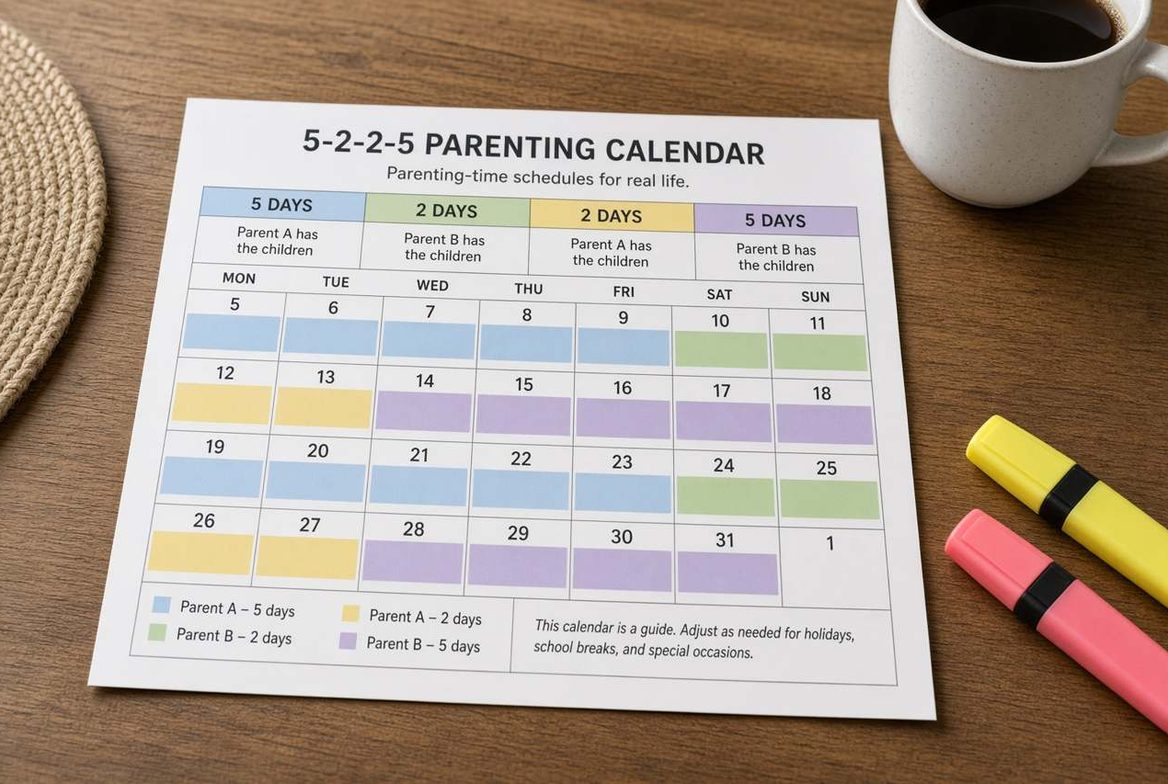
Equal time is common where it serves the child, but the court builds the allocation from your family’s facts: the children’s ages, school, both parents’ work schedules, how far apart the homes are, and who has actually been doing what. A 5-2-2-5 that works for a nine-year-old with two parents near the school is wrong for a toddler or for a parent who travels three weeks a month. The schedule is engineered for the life the child has, then written so it holds up on a Tuesday in February.
What I do
Start from the child’s week, not from a percentage
Draft the exchanges, holidays, travel and right-of-first-refusal terms that actually get litigated
Match the schedule to the support calculation, because every overnight now moves the number
The co-parenting apps: OurFamilyWizard and TalkingParents.
Judges in the Denver-metro districts, parenting plans and decision-makers routinely require that all non-emergency communication between parents go through a co-parenting application, and they usually name one of these two or let the parents choose between them. Both do the same basic thing: every message is timestamped, marked when it is read, and cannot be edited or deleted, so the record of what was said, when, and by whom is kept by a third party neither parent controls. Here is what each does, what it costs, and how the record is used in court.
Documented messaging: timestamps record when each message was received and read; messages are stored unalterably.
ToneMeter and a writing assistant that flag hostile or emotional phrasing before a message is sent.
A shared parenting calendar with color-coded time, holiday scheduling and yes/no trade requests.
An expense ledger with receipts, stated splits (50/50, 80/20) and in-app payments; a running balance.
Documented in-app calls, an information bank for medical, school and insurance records, and a login history.
For court
Records are exported as certified reports. Free professional accounts let your lawyer, a child and family investigator or a parenting coordinator view the activity and download the records directly, which removes any argument about what was produced.
Cost
As of September 2026: a paid subscription for each parent, billed annually, about $110 a year for the basic plan; about $150 for the most-used plan, with 45 minutes of calls a month, the writing assistant, expense tracking and GPS check-ins; about $216 for unlimited calls, storage and certified records; about $300 with call recording and transcription. One parent may pay for both. Free or discounted subscriptions for parents in financial need, and a military rate.
Secure messaging with timestamps and read status; every message and call is permanently saved and cannot be edited or deleted.
Accountable Calling: calls placed through the app, documented, with minutes that scale by plan.
A shared calendar, an information library, and Accountable Payments for reimbursements between parents.
Vault storage for documents, photos and video; a personal journal that the other parent cannot see.
A sentiment scanner and writing assist on the top plan.
For court
Unlimited PDF records on every plan, and a printed, certified records package for a hearing, included on the top plan and available for a fee on the others. The records carry the timestamps and read status the court needs.
Cost
As of September 2026: a paid subscription (the free tier ended March 30, 2026), $7 a month for messaging, calendar, information library, 30 minutes of calls and unlimited PDF records; $16 for more calling and storage; $32 for unlimited calls, the sentiment scanner, priority support and one printed records package. Eight percent off when paid annually. Fee waivers for parents who qualify on financial-hardship or domestic-violence grounds.
How the record is used as evidence.
Get it into the order. A parenting plan or temporary order that requires the app is what makes going around it a violation. Without the clause, texts and voicemails continue and the record is fragmentary.
Write every message for the judge. They will read it. Short, factual, about the child, no adjectives. The tone tools exist because one heated paragraph outweighs a year of good ones.
Never go around it. A parent who texts, calls or emails outside the app after the order has undercut the record and given the other side an exhibit. Emergencies are the exception the plan defines.
Use the calendar and the ledger. An exchange requested and declined in the calendar, or a reimbursement posted with a receipt and never paid, is the exhibit in an enforcement or contempt motion. Screenshots of a text thread are not.
Export the record, do not photograph it. A certified or PDF record with timestamps and read status is produced by the app, not by a phone; the other parent’s own messages come in as statements of a party, and the app’s records address authentication.
Give the professionals access. A CFI or PRE who can read the app sees the whole pattern rather than the excerpts each parent chooses; so does a decision-maker. That transparency is itself persuasive.
How it gets into your order.
A parenting-plan clause, agreed or ordered, along these lines:
All non-emergency communication between the parents concerning the children shall occur through a co-parenting application (OurFamilyWizard or TalkingParents). Each parent shall maintain an active subscription, check the application at least once daily, and respond to a request within forty-eight hours. Emergencies concerning a child’s health or safety may be communicated by telephone and shall be confirmed in the application.
The clause also names who pays, what counts as an emergency, whether new partners may be given access, and that the record is admissible for enforcement and modification. In a high-conflict case I ask for it at temporary orders, so that the record exists for the permanent-orders hearing rather than beginning after it. Neither app makes anyone a better co-parent; both make the record of who was.
Features and prices are as stated on the companies’ own sites in September 2026 and change; confirm before subscribing. OurFamilyWizard and TalkingParents are trademarks of their owners, used here to identify the products. I have no relationship with either company and receive nothing from either.
What I tell every parent at the first meeting.
Six things. None of them is a legal secret. All of them get ignored under stress.
Write as if a judge will read it.
Every text, every email, every note in the parenting app. One may. Short, factual, about the child.
Never withhold time to enforce anything.
Not support, not an apology, not a returned phone call. The remedy for a broken order runs through the court, and the parent who links things loses credibility in both fights.
Keep the children out of the middle.
No messages carried, no questions about the other house, no adult information. Courts see it, and evaluators are trained to.
Firm is not scorched earth.
The statute asks whether you will foster the child’s relationship with the other parent. Prove that you will while you fight for what matters.
Live the schedule you are asking for.
If you want equal time, do the pickups, the appointments and the homework now. The status quo is evidence.
Document; do not retaliate.
When the other parent behaves badly, write it down with a date and tell me. Answering in kind hands them the case.
Five things parents get wrong.
Mothers get custody.
There is no mother-or-father preference in the statute. The parent with the record of involvement has the case, whoever that is.
50/50 is automatic.
Equal time is common where it serves the child; it is never presumed. The schedule is built from your family’s facts.
My twelve-year-old can choose.
A child’s wishes are one factor, weighted by maturity. No age decides, and a child put in the middle hurts the parent who did it.
If I move out, I lose.
Nobody has to leave when a case is filed, and two months out becomes the status quo. Talk to me before you move, not after.
The louder side wins.
Volume reads as inability to put the child’s needs first. Calm, documented, child-centered conduct is what the court rewards.
Support and parenting time are linked.
They are independent obligations. Neither parent may withhold one to enforce the other; both remedies run through the court.
What to bring, and what to settle first.
Before the first meeting
Bring the record.
The children’s school calendar, report cards and activity schedule
Your work schedule, and the other parent’s, as they actually run
A month of messages between you and your co-parent
Medical, dental and therapy providers, and who takes the children
Any protection order, police report or prior court order
Your proposed schedule, drawn on a calendar, with the exchanges
Anything the other parent has already proposed, in writing
Before the first hearing
Six things settled first.
An interim schedule in writing, even by email, so the status quo is agreed
A written communication channel, and the rule that everything goes through it
Decision-making by subject: school, health, activities, religion
Exchanges: where, when, who drives
Holidays and the summer, before the first one arrives
Whether to ask for a CFI or PRE, and what the appointment should say
Custody is decided on practical facts and credibility, not volume. The record you are building today is the case.
The statute · CFI or PRE · Changing the order later · Relocation
The statute.
Under C.R.S. § 14-10-124 the court allocates parental responsibilities, meaning decision-making and parenting time, in the best interests of the child, giving paramount consideration to the child’s physical, mental and emotional conditions and needs. The factors are concrete: the wishes of the parents and, weighted by maturity, of the child; the child’s relationships with parents, siblings and others; adjustment to home, school and community; the health of everyone involved; each parent’s ability to encourage the child’s relationship with the other; each parent’s past pattern of involvement; the physical proximity of the homes; and each parent’s ability to put the child’s needs ahead of their own. Where there is a history of domestic violence or child abuse, the statute directs the court to the child’s safety first.
CFI or PRE.
A Child and Family Investigator (C.R.S. § 14-10-116.5) is a neutral appointed to investigate a defined set of questions and report to the court; the investigation is bounded in scope and cost. A Parental Responsibilities Evaluator (C.R.S. § 14-10-127) is a mental-health professional who conducts a deeper evaluation, with interviews, collateral contacts and sometimes testing, at a higher cost and with more weight. Selecting the right neutral, framing the questions, and preparing for the interviews and the home visit is where these cases are shaped. The full guide is on custody evaluations.
Changing the order later.
Parenting orders can be modified after the decree, but not all changes are treated the same. Some schedule adjustments turn on the child’s best interests alone; a change in the parent the child mostly lives with faces a higher bar. The record you keep after the decree, in the same disciplined way, is what a later motion is built on. See modifying custody and support.
Relocation.
A move that changes the geography of the schedule has its own rules, and a move out of state is a different case from a move across the metro. The statute sets what the moving parent must show and what the court weighs. See relocation and move-away.
Withheld parenting time
The other parent is not following the schedule? That is enforcement, not modification.
Colorado has a statute built for withheld parenting time: a verified motion under C.R.S. § 14-10-129.5, decided on the papers within thirty-five days, with make-up time of the same kind and length as the time lost, attorney fees the court must award against the parent who withheld or failed to exercise the time, and contempt as one remedy among several. Make-up time, not jail, is usually the point. A single withheld weekend supports make-up time and fees under this statute even where it would not support contempt.
No presumed schedule exists. Equal time is common where it serves the child, but the court builds the allocation from your family’s actual facts: ages, school, work schedules, geography, and each parent’s involvement. The schedule follows the child’s life, not a formula.
Will my child get to choose?
A child’s wishes are one factor, weighted by maturity. There is no age at which a child decides. Courts are careful with this, and so am I: putting a child in the middle of the dispute hurts the child and, usually, the parent who did it.
Does the court prefer the mother?
No. There is no mother-or-father preference in the statute. The court works from the child’s actual circumstances and the statutory factors, and the parent who has actually been doing the school runs, the appointments and the homework has the record to show it.
What is the difference between decision-making and parenting time?
Decision-making is the authority over the big decisions: education, health care, religion, extracurriculars. It can be joint or allocated by subject. Parenting time is the schedule: where the child sleeps, holidays, exchanges. The two are decided separately, and a parent can have equal decision-making with less than equal time, or the reverse.
What is a CFI?
A Child and Family Investigator: a neutral the court appoints in contested cases to investigate and recommend. In complex matters the court may appoint a Parental Responsibilities Evaluator instead, whose evaluation is deeper, costs more and carries more weight. The appointment happens early, and preparing for it means making the true picture of your parenting visible, not coaching.
The other parent is telling the children things about me. What do I do?
Document it, don’t retaliate through the children, and tell me. Courts take a parent’s undermining of the child’s relationship with the other parent seriously in the best-interests analysis, and the disciplined parent’s record is what makes that showing possible.
Can custody be changed later?
Yes, on a motion. Some schedule adjustments turn on the child’s best interests alone; a change in the parent the child mostly lives with faces a higher bar. Relocation has its own statute. The record you keep after the decree matters as much as the one you built before it.
Your children get one childhood. Talk to me before the first hearing.
A consultation is a working session, in person in Greenwood Village or by video: we go through your family’s actual schedule, the record so far, and I tell you what I would do first. Your note reaches my office directly; during business hours we call you back within the hour, run the conflicts check, and set the meeting.
One call. A real person picks up, hears you out, and tells you how we would handle what you are facing and what to do first. No phone tree, no sales pitch, no obligation. Your first conversation is with our intake paralegal, who will get you to Aaron fast.