
Colorado child support calculator, 2026 edition.
The statute’s arithmetic, line by line: the $40,000 schedule, the per-overnight credit table that replaced the 93-night cliff, the self-support reserve, child care net of the federal credit, insurance and maintenance. Tick a parenting schedule, enter two incomes, and read the worksheet. Your numbers stay in your browser.
- 01The calculator
- 02How the 2026 formula works
- 03Worked examples
- 04The parenting-time table
- 05Low income, high income
- 06Getting the inputs right
- 07Methodology and updates
- →Questions
Talk to us about your case.
303-507-5529One call. A real person picks up, hears you out, and tells you how we would handle what you are facing and what to do first. No phone tree, no sales pitch, no obligation. Your first conversation is with our intake paralegal, who will get you to Aaron fast.
Rather write? Send a short note and during business hours we call you back within the hour.
Updated September 21, 2026Law current through March 1, 2026Reviewed by Aaron Herzberg, Colorado attorney
How the 2026 formula works
Colorado uses an income-shares model: the children should get the share of parental income they would have had in one household. Since March 1, 2026 every case runs on one worksheet, and every overnight counts.
- Lines 1–2Adjusted gross income
Each parent’s gross monthly income, adjusted for maintenance in this case (grossed up by 1.25 or 1.33 when it is not deductible), child support actually paid under other orders, and other children the parent supports (75% of the schedule amount for children in the home). C.R.S. § 14-10-115(3)(a), (6).
- Line 3Income shares
Each parent’s percentage of the combined figure, rounded to two decimals as the worksheet prints it.
- Line 4Basic obligation
From the schedule for the combined income and number of children, interpolated between the $50 rows. The schedule runs from $50 to $40,000 a month. C.R.S. § 14-10-115(7)(a)(II), (7)(b).
- Lines 5–6The parenting-time credit
Each parent’s share of the basic obligation, less a credit equal to the basic obligation times the percentage for that parent’s overnights from the table. The parent with the positive remainder is the obligor; the other parent’s negative figure counts as zero. C.R.S. § 14-10-115(8)(b), (8)(h).
- Line 7Low-income adjustment
If the obligor’s income is at or below the self-support reserve ($1,831.83 in 2026) the obligation is reduced to a flat $50–$150; just above it the obligation ramps in at 80–95% of income over the reserve. C.R.S. § 14-10-115(7)(a)(III)–(V).
- Lines 8–11Add-ons
Work-related child care net of the federal credit, education-related child care, the children’s health insurance premium, ongoing extraordinary medical costs and other extraordinary expenses, shared by income; each parent gets credit for what that parent pays directly. C.R.S. § 14-10-115(9)–(11).
- Lines 12–13The order
The obligor’s obligation minus its own excess add-ons, plus the other parent’s excess add-ons, capped at 10% or 20% of a low-income obligor’s income and never more than the obligor would owe with no overnights at all.
Under the old law a 92nd overnight was worth nothing and a 93rd changed the worksheet. Now each night is worth what the table says, and the fight over the 93rd night is over.
Worked examples
Computed by the same engine that runs the calculator above, so they are current as of September 21, 2026.
Parent 1 earns $6,000 and has the children 100 nights; Parent 2 earns $4,000 and has them 265. Combined income $10,000; basic obligation $2,001.00; shares 60% and 40%. Parent 1’s share less a 15.37% credit leaves $893.05. Parent 1 pays.
Add $800 of Parent 2’s work child care and the number rises: the calculator nets the federal credit first.
Equal overnights, 182.5 each, so each parent’s credit is 50% of the $1,350.00 basic obligation. The 70% earner still pays: $270.00 from Parent 1 to Parent 2.
Equal time is not zero support unless the incomes are also equal.
Parent 1 has no overnights and earns just above the $1,831.83 self-support reserve. Instead of the full share, the obligation is 85% of the income over the reserve: $312.94.
The ramp is the 2026 law’s answer to orders that could never be paid.
Combined income of $60,000 is above the $40,000 schedule. Extrapolating proportionally gives a basic obligation of $5,097.00; the statutory floor is the $40,000 row, $3,398, which produces $2,247.10 instead. The court decides which.
Above the schedule the children’s actual standard of living becomes evidence.
The parenting-time table
The credit percentage for selected overnight counts, from C.R.S. § 14-10-115(8)(h). The calculator carries the full table, one row for every overnight from 0 to 365, and interpolates fractions.
| Overnights a year | Typical schedule | Credit |
|---|---|---|
| 1 | A single night | 0.07% |
| 36 | A week in summer plus a few holidays | 3.19% |
| 52 | Every other weekend, Friday to Sunday | 5.27% |
| 78 | Every other weekend, Friday to Monday | 9.90% |
| 92 | The old shared-care threshold, minus one | 13.19% |
| 104 | Every other weekend plus a midweek overnight | 16.54% |
| 130 | Every other long weekend plus Wednesdays | 25.58% |
| 146 | Two of every five nights | 32.32% |
| 182.5 | Equal time | 50.00% |
| 219 | Three of every five nights | 67.68% |
| 292 | The majority parent opposite 73 nights | 91.13% |
| 365 | All overnights | 100.00% |
The table is symmetric: a parent with 100 overnights has a 15.37% credit and the other parent, with 265, has 84.63%. The two credits always add to 100%.
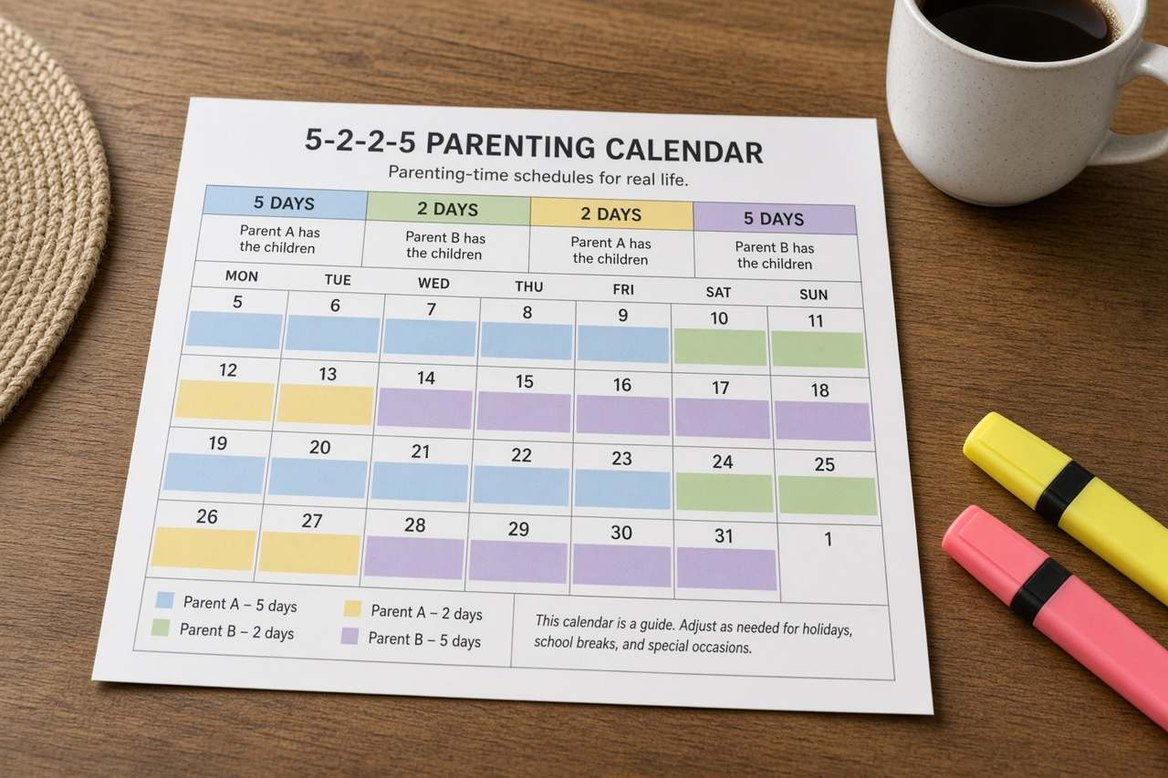
Why the table matters more than it looks
Every overnight earns a percentage; the cliff at 93 nights is gone.
Under the old law, parenting time below 93 overnights a year did not change child support at all, and crossing that line switched the whole case to a different worksheet with a 1.5 multiplier. Cases were litigated over a single Sunday night. The 2026 table smooths the curve: the credit at 52 overnights is small, at 104 it is meaningful, and at equal time it is half the basic obligation. The number still moves the money, but there is no cliff, and a schedule can be built around the children rather than around the worksheet.
The credit is applied to the combined basic obligation, not to the parent’s own share. That is why the two parents’ line-6 figures are always equal and opposite, and why the worksheet counts the negative one as zero.
Low income, high income
| Obligor’s monthly adjusted gross income | What the worksheet does | Cap |
|---|---|---|
| $650 or less | A $10 minimum order, regardless of the number of children, unless the shared-time result is lower. | — |
| Over $650, up to the self-support reserve ($1,831.83) | The basic obligation is replaced by a flat $50 (one child), $70, $90, $110, $130 or $150 (six or more), unless the shared-time result is lower. | 10% of income |
| Over the reserve, up to about $2,627.73 | The obligation is the lesser of the worksheet amount and 80% (one child), 85%, 89%, 92%, 94% or 95% (six or more) of the income over the reserve, never less than the flat amount. | 20% of income |
| Above $40,000 combined | The $40,000 row is the presumptive minimum; the court has discretion above it and must make findings about the children’s needs and standard of living. | — |
The reserve is the state minimum wage ($15.16 an hour in 2026) times 29 hours times 50 weeks, divided by twelve, and it moves each January. C.R.S. § 14-10-115(3)(g.5), (7)(a)(III)–(VII).
Getting the inputs right
The calculator is only as good as the incomes. These are the questions that decide most contested child support cases.
Count it
- Wages, salary, bonuses and commissions on a twelve-month average
- Consistent overtime; a second job the court finds is regular
- Self-employment net of ordinary and necessary expenses, with depreciation and personal perks added back
- Rents, interest, dividends, capital gains, pensions, annuities
- Potential income, if a parent is voluntarily unemployed or underemployed
Leave it out
- Child support received for other children
- Means-tested public assistance
- A new spouse’s or partner’s earnings
- Overtime that is not consistent, or a second job the court excludes
- Imputed income for a parent caring for a child of the parties under 24 months, or in a few other protected situations
Where I spend the time
In a salaried case the worksheet takes ten minutes and the argument is about overnights. In a business-owner case the worksheet is the last thing we do: first the add-backs, the retained earnings, the personal expenses run through the company, the year the income conveniently dropped. The income determination page covers those fights; the business-owner page covers the rest. The calculator will happily accept whatever income you type. The court will not.
One practical rule: run the worksheet both ways before you argue about it. A parent who wants more overnights should know what the credit is worth; a parent who is resisting them should know what the fight is about.
Questions about child support in Colorado
How is child support calculated in Colorado in 2026?
Add both parents’ monthly adjusted gross incomes, find the basic obligation for that combined income and number of children on the statutory schedule (C.R.S. 14-10-115(7)(b), now running to $40,000 a month), and split it between the parents by their shares of income. Each parent’s share is then reduced by a credit for that parent’s overnights from the parenting-time table in 14-10-115(8)(h). The parent left owing the positive amount is the obligor. Add each parent’s share of work-related child care net of the federal credit, the children’s health insurance premium and any extraordinary expenses, subtract what each already pays directly, and the difference is the order.
What changed on March 1, 2026?
Four things. The schedule now runs to $40,000 of combined monthly income instead of $30,000. Shared physical care no longer starts at 93 overnights with a 1.5 multiplier; every overnight earns a percentage credit from a statutory table, on one worksheet. Low-income rules now use a self-support reserve tied to the state minimum wage, a $10 minimum order, flat reduced amounts, a ramp and caps. And the $250-a-child threshold for extraordinary medical expenses was removed. Existing orders do not change automatically; the new arithmetic applies when a motion is decided after March 1, 2026.
How many overnights do I need to reduce child support?
Any number, now. Under the 2026 table one overnight a year earns a 0.07% credit, 52 earns 5.27%, 92 earns 13.19%, 104 earns 16.54%, 130 earns 25.58% and 182.5 earns 50%. The credit is applied to the basic obligation, so the effect on the final number is gradual rather than the old cliff at 93 nights. Parenting time still has to be real: the court can deviate where a parent spends substantially more or less time than the overnight count reflects.
Does the calculator handle equal parenting time?
Yes. Enter 182.5 overnights each, or tick any of the equal-time schedules. With equal time each parent’s credit is 50% of the basic obligation, so the higher earner usually pays the difference between the two shares, adjusted for child care, insurance and expenses each parent pays directly. Equal time does not mean no child support unless the incomes are also equal.
What counts as income?
Gross income from any source: wages, salary, bonuses, commissions, consistent overtime, self-employment and business income after ordinary and necessary expenses, rents, interest, dividends, capital gains, pensions, workers’ compensation, unemployment and disability benefits, and more (C.R.S. 14-10-115(5)). Child support received for other children, means-tested public assistance and a new spouse’s income are not counted. If a parent is voluntarily unemployed or underemployed the court may impute potential income, with exceptions for a parent caring for a child under 24 months and a few others.
How does maintenance affect child support?
Maintenance ordered between the same two parents is subtracted from the payor’s income and added to the recipient’s on the worksheet. Because maintenance under orders entered after 2018 is not deductible, the statute grosses the amount up by 1.25 when the parties’ combined income is $10,000 a month or less and by 1.33 when it is more (C.R.S. 14-10-115(3)(a)(II), (5)(a)(I.5)). Maintenance is calculated first for that reason. The combined calculator on this site runs the two statutes in order.
What is the self-support reserve?
A floor that protects a low-income obligor. For 2026 it is $1,831.83 a month: the state minimum wage of $15.16 times 29 hours times 50 weeks, divided by twelve. An obligor at or below $650 pays a $10 minimum order. Between $650 and the reserve the basic obligation is reduced to $50 to $150 a month depending on the number of children, and the order is capped at 10% of the obligor’s income. Above the reserve the obligation ramps in at 80% to 95% of the income over the reserve, with a 20% cap up to about $2,628 a month.
What if our combined income is over $40,000 a month?
The schedule stops at $40,000. By statute the basic obligation may not be less than the $40,000 row, and the court has discretion above it (C.R.S. 14-10-115(7)(a)(VII)). The calculator extrapolates the schedule proportionally by default, the way commercial software does, and shows the statutory floor beside it; switch the option off to use the floor. Above the top of the schedule the court is required to translate the children’s actual standard of living into findings, and the case is about evidence.
How is child care handled?
Work-related child care goes on line 8a net of the federal child and dependent care credit the paying parent is expected to receive (C.R.S. 14-10-115(9)(b)). The calculator estimates that credit from the parent’s income and the number of children, using the 2026 federal rules, and discloses the estimate in the notes. If you know the net figure, enter it and tick the box. Child care while a parent is in school counts on line 8b. The cost is shared by income like the basic obligation.
Can the judge order a different amount?
Yes. The guideline amount is a rebuttable presumption. The court may deviate where applying it would be inequitable, unjust or inappropriate, with findings that state the reasons and the presumed amount, for example where a parent spends substantially more time than the overnight count reflects, for extraordinary costs of parenting time, for a gross disparity in income, or for consistent overtime not counted as income (C.R.S. 14-10-115(8)(e)). Parents can also agree to a different number, which the court reviews for adequacy.
Does the calculator match the court's worksheet?
It follows JDF 1821 line for line, and the results are checked against a published test set and a commercial Colorado calculator. The one place the worksheet’s printed instructions are ambiguous, the final netting when one parent’s line 6 is negative, the calculator treats the negative amount as zero, which is how the Child Support Commission’s own worked example comes out. If your filing needs the form itself, the numbers transfer directly.
How do I change child support?
File a motion to modify. The statute deems a change substantial and continuing when the recalculated amount differs from the current order by ten percent or more (C.R.S. 14-10-122(1)(b)), and applying the 2026 rules can itself produce that change. The new amount runs from the date the motion is filed, not from the date circumstances changed, so timing matters. The modification pages explain the process.
From the blog.
In a hard-fought Colorado custody case the judge can appoint an attorney whose only client is the child's best interests. What a CLR does, how it differs from a…
Sept 18, 2026The SLAT Trap: When the Estate Plan Meets the DivorceSpousal Lifetime Access Trusts move wealth out of the taxable estate, with the marriage as the access mechanism. In a divorce, the donor loses the access,…
Sept 17, 2026Can You File for Divorce in Another State If You Live in Colorado?Where a divorce can be filed, where the money can be decided, and where the children's case belongs are three different questions. Colorado's 91-day domicile…
The worksheet is arithmetic. Income is the trial.
A consultation is a working session, in person in Greenwood Village or by video: bring the pay stubs, the returns and the parenting plan, and we run the numbers the way a judge will see them. Your note reaches my office directly; during business hours we call you back within the hour, run the conflicts check, and set the meeting.
Talk to us about your case.
303-507-5529One call. A real person picks up, hears you out, and tells you how we would handle what you are facing and what to do first. No phone tree, no sales pitch, no obligation. Your first conversation is with our intake paralegal, who will get you to Aaron fast.
Rather write? Send a short note and during business hours we call you back within the hour.