0
Missed payments a judge can forgive
Each one is a final judgment. A change in support reaches only payments due after a motion is filed.

Support that was ordered and not paid is called arrears. In Colorado each missed payment becomes a court judgment the day it is missed, with interest, and it can be collected for twenty years. In plain English: what the parent who is owed can do, what the Family Support Registry and the county child support office will and will not do for you, and what to do if you are the one behind.
Talk to us about your case.
303-507-5529One call. A real person picks up, hears you out, and tells you how we would handle what you are facing and what to do first. No phone tree, no sales pitch, no obligation. Your first conversation is with our intake paralegal, who will get you to Aaron fast.
Rather write? Send a short note and during business hours we call you back within the hour.
Child support belongs to the child. That one idea explains almost every rule on this page.
It is why a missed payment becomes a judgment the moment it is missed, without anyone going to court. It is why no judge can forgive payments already due, why the other parent’s promise to let it go is not a defense, and why waiting can cost the parent owed the interest but never the principal. For the parent who is owed, the money is secure for twenty years from each due date. For the parent who owes, it grows every month the order stands, and only a motion to modify, actually filed, stops it.
Most parents do not need the statutes; they need to know what to do next. Two offices do most of the work in Colorado, and they are often confused with each other. The Family Support Registry is the state’s payment office: money goes in, money goes out, and it keeps the record. The county child support office, called Child Support Services, is the collector: it sets support, finds the other parent, and uses tools no private lawyer has. Both are explained below, then the choices, then the arithmetic for anyone who wants it. The statutes are listed at the end.
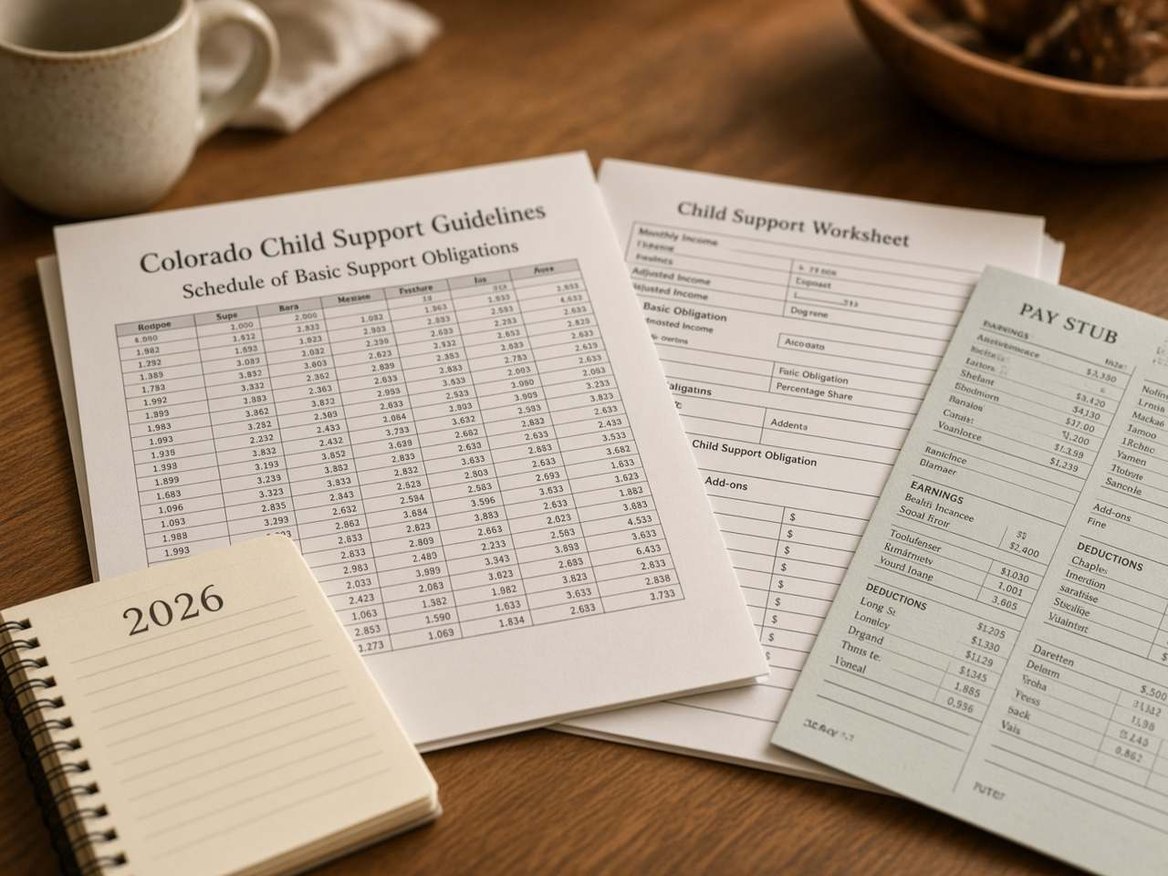
Each one is a final judgment. A change in support reaches only payments due after a motion is filed.
Counted from each due date. An Entry of Support Judgment filed in time keeps every payment it covers alive.
On payments missed since July 1, 2021. The parent owed may waive it; the court may reduce it for good cause.
No application fee. A $35 annual fee on some cases, taken from the support once more than $550 a year is collected.
Everything else on this page follows from these.
The day a payment is due and not paid, it becomes a final money judgment, automatically. Nobody has to sue. It earns interest from that day and can be collected for twenty years.
Support can be changed only for payments that come due after a motion to modify is filed. The payments already missed stay owed, in full, whatever the reason. The one common exception: if the child moved in with the paying parent, support can be adjusted back to the move.
A deal between parents, by text, email or handshake, is not effective until a court approves it. And support and parenting time are separate: withheld weekends do not excuse withheld support, and unpaid support does not excuse withheld weekends.
Child support belongs to the child. That is why the principal cannot be forgiven by a judge, waived by a text, or lost to delay.
In rough order of how often they work. The first two cost nothing; the county runs most of it; a lawyer runs the rest.
| The tool | What it does | Who uses it |
|---|---|---|
| Wage withholding (income assignment) | Already in most orders. The employer takes the support out of each paycheck and sends it to the Registry. If it is not in place, you, a lawyer or the county can serve the employer with the notice; when your ex changes jobs, the county’s new-hire match finds the new employer. | You, a lawyer, or the county |
| The county’s tools | Driver’s license and professional-license suspension, tax refund and lottery intercepts, reporting to the credit bureaus, a bank levy, a passport hold above $2,500 in arrears, liens on property, and a claim on insurance settlements. No private lawyer can use these. | Only the county |
| An Entry of Support Judgment | A sworn form (JDF 1813) listing what was owed, what was paid and the total with interest, filed in your existing case. No fee, no lawyer required. It makes the total a lien you can record against real estate, and it is the basis for garnishing wages and bank accounts. | You or a lawyer |
| Contempt of court | A hearing where your ex must explain to the judge why the support was not paid. The Registry record is the proof. The judge can order payment on a schedule, fees, and, in the right case, jail until a purge amount is paid. See Contempt of Court. | You, a lawyer, or the county |
| A lien | A $25 transcript of judgment recorded with the county clerk in any county where your ex owns, or may own, real estate. It is paid when the property is sold or refinanced. | You or a lawyer |
| Security or a bond | For a parent who is self-employed or paid in cash, the court can require money or a bond up front so the support does not depend on a paycheck. | The court, on request |

Up to half of take-home pay, or sixty percent, and five points more when the support is more than twelve weeks late.
Fifty percent of disposable earnings if the paying parent is supporting another spouse or child, sixty percent if not, rising to fifty-five or sixty-five percent for support more than twelve weeks overdue. Support withholding comes ahead of any other garnishment or lien. Earnings include pensions, workers’ compensation and severance, not only wages. For a parent who is self-employed or paid in cash, wage withholding reaches nothing, which is what the bond, the lien and contempt are for.
If the order already has wage withholding and your ex has a regular employer, the money is usually a phone call away: the county serves the employer. If your ex is self-employed, moves between jobs or owns property, the Entry of Support Judgment and a lien matter more than anything the county does, and that is where a lawyer earns the fee. Most parents end up using both, and the two can run at the same time.
Every parent with a Colorado support order has heard of it, and most are not sure what it does. It does two things, and it does not do a third.
One central office, run by the state’s Division of Child Support Services, that receives every child support and maintenance payment, sends it on to the parent who is owed, and keeps the official record. The paying parent, or the employer, pays the Registry by check, online, by card or by withholding; the Registry pays the receiving parent by direct deposit or onto a payment card, usually within a couple of days. Both parents can see the account online, and the Registry will print a certified payment history on request.
Most do. If the county child support office is involved in your case, always. If it is not, the Registry is used whenever the court orders payment through it or the support is collected by wage withholding, and Colorado orders wage withholding in every case unless both parents agree in writing to a different arrangement and the court approves it. So a private order between two parents who agree to pay each other directly can skip it; nearly everyone else is in it. The account is set up automatically when the order is entered, and each parent gets a notice in the mail with the account number.
It does not collect. If a parent stops paying, the Registry records a zero; it does not call anyone, suspend anything or file anything. It does not decide what is owed or calculate interest. For collection you go to the county child support office or a lawyer. What the Registry gives you is the proof: its record is presumed correct in court, it is the exhibit at a contempt hearing, and it is what the Entry of Support Judgment is built from.
The collector. Every Colorado county has one, through its human services department, and it will work for any parent who applies, not only families on public assistance.
Apply online at the state’s child support site or at your county office; either parent can, and so can a grandparent or other caregiver raising the child. There is no application fee. If you have never received public assistance, a $35 annual fee is taken from the support once the county has collected more than $550 for you in a year. If you receive or received assistance, the county collects for the state first to repay it, then for you.
What to expect. A caseworker, a case number, and letters. The county acts on its own schedule and its own judgment about which tool to use. Tell it about any payments you receive directly, any change of address or job, and any safety concern: a parent who fears the other can ask for the address to be kept out of the file.
If you are the one who owes, the county is also the office that lifts a license suspension once you are on a payment plan, and the one that can waive its interest to settle. Ignoring its letters is how a suspension happens.
| County | Child support office | Phone | Hours |
|---|---|---|---|
| Denver | Denver Human Services, 1200 Federal Blvd., Denver 80204; also 3815 Steele St. and 4685 Peoria St. | 720-944-2960 | Mon–Fri, 8–4 |
| Arapahoe | 14980 E. Alameda Dr., Garden Level, Aurora 80012; also 1690 W. Littleton Blvd., Littleton | 303-752-8900 | Mon–Fri, 8–4:30 |
| Jefferson | 3500 Illinois St., Suite 1300, Golden 80401 | 303-271-4300 | Mon–Thu, 7:30–5:30; closed Fridays |
| Douglas | 11045 E. Lansing Circle, First Floor, Englewood 80112 | 303-814-7145 | See the county’s site |
| Adams | Pete Mirelez Human Services Center, 11860 Pecos St., Westminster 80234 | 720-523-2600 | Mon–Fri, 7:30–5; walk-ins |
| Broomfield | 100 Spader Way, Broomfield 80020 | 720-887-2261 | See the county’s site |
| Boulder | Longmont HUB, 515 Coffman St., Longmont 80501 | 303-441-1000 | 8–4:30 |
From each county’s website, September 20, 2026; confirm there, or through the state’s office search, before you go. Family Support Registry: 303-299-9123 or 1-800-374-6558. DMV, for license reinstatement: 303-205-5613.
They do different things, and the two can run at the same time. The county asks to be told when a private lawyer is hired.
| What the county does | What a private lawyer does |
|---|---|
| Finds the other parent and the employer | Post-judgment discovery and subpoenas |
| Licenses, tax refunds, passport, credit bureaus, bank levies | The Entry of Support Judgment with interest; recorded liens; garnishment |
| Contempt, after screening ability to pay | Contempt prosecuted for you |
| Free to apply; $35 a year on some cases | A fee the court can shift to the other side |
| Represents the State of Colorado | Represents you |
A regular paycheck, an employer the county can find, and no interest worth fighting over. Wage withholding and the license and tax tools collect most of these cases without a lawyer.
Your ex is self-employed, paid in cash or owns property; years of interest are owed; the county has had the case for a year with nothing to show; or the other side is about to sell a house, inherit or settle a claim. The Entry of Support Judgment, the lien and contempt move faster in private hands.
If the order already has wage withholding and your ex simply changed jobs, the county’s new-hire match usually finds the new employer within weeks. Call the caseworker before you spend money.
The arrears will not shrink on their own, and most of the instincts people follow make them bigger. Four things help.
A change reaches only payments due after the filing date. Run the guideline first on the child support calculator; the change has to move support by ten percent. See Modifying Child Support.
A payment the Registry did not record is one you will have to prove. Cash and gifts to the children are how credits are lost.
Since 2021 a judge can reduce or waive interest for good cause, and set a repayment schedule. Ability to pay is the question; document it.
A suspended license is reinstated once the county approves a plan; after a second suspension, only after three months of payments. The county can waive its own interest to settle.
What does not work: stopping payment because the order seems wrong, paying the children directly, relying on the other parent’s promise, filing bankruptcy, or waiting for the youngest to turn nineteen. Each leaves the judgments where they were, with interest.
Most defenses to back child support fail, because the money belongs to the child. A few succeed, and some reach only the interest.
| The argument | Does it reduce what is owed? | The rule |
|---|---|---|
| “I paid her directly.” | Yes, if you can prove it | The Registry record is presumed right. Cancelled checks and bank transfers count; cash, gifts and money spent on the kids usually do not. |
| “She waited years to collect.” | No; maybe the interest | Waiting can cost the parent owed the interest, never the principal. |
| “She told me not to worry about it.” | No | Only a court can change the order. A promise, a text or an email does not. |
| “The child turned nineteen.” | No | That ends future support. Everything missed before it stays owed. See When Child Support Ends. |
| “The child lived with me.” | Yes, back to the move | Support can be adjusted to the date the child moved in, if the motion is filed within five years. |
| “Social Security paid for the kids.” | Often | Dependent benefits on the paying parent’s record are credited, including a lump-sum back payment. |
| “DNA says I am not the father.” | Possibly | Within two years of the order, the court can end support and cancel what is unpaid. |
| “She kept the kids from me.” | No | Support and parenting time are separate. Withheld weekends have their own remedy; see parenting-time enforcement. |
| “I could not afford it.” | No | It is a defense to contempt and a reason to reduce interest, not to the debt. The fix is a motion to modify, filed the week things change. |
| “I filed bankruptcy.” | No | Child support and its interest survive bankruptcy, and the withholding keeps running. |
Two numbers a parent should know before filing anything, without the history.

Ten percent a year on payments missed since July 1, 2021, which the parent owed may compound once a year or waive; payments missed before that date earned twelve percent until then. The interest belongs to the parent, not the county: the county’s ledger often shows none, because charging it is optional for the county, and a parent who wants it works it out and puts it in the Entry of Support Judgment. Since 2021 the paying parent can ask the court to reduce or waive it for good cause. A simple, conservative figure is harder to attack than an aggressive one.
An example. $800 a month ordered and none of it paid through 2024 is $9,600 in missed payments. By the end of 2026 the interest at ten percent, compounded once a year on each payment, is about $2,645, for a total of about $12,245. On a fifteen-year arrearage the interest can rival the principal, which is why delay costs the parent owed even though the principal is safe.
Each missed payment can be collected for twenty years from its own due date; after that the law treats it as paid. Because each payment has its own clock, a parent owed support since 2006 is losing a payment every month. Filing an Entry of Support Judgment stops that for every payment it covers and restarts the clock. File it before the oldest payment worth keeping turns twenty, before your ex sells or refinances a house, and whenever your ex comes into money.
For the lawyers, the statutes. Each payment a judgment, and no retroactive modification: C.R.S. § 14-10-122(1)(c)–(d); the verified entry: the same section and JDF 1813; the twenty years: C.R.S. § 13-52-102(2)(a); interest: C.R.S. § 14-14-106; wage withholding and the Registry: C.R.S. § 14-14-111.5 and C.R.S. § 26-13-114; the garnishment caps: C.R.S. § 13-54-104(3); the county’s duties and fee: C.R.S. § 26-13-105 and C.R.S. § 26-13-106(4); licenses, intercepts, credit reporting and levies: C.R.S. § 26-13-111 through C.R.S. § 26-13-128; contempt and the Registry record: C.R.S. § 14-14-110; the passport hold: 42 U.S.C. § 652(k); bankruptcy: 11 U.S.C. §§ 523(a)(5), 362(b)(2). The cases on waiver and delay are In re Marriage of Johnson, 2016 CO 67 and In re Marriage of Gallo, 2024 COA 86.
Six things, in the order they come up. Not legal advice for your case; the mistakes I have watched for thirty years.

It is the proof, and it is free. Every number on this page starts from it.
Licenses, intercepts, passports and bank levies. Keep the judgment entry, the liens and contempt in your own hands, or a lawyer’s.
A number the other side can pick apart invites a fight. Simple and conservative wins.
Each missed payment has its own clock. The Entry of Support Judgment stops it for everything it covers.
An agreement is not effective until a court enters it. If there is a deal, it goes in a stipulation the judge signs.
Every month before the filing date is a judgment at the old amount, with interest, for twenty years.
Back child support expires when the child grows up.
Turning nineteen ends future support. Each missed payment stays a judgment for twenty years from its due date.
The Registry will collect it for me.
The Registry records and forwards payments. Collection is the county child support office, or a lawyer.
If the county does not charge interest, none is owed.
Interest is optional for the county. The parent can still claim it in an Entry of Support Judgment.
She said I did not have to pay.
An agreement is not effective until a court enters it. A promise is not a defense.
Bankruptcy will wipe it out.
Child support and its interest survive bankruptcy, and the withholding does not stop.
A judge can forgive the arrears if I explain.
Not payments already due. The court can reduce interest for good cause and set a repayment schedule.

Child support belongs to the child. The Registry record is how that becomes a number a court will enforce.
Start with a confidential conversation: tell me what is owed →
Support that a court or the county ordered and that was not paid when it was due. In Colorado every missed payment becomes a court judgment on the day it is missed, automatically, and it can be collected for twenty years. A judge cannot erase it later, the other parent cannot waive it by text message, and it does not disappear when the child grows up.
Three things, and they work together. Make sure a wage withholding (income assignment) is in place, so the employer sends the money before your ex sees it. Open a case with your county child support office, which can suspend a driver’s license, take a tax refund, report to the credit bureaus, block a passport and levy a bank account. And, through a lawyer or on your own, file an Entry of Support Judgment, which turns the total owed with interest into a lien and lets you garnish, and if it comes to that, ask the court to hold your ex in contempt.
Colorado’s central payment office for child support. The paying parent pays the Registry, the Registry pays the parent who is owed, and it keeps the official record of every payment. It is a payment processor and a record keeper, not a collector: it does not chase a parent who stops paying, and it does not calculate what is owed or the interest. Its record is what a court relies on, which is why paying through it protects both parents.
Most do. If the county child support office is involved, always. If it is not, the Registry is used whenever the order says so or the support is collected by wage withholding, which Colorado orders in every case unless both parents agree in writing to a different arrangement and the court approves it. The account is set up automatically when the order is entered, and each parent gets a notice in the mail with the account number.
Yes to both. Child Support Services, run through each county’s human services department, can establish paternity, set the support amount under the guidelines, review it for changes, find the other parent and the employer, and collect and enforce with tools no private lawyer has. Anyone can apply, online or at the county office, and there is no application fee. What it does not do is represent you, handle parenting time, or, in most counties, compute the interest.
Nothing to apply. If you have never received public assistance, a $35 annual fee is taken from the support once the county has collected more than $550 for you in a year. There are no attorney fees, because there is no attorney working for you: the county’s lawyers represent the State of Colorado.
Not the payments already missed. Each one is a final judgment, and a change in support reaches only payments that come due after a motion to modify is filed. What a judge can do, since 2021, is reduce or waive the interest for good cause and set a repayment schedule. The two real exceptions: if the child moved in with the paying parent, support can be adjusted back to the date of the move, and a DNA test within two years of the order can end support and cancel what was unpaid.
No. A change in child support is not effective until a court approves it and enters it as an order. In a 2024 case a mother had emailed the father to help where he could, he paid nothing for fifteen years, and the court entered judgment for $233,025. What the other parent can give up is the interest, not the principal, because the support belongs to the child.
Only if you can prove it. The Registry’s record is presumed correct, so the burden is on you to show cancelled checks, bank transfers or receipts. Cash, gifts to the children and money spent on the children that the order did not require are usually not credited. Paying outside the Registry can also get a county case closed.
Ten percent a year on payments missed since July 1, 2021, which the parent owed may compound once a year or waive. Older missed payments earned twelve percent until then. The court can reduce the interest for good cause. The county’s ledger often shows no interest at all, because charging it is optional for the county; the parent owed can still claim it by filing an Entry of Support Judgment with the interest worked out.
Up to fifty percent of take-home pay if the paying parent supports another spouse or child, sixty percent if not, and five points more when the support is more than twelve weeks late. Support withholding comes ahead of every other garnishment. For a parent who is self-employed, the court can require security or a bond instead.
No and no. Turning nineteen ends future support; every payment missed before that stays a judgment for twenty years, and the wage withholding keeps running until it is paid. Bankruptcy does not discharge child support or its interest, and does not stop the withholding, the license suspension or the tax refund intercept.
The next page in this chapter, the pages that belong with it, and the blog posts on the same question.
In a hard-fought Colorado custody case the judge can appoint an attorney whose only client is the child's best interests. What a CLR does, how it differs from a…
Sept 18, 2026The SLAT Trap: When the Estate Plan Meets the DivorceSpousal Lifetime Access Trusts move wealth out of the taxable estate, with the marriage as the access mechanism. In a divorce, the donor loses the access,…
Sept 17, 2026Can You File for Divorce in Another State If You Live in Colorado?Where a divorce can be filed, where the money can be decided, and where the children's case belongs are three different questions. Colorado's 91-day domicile…
A consultation is a working session, in person in Greenwood Village or by video: we go through the orders and the Registry history together, I check or build the arrears and interest figure, and I tell you which collection tools fit, whether the county or a lawyer should run them, and what I would file. If you are the one behind, I tell you what stops the growth. Your note reaches my office directly; during business hours we call you back within the hour, run the conflicts check, and set the meeting.
Talk to us about your case.
303-507-5529One call. A real person picks up, hears you out, and tells you how we would handle what you are facing and what to do first. No phone tree, no sales pitch, no obligation. Your first conversation is with our intake paralegal, who will get you to Aaron fast.
Rather write? Send a short note and during business hours we call you back within the hour.