10%
The line
A recalculation that moves support by less than ten percent a month is deemed not a substantial and continuing change. Ten or more usually is.

Child support is the most modified order in family law and the one with the clearest test: a change in circumstances that is substantial and continuing, which the statute defines as a guideline recalculation that moves the monthly amount by ten percent or more. Since March 1, 2026 the guideline itself has changed — every overnight now moves the number — and many orders written under the old table are worth re-running. This page covers the standard, what counts as income, the new table, when the new amount starts, the county review route, out-of-state orders, and arrears.
Talk to us about your case.
303-507-5529One call. A real person picks up, hears you out, and tells you how we would handle what you are facing and what to do first. No phone tree, no sales pitch, no obligation. Your first conversation is with our intake paralegal, who will get you to Aaron fast.
Rather write? Send a short note and during business hours we call you back within the hour.
Run the new number before you file.
The ten-percent rule is a comparison of two worksheets: the order as it stands and the guideline on today’s incomes and overnights. Run the second one here, line by line on the 2026 worksheet, with a report you can save.
Open the child support calculator →Support is arithmetic. A modification is a fight about the inputs.
Colorado child support is a formula: both parents’ incomes, the number of overnights, the cost of health insurance and child care, run through a schedule the legislature publishes. Because it is a formula, a modification is not an argument about fairness. It is an argument about what goes into the formula now, compared with what went in when the order was entered, and whether the difference clears the statute’s ten-percent line. The parent who runs the worksheet before filing knows whether there is a case. The parent who files first and calculates later often learns there was not, at the cost of a fee award.
The inputs are where thirty years of trial experience matter. A business owner’s income is not the number on the K-1. A parent who quit a job is not necessarily earning what the court will use. A schedule that changed by text two years ago changes support back to the day it changed, within a five-year limit most lawyers have never read. And as of March 2026 the guideline counts every overnight, so an order built on the old rule that ignored fewer than ninety-three overnights may move by more than ten percent on the schedule alone. This page sets out the whole of it, in the words the statute uses.
A recalculation that moves support by less than ten percent a month is deemed not a substantial and continuing change. Ten or more usually is.
A modified order should run from the filing date, unless the court finds undue hardship or substantial injustice. Never earlier, with one exception.
Where the child’s physical care changed, support is modified from the date of the change, but not more than five years before the motion.
Either parent may ask the county child support unit to review the order; after thirty-six months it must.
The provisions of any decree respecting child support may be modified only as to installments accruing subsequent to the filing of the motion for modification and only upon a showing of changed circumstances that are substantial and continuing, or on the ground that the order does not contain a provision regarding medical support. Then the statute defines the floor.
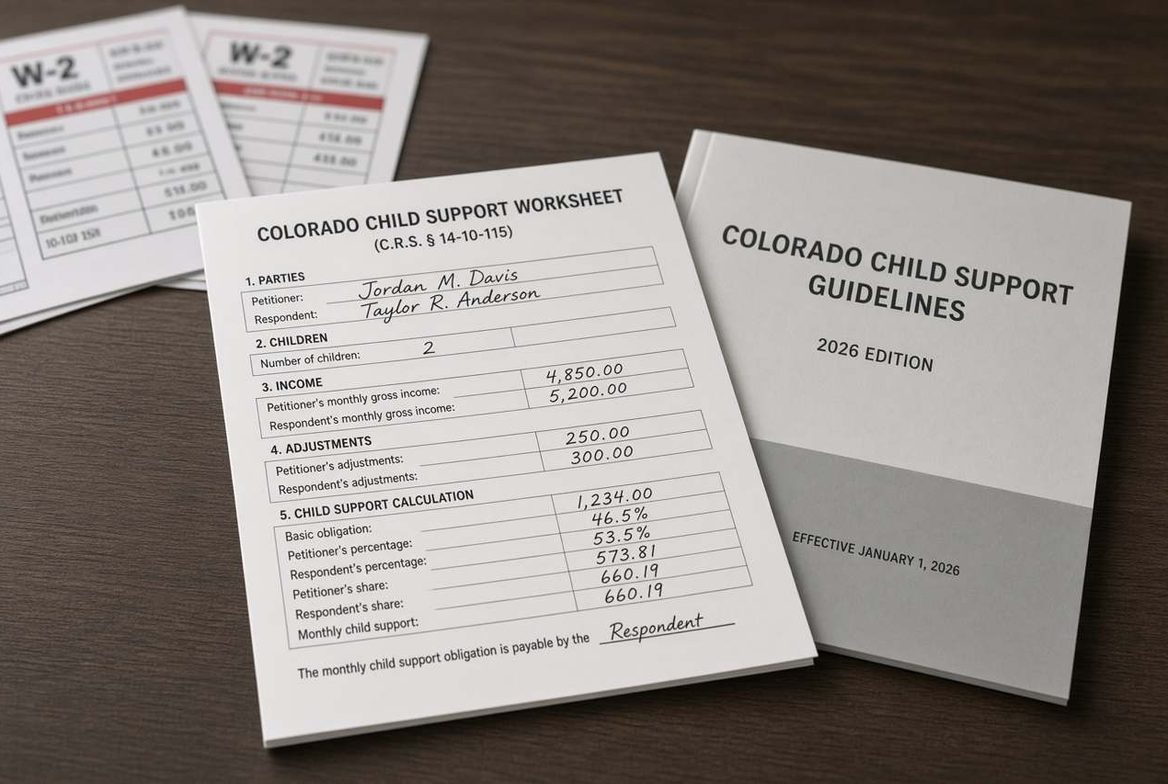
A recalculation that moves support less than ten percent is deemed not substantial and continuing; it is measured against the amount currently in effect, and it is a presumption that still needs evidence of an actual change.
Application of the child support guidelines and schedule to the circumstances of the parties at the time of the filing of a motion for modification which results in less than a ten percent change in the amount of support due per month shall be deemed not to be a substantial and continuing change of circumstances. There is no “unless” clause. The only ground that does not need the ten percent is an order with no medical-support provision.
Measured against the order, not the guideline. The ten percent is measured against the amount of support currently in effect, even where that amount was a stipulated figure below the guideline. A parent who agreed to pay more than the worksheet required cannot later modify unless the new worksheet moves the agreed number by ten percent.
A presumption, with evidence behind it. The Colorado Supreme Court has treated the ten-percent rule as a rebuttable presumption that works in both directions: clearing it does not end the inquiry, and the moving parent still has to show, with credible evidence, that circumstances actually changed. In Aldrich a business owner who claimed his income had fallen lost because his bank deposits said otherwise; the court was not required to recalculate at all. A modification is won on proof of the inputs, not on the arithmetic alone.
Deviation. The guideline is a rebuttable presumption in an action to establish or modify support; the court may deviate where its application would be inequitable, unjust or inappropriate, with findings. Deviations are rare and must be argued, not assumed.
The worksheet is the argument. A modification is won by the parent who documented the inputs.
Most modifications are income cases. The statute defines gross income as income from any source and lists what it includes; the fight is over what a parent could earn, and over what a business really pays its owner.
| The situation | What the court uses | Authority |
|---|---|---|
| A raise, a bonus, a new job | Actual income from any source: salary, wages, commissions, bonuses, dividends, severance, capital gains, rental income, pass-through income from a partnership, closely held corporation or LLC, and significant in-kind payments that reduce living expenses. A bonus is income in the year received; a court may average irregular income. | C.R.S. § 14-10-115(5)(a)(I) |
| An involuntary job loss | Actual income while the parent searches in good faith, with the court free to look at historical earnings in deciding what the parent can earn. A parent fired for cause is not automatically treated as voluntarily unemployed; the court looks at the circumstances. | Bregar, 952 P.2d 783 (Colo. App. 1997); Atencio, 47 P.3d 718 (Colo. App. 2002) |
| Voluntary unemployment or underemployment | Potential income: what the parent could earn, on findings, where the parent unreasonably forgoes higher-paying work. The court cannot impute without findings about the parent’s actual ability and opportunity. A vocational evaluation is the usual proof. | C.R.S. § 14-10-115(5)(b)(I); Krejci, (Colo. App. 2013) |
| The exceptions to imputation | No potential income for a parent who is physically or mentally incapacitated, a parent caring for a child under twenty-four months for whom the parents owe a joint legal responsibility, or an incarcerated parent sentenced to 180 days or more. | C.R.S. § 14-10-115(5)(b)(I)(A)–(C) |
| A career change, school, a temporary job | Not underemployment where the job is temporary and reasonably intended to result in higher income within the foreseeable future, is a good-faith career choice not intended to deprive a child of support and does not unreasonably reduce the support available, or the parent is enrolled full-time in an educational or vocational program. A nurse who cut hours to care for a disabled child made a good-faith choice and was not shirking. | C.R.S. § 14-10-115(5)(b)(III); Goldstone (Collins), 2023 COA 116 |
| The default work week | Where potential income is imputed and the evidence does not show otherwise, the court uses a thirty-two-hour work week for fifty weeks a year at the parent’s potential rate. | C.R.S. § 14-10-115(5)(b.5) |
| A business owner or professional | Gross receipts minus ordinary and necessary expenses required to produce the income, excluding the accelerated component of depreciation, with personal expenses run through the business added back. The K-1 and the tax return are the starting point, not the answer. Income Determination covers it in full. | C.R.S. § 14-10-115(5)(a)(III) |
| A lump sum | A workers’ compensation or similar lump sum is allocated according to its own terms, not spread over twelve months by default. | Aragon, 2019 COA 76 |
A new spouse’s income is not the parent’s income. A legal duty to support other children adjusts the parent’s income on the worksheet, and cannot be used to reduce an existing order below what the worksheet would otherwise give.
The second input that moves support is the schedule. Until 2026 the guideline ignored a parent’s overnights below ninety-three a year and then applied a multiplier above it, which produced the cliff every Colorado parent has argued over. That rule is gone.

Since March 1, 2026 the credit begins at the first overnight, with a cap at the no-overnights amount. Orders written under the old 93-overnight rule are worth re-running.
Since March 1, 2026, shared physical care means that each parent keeps the children for at least one overnight each year and both parents contribute to the children’s expenses beyond child support. The shared parenting time adjustment is calculated from a parenting time credit percentage listed in a table in the statute, based on each parent’s number of overnights; the credit is the total basic obligation multiplied by that percentage, deducted from each parent’s share; the parent owing the greater amount pays the difference. The old 1.5 multiplier is repealed. Where children are on different schedules, the overnights are added and divided by the number of children.
The cap. The amount of child support ordered must not exceed the amount that parent would owe if the parent had no overnights. The credit can reduce support; it can never increase it above the no-overnights figure.
What it means for a modification. A parent with sixty or eighty overnights a year, who received no credit under the old rule, may see a change of more than ten percent under the new table on the schedule alone. A parent whose schedule drifted from the plan — more overnights or fewer — has a modification whether or not anyone changed the plan on paper, because support follows the schedule the child actually lives. And every parenting-time motion now has a support motion inside it.

The one exception to filing-date relief: where the child’s physical care changed by order, voluntarily or by agreement, support is modified from the date of the change, up to five years back.
This is the one exception to the rule that relief runs from the filing date. When a court-ordered, voluntary or mutually agreed upon change of physical care occurs, the provisions for child support, if modified, are modified or terminated as of the date when physical care was changed. The statute also allows an order to be established retroactively to the date of the change. The child who moved in with the other parent two years ago is a support case for the whole two years.
The five-year limit. The court shall not modify support under this subsection for any time more than five years before the filing of the motion, unless it finds that applying the limit would be substantially inequitable, unjust or inappropriate; the Court of Appeals has applied the limit to any motion filed after it took effect regardless of when care changed, and requires a hearing before the exception is used. A parent who took the children in and never filed has five years of arrears building in their favor and a clock running.
Updating without a hearing. The statute directs parents to exchange the information relevant to support once a year, for the purpose of updating and modifying the order without a court hearing. Where the parents agree on the new worksheet, a stipulation is entered on the papers. Where they do not, the motion is filed.
House Bill 25-1159 rewrote the guideline in two stages.
| Effective | The change | What it does to an existing order |
|---|---|---|
| May 31, 2025 | The $250-per-child threshold before uninsured medical expenses are shared is repealed; extraordinary medical expenses now include copayments, deductibles and uninsured out-of-pocket costs, excluding over-the-counter items. The dependency-exemption allocation is decided on statutory factors. A concurrent-enrollment program no longer counts as an equivalent of high school for emancipation. | An order that split medical costs only above $250 is out of step with the statute; the difference rarely reaches ten percent on its own but is fixed in any modification. |
| March 1, 2026 | Shared physical care begins at the first overnight; the parenting-time credit table replaces the 92-overnight threshold and the 1.5 multiplier; support is capped at the no-overnights amount. | The largest effect. Parents with fewer than ninety-three overnights had no credit under the old rule; many of those orders move by more than ten percent when re-run. |
| March 1, 2026 | The schedule of basic support obligations is extended to combined monthly adjusted gross incomes of about $40,000, replacing the old top of the table and the extrapolation fights above it. | High-income orders that were set by extrapolation or deviation above the old table may change under the published figures. |
| March 1, 2026 | A statutory self-support reserve (the state minimum wage times twenty-nine hours times fifty weeks, divided by twelve) replaces the old $1,500 figure; the $10 minimum order applies at incomes of $650 a month or less, with graduated amounts above it. | Low-income orders are recalculated on the new floor. |
Is the new law itself a changed circumstance? The Court of Appeals held in 1988 that the adoption of the guidelines, producing a change of more than ten percent, was a sufficient basis for modification; the Supreme Court later required credible evidence of an actual change and not arithmetic alone. No court has decided the question for the 2026 table. Any motion decided after March 1, 2026 is calculated under it, so the practical answer is to file on the ten percent and the facts behind it, not on the statute alone.
Three sentences of the statute decide more money than the ten-percent rule does.
| The rule | In the statute’s words | What it means |
|---|---|---|
| Installments are judgments | A payment becomes a final money judgment when it is due and not paid; it is not retroactively modified, and may be enforced as other judgments without further action by the court. | Every month you paid the old number, or failed to, is settled the day it came due. A modification cannot reach it. |
| The filing date | If child support is modified, the modification should be effective as of the date of the filing of the motion, unless the court finds that it would cause undue hardship or substantial injustice. In no instance shall the order be retroactively modified prior to the date of filing, unless there has been a change of physical custody. | The months between filing and hearing are trued up in the order. The months before filing are lost. File on the day the change becomes real. |
| The physical-care exception | When a court-ordered, voluntary or mutually agreed upon change of physical care occurs, support is modified or terminated as of the date when physical care was changed, but not more than five years before the filing. | The one door to the past: the child who moved. Everything else runs forward from the motion. |
“Should be” effective at filing, not “shall.” A paying parent who can show that a retroactive increase to the filing date would cause undue hardship, or a receiving parent who can show substantial injustice in a retroactive decrease, can ask for a later date; the court needs findings either way.
Every month between the change and the filing is a month at the old number, and nothing recovers it.
Two routes to the same statute, and most parents only know about one.
| County Child Support Services review | A motion in the district court | |
|---|---|---|
| Who can use it | Either party in a case with an active order, by written request to the county child support office on its review form with an income and expense declaration. | Either parent, in the case that entered the order. |
| The threshold | If thirty-six months or more have passed since the last review or adjustment, the unit must begin a review. Inside thirty-six months the requester must show a substantial and continuing change under the statute. | The statute’s test: substantial and continuing, ten percent or a missing medical-support provision. |
| The standard | The same: an adjustment where the calculation shows at least a ten percent change in the ordered amount or a change in medical support. | The same, decided by a judge on evidence. |
| The process | The unit gathers income information from both parents, runs the worksheet, gives notice of the proposed adjustment with a fifteen-day window to object, then files a motion and the proposed order or stipulation with the court. | Motion, sworn financial statements and mandatory disclosures within forty-two days, mediation in the metro districts, a hearing. |
| Cost and time | No fee. The state says it can take up to six months. | A filing fee; typically two to four months to a contested hearing; the cost of counsel. |
| When it fits | Straightforward W-2 incomes, a schedule that plainly changed, a parent who cannot afford counsel, an order that has not been looked at in years. | An owner’s income, an imputation fight, a vocational evaluation, a five-year physical-care claim, a parent who needs the relief dated to a filing this month. |
The routes are not exclusive; a parent can file a motion while a county review is pending, and the county unit’s worksheet is often useful evidence. Because relief runs from the filing date, a parent with a strong case files first and lets the review catch up.
Child support jurisdiction follows the Uniform Interstate Family Support Act, which every state has adopted. The rules are mechanical and unforgiving.

Colorado keeps its order while a parent or the child lives here; a moving party generally files in the other party’s state; and the age of emancipation travels with an out-of-state order.
Colorado keeps its own order as long as, at the time a request for modification is filed, Colorado is the residence of the obligor, the individual obligee or the child, or the parties consent in a record or in open court to Colorado’s continuing jurisdiction. One parent moving away changes nothing while the other parent or the child is here.
Modifying another state’s order here requires that neither the child, nor the receiving parent, nor the paying parent still resides in the issuing state, that the petitioner seeking modification is a nonresident of Colorado, and that the respondent is subject to personal jurisdiction here; or that both parties have filed consents in the issuing court. The rule sends the moving party to the other party’s state. If everyone now lives in Colorado and the child does not live in the issuing state, Colorado has jurisdiction to enforce and modify.
What Colorado cannot change. A Colorado court may not modify any aspect of an out-of-state order that could not be modified under the law of the issuing state, including the duration of the obligation. An order from a state where support ends at eighteen does not become a Colorado nineteen order because the family moved here; the age of emancipation travels with the order. The Interstate Custody page covers the custody side of the same move.
A modification changes the future. What is already owed is a judgment, with interest, and the statute is precise about both.
| The rule | What it says |
|---|---|
| Each installment is a judgment | A support payment becomes a final money judgment when it is due and not paid, enforceable as any other judgment without further action by the court, and a lien is created by operation of law for each one. |
| Interest, two rates | On support that came due before July 1, 2021: four percent above the statutory rate, compounded monthly, which is twelve percent a year. On support due on or after July 1, 2021: two percent above the statutory rate, compounded annually, which is ten percent a year. |
| Waiver and reduction | The interest may be waived by the parent owed the money. The paying parent may apply to the court for a finding of good cause to reduce it, weighing whether the interest would result in undue hardship or substantial injustice, and the court may set an equitable period of repayment. |
| How long it lasts | Execution may issue on a judgment at any time within twenty years of its entry; each installment carries its own clock. |
| Withholding continues | The income assignment remains in effect until further notice from the obligee, the county unit or the court, and does not terminate until all current support, past-due support, medical support and fees are paid in full. It does not stop when the child turns nineteen if arrears remain. |
| Other enforcement | License suspension for a parent who has failed to comply with a payment agreement, after written notice and thirty days to seek review; tax-refund intercepts; credit reporting; contempt. The Enforcement page covers the remedies. |
A paying parent who stopped paying because the facts changed, without filing, owes every installment at the old number, with interest, and cannot recover it. A receiving parent who let the other parent pay less by agreement can still collect the difference. Neither of these is fixed by a modification; both are avoided by filing.
The same five steps as any post-decree motion, with the worksheet as the one that decides support cases.
Before anyone files, I run the guideline on the facts as they are and on the facts as the other side will argue them: their income theory, their overnight count, their child-care figure. If the difference is under ten percent, the motion loses. If it is over, the worksheet is the exhibit and the motion is drafted around it.

The state’s form (JDF 1403) with the worksheet, or a stipulation (JDF 1404) where the parents agree; a contested case gets a drafted motion with exhibits. The filing date fixes when relief starts, so the motion is filed the day the change becomes real, and the evidence follows.

A post-decree motion involving financial issues triggers the mandatory disclosures and a sworn financial statement from both parents within forty-two days: returns, pay stubs, business statements, benefit documents. An owner’s income case adds the company’s books and, often, a subpoena.

The metro districts require mediation before a contested post-decree hearing. Support cases settle there more often than any other motion, because the worksheet leaves less to argue about once the inputs are on the table. A stipulated order is entered on the papers.

Usually a half day: the parents, the pay records, the vocational expert if income is imputed, the recalculated worksheet. The court enters the new amount, dates it to the filing or finds a reason not to, and trues up the months in between. Fees can shift under the family-law fee statute where the incomes differ.
| Motion | In my experience | What stretches it |
|---|---|---|
| Stipulated modification on a new worksheet | Weeks | A court that questions a below-guideline figure |
| County Child Support Services review | Up to six months | Slow income verification; an objection that sends it to a hearing anyway |
| Contested modification, W-2 incomes | Two to four months | Mediation scheduling; a dispute over the overnight count |
| Contested modification, owner or imputed income | Three to six months | Disclosure fights over the business; a vocational evaluation; a subpoena to the company |
| Five-year physical-care claim | Three to six months | Proving when care actually changed; the hearing the exception requires |
Ranges from my own cases in the Denver metro courts; the case management order and the court’s calendar control the dates.
Six things, in the order they come up. Not legal advice for your case; the mistakes I have watched for thirty years.

If the ten percent is not there on the other side’s numbers, the motion loses and may cost you fees. If it is there on both, it is a strong motion.
Relief runs from the filing date. Waiting three months to see whether the new job works out costs three months at the old number, and nothing recovers it.
Paying less by text agreement, or letting the other parent pay less, does not change the order. Every installment is a judgment with interest the day it comes due.
A job-search log, six months of new pay stubs, the company’s books for the down year. A bad quarter is not a change; a documented one is.
Since 2026 every overnight moves the number. A calendar of the real schedule, not the plan, is the exhibit, and a change of physical care reaches back to the day it happened.
The review is free and slow, and it files the motion for you at the end. A motion of your own starts the clock on relief today. In a contested case, file.
The new 2026 law automatically changes my support.
Nothing recalculates an existing order by itself. A motion decided after March 1, 2026 uses the new table; the test is still ten percent.
A ten percent change in my income is enough.
The ten percent is measured on the support amount after the recalculation, not on either parent’s income. A ten percent raise may move support three percent.
If I quit my job, my support goes down.
The court imputes potential income to a parent who is voluntarily underemployed. A good-faith career change or full-time schooling can be an exception; walking away from a salary is not.
Support ends when my child turns eighteen.
Nineteen in Colorado, and later for a child still in high school, and it ends automatically only for the last child. A multi-child order needs a motion.
My ex's new husband earns a fortune, so support should drop.
A new spouse’s income is not a parent’s income. It is not on the worksheet.
We agreed to a lower number, so that's what I owe.
Until the court enters it, the order controls, and every unpaid installment is a judgment with interest. The court will usually enter a reasonable stipulation; file it.
Support is arithmetic. A modification is a fight about the inputs, and it is won by the parent who documented them.
Start with a confidential conversation: tell me what changed →
No. Nothing recalculates an existing order on its own. Any motion decided after March 1, 2026 is calculated under the new table and the new overnight credit, and the statute’s test is whether that recalculation moves your support by ten percent or more. Whether the change in the law is by itself a changed circumstance is an open question; the safe course is to show the ten percent and the facts behind it.
Yes, within limits. Where physical care changed by court order, voluntarily or by agreement, the court modifies support as of the date care actually changed, not the filing date. It cannot go back more than five years before the motion unless it finds that applying the limit would be substantially inequitable. This is the one exception to the rule that relief starts at filing.
The modification should be effective as of the date the motion was filed unless the court finds that would cause undue hardship or substantial injustice. The difference between the old and new amounts for the months in between is trued up in the order: a credit against future payments if support went down, a judgment if it went up.
Your actual income if the loss was involuntary and you are looking for work, and the court may look at your historical earnings in deciding what you can earn. If you are voluntarily unemployed or underemployed the court uses potential income, except for a parent who is physically or mentally incapacitated, caring for a child under two, or incarcerated for 180 days or more. A job that is temporary and reasonably intended to lead to higher income, a good-faith career choice that does not unreasonably reduce support, and full-time enrollment in an educational program are not underemployment.
Not by itself. Support ends automatically only when the last or only child emancipates. With three children the order stays at the three-child amount until you file a motion, and the reduction runs from the filing. File before the birthday. The whole subject is on the When Child Support Ends page.
The income assignment stays in effect until the obligee, the county child support unit or the court notifies the employer, and it does not terminate until all current support, arrears, medical support and fees are paid in full. If there are no arrears, a notice of termination to the employer through the Family Support Registry ends it; if there are, withholding continues against the arrears.
Either party with an active order can request a county review; if it has been thirty-six months since the last review or adjustment the unit must begin one, and inside that window you must show a substantial and continuing change. The unit applies the same ten-percent test, gives both parties notice and a fifteen-day window to object, then files the motion in court itself. It costs nothing and can take up to six months. A motion of your own is faster and lets you control the evidence; in a contested case with an owner’s income or an imputation fight, it is the only realistic route.
Interest runs at twelve percent a year, compounded monthly, on support that came due before July 1, 2021, and at ten percent a year, compounded annually, on support due after that. The parent owed the money can waive the interest. The paying parent can ask the court to find good cause to reduce it where it would cause undue hardship or substantial injustice, and the court can set an equitable repayment period.
Colorado keeps continuing, exclusive jurisdiction over its own support order as long as the paying parent, the receiving parent or the child still lives here, or both parties consent in writing. If everyone has left Colorado, the parent seeking the change generally has to file in the state where the other party lives. An out-of-state order registered in Colorado can be modified here only under the same rules, and its duration follows the issuing state’s law: an order that ends at eighteen does not become a nineteen order by moving here.
An agreed stipulation on a new worksheet is a short project. A contested modification is two to four months of disclosure and a hearing, longer where a business owner’s income or a vocational evaluation is in play. The court can order one side to pay the other’s fees under the family-law fee statute where the incomes differ. I quote the consultation fee when we schedule and explain the retainer before you sign anything.
The next page in this chapter, the pages that belong with it, and the blog posts on the same question.
Colorado rebuilt child support on March 1, 2026: a schedule that now runs to $40,000 a month, a credit for every overnight in place of the 93-night cliff, a…
Sept 17, 2026Can You File for Divorce in Another State If You Live in Colorado?Where a divorce can be filed, where the money can be decided, and where the children's case belongs are three different questions. Colorado's 91-day domicile…
Sept 15, 2026What Mediation Does in a Colorado Divorce, and What It Cannot DoNearly every Denver-area court sends divorcing spouses to mediation before a contested hearing. How a session actually runs, what makes it work, what it cannot…
A consultation is a working session, in person in Greenwood Village or by video: I run the guideline on your facts and on the facts as the other side will argue them, tell you whether the ten percent is there, and what I would file. Your note reaches my office directly; during business hours we call you back within the hour, run the conflicts check, and set the meeting.
Talk to us about your case.
303-507-5529One call. A real person picks up, hears you out, and tells you how we would handle what you are facing and what to do first. No phone tree, no sales pitch, no obligation. Your first conversation is with our intake paralegal, who will get you to Aaron fast.
Rather write? Send a short note and during business hours we call you back within the hour.