91 days
Domicile, not station
One spouse must be domiciled in Colorado for ninety-one days before filing. Orders to Fort Carson or Buckley are not domicile on their own.

A military divorce is an ordinary Colorado divorce with federal law laid over it at five points: where you can file, the Servicemembers Civil Relief Act, military retired pay and the survivor benefit, TRICARE and the other benefits, and deployment. Each has its own statute and its own deadline, and most of the mistakes are made on paper. Here is each one, as of September 2026.
Talk to us about your case.
303-507-5529One call. A real person picks up, hears you out, and tells you how we would handle what you are facing and what to do first. No phone tree, no sales pitch, no obligation. Your first conversation is with our intake paralegal, who will get you to Aaron fast.
Rather write? Send a short note and during business hours we call you back within the hour.
I served eight years in the U.S. Navy and the Navy Reserve. Orders, deployments, drill weekends and military pay are not foreign to me, and I know how much of a service member’s life the court never sees on paper. If you or your spouse serves, you get a lawyer who has been on that side of it.
A Colorado judge decides a military divorce under Colorado law. Federal law decides where it can be filed, when it can go forward, and what the government will pay.
The Colorado part is the same as in any divorce: ninety-one days of domicile before filing, an equitable division of the marital property, the maintenance guideline, the child support schedule, and a parenting plan decided on the children’s best interests. The federal part arrives at five points. Being stationed here is not the same as living here, and the difference decides where the case belongs. The Servicemembers Civil Relief Act can pause a case for a member who cannot be there. Retired pay is divided under a federal statute that decides what counts and who pays it. The survivor benefit and TRICARE turn on dates. And deployment has its own custody statute.
The Denver-area installation is Buckley Space Force Base in Aurora; an hour south are Fort Carson, Peterson and Schriever Space Force Bases and the Air Force Academy. What goes wrong in these divorces usually goes wrong on paper: a decree dividing pay the government will not pay, a survivor election that arrives in the thirteenth month, a settlement built on disability pay the court cannot reach. The law below is current as of September 2026. The order the government pays from has its own page, QDROs & Retirement Division.

One spouse must be domiciled in Colorado for ninety-one days before filing. Orders to Fort Carson or Buckley are not domicile on their own.
A member whose duties prevent appearing gets a stay of at least ninety days on a letter from the member and one from the commanding officer.
Ten years of marriage overlapping ten years of creditable service lets the government pay the former spouse directly. Under that, the member pays.
A former spouse’s request to deem the SBP election must reach the service within one year of the order, or that route is gone.
Military families rarely live where they are from, and a Colorado court can be the right place for one part of a divorce and the wrong place for another. Four questions decide it, and each has its own test.

A Colorado court can end the marriage if either spouse has been domiciled here for ninety-one days. Presence under military orders does not count on its own; the intent to make Colorado home does.
The statute requires that “one of the parties has been domiciled in this state for ninety-one days next preceding the commencement of the proceeding” (C.R.S. § 14-10-106(1)(a)(I)). Domicile is residence plus the intent to remain. In Viernes v. District Court (1973) a husband stationed here for more than ninety days claimed Hawaii as his domicile, and his wife had never been to Colorado; presence under military orders was not domicile, and the case was stopped.
The proof is ordinary. The state of legal residence on the Leave and Earnings Statement and DD Form 2058, voter registration, a Colorado license and vehicle registration, a lease or a house, a job lined up for after the service. A spouse who is not in the military and has lived here intending to stay meets the rule on that spouse’s own domicile.
The decree and the money are different questions. Viernes also held that jurisdiction to grant a divorce does not “automatically include the right to resolve all financial issues between the parties to the marriage.” Maintenance, support and property need personal jurisdiction over the responding spouse, and military retired pay needs more.
| The question | The test | Authority |
|---|---|---|
| Can a Colorado court end the marriage? | One spouse domiciled in Colorado for ninety-one days before filing. Either spouse’s domicile is enough. | C.R.S. § 14-10-106(1)(a); Viernes v. District Court, 509 P.2d 306 (Colo. 1973) |
| Can it divide military retired pay? | Only with jurisdiction over the member “by reason of (A) his residence, other than because of military assignment, in the territorial jurisdiction of the court, (B) his domicile in the territorial jurisdiction of the court, or (C) his consent to the jurisdiction of the court.” | 10 U.S.C. § 1408(c)(4); In re Marriage of Booker, 833 P.2d 734 (Colo. 1992) |
| Which state decides the children? | The home state: where the child lived with a parent for 182 consecutive days before filing, counting temporary absences. An interim deployment order does not make a state the home state. | C.R.S. § 14-13-102(7); C.R.S. § 14-13-201 |
| Which state sets child support? | A state with personal jurisdiction over the paying parent, under the interstate support act. | C.R.S. § 14-5-201 |
The second row usually decides it. A Colorado court can grant the divorce on the civilian spouse’s domicile and still be unable to divide the pension of a member stationed here but domiciled elsewhere, unless the member consents. DFAS will not honor a later modification from another state that lacked the same jurisdiction over both spouses (§ 1408(d)(7)). Custody: Interstate & International Custody.
Arapahoe County District Court, the 18th Judicial District, in Centennial, for families living in Arapahoe County.
El Paso County District Court, the 4th Judicial District, for families living in El Paso County.
The district court where a spouse lives. The case follows the home, not the installation.
Stationed is not domiciled. The divorce, the pension and the children are three jurisdiction questions, answered before anyone files.
The SCRA does not stop a military divorce. It keeps one from being decided while a member cannot be there, in custody as well as money.

Active-duty members of every branch, including the Space Force and the Coast Guard; Guard members on federal orders or long national-emergency duty; reservists from the day orders arrive.
The Act covers members of the Army, Navy, Air Force, Marine Corps, Space Force and Coast Guard on active duty; National Guard members on federal active duty, or on national-emergency duty under section 502(f) of Title 32 for more than thirty consecutive days; and reservists from the day they receive orders (50 U.S.C. §§ 3911, 3917). Limitation periods are tolled during service (§ 3936).
What it does not do. It is time to take part, not a veto; the Court of Appeals has said it does not prevent a judgment once the member has had notice and adequate time to defend. It also cuts both ways: a default taken against a deployed member without the affidavit invites a motion to reopen the whole decree.
The paperwork. No Colorado court form asks the question; the affidavit for a decree without appearance (JDF 1018) has no military-status statement. The usual proof is a Defense Manpower Data Center status report attached to a declaration under penalty of perjury; a false affidavit is a federal crime. Every decree dividing retired pay also needs a recital that the member’s rights under the Act were observed, or DFAS will not treat it as served (10 U.S.C. § 1408(b)(1)(D)).
| § 3931: the member has not appeared | § 3932: the member knows and asks | |
|---|---|---|
| Triggered by | Any request for a default judgment, “including any child custody proceeding” | The member’s application, or the court’s own motion, at any stage before final judgment |
| What is required | An affidavit “stating whether or not the defendant is in military service and showing necessary facts to support the affidavit” | A letter from the member on how current duty materially affects appearing, with a date of availability, and a letter from the commanding officer that duty prevents appearance and leave is not authorized |
| What the court must do | Appoint an attorney for a member in service before any judgment; stay at least ninety days where a defense may exist that needs the member, or the member cannot be reached | Stay the case for at least ninety days; appoint counsel if a further stay is refused |
| Afterward | A default entered during service or within sixty days after can be reopened, on an application within ninety days after service ends, if service materially affected the defense and there is a meritorious defense | Asking is not an appearance for jurisdiction; a member refused under this section cannot then invoke § 3931 |
Colorado Guard members on state orders are generally outside the federal Act. For state service of more than thirty days, a Colorado court “shall stay the proceedings upon the application of a person … unless, in the opinion of the court, the ability of the person to prosecute or defend the action is not materially affected,” for the service and thirty days after, on the orders and a statement from the adjutant general (C.R.S. § 28-3-1403; C.R.S. § 28-3-1407).
Colorado has treated military retired pay earned during the marriage as marital property since In re Marriage of Gallo, 752 P.2d 47 (Colo. 1988). The Uniformed Services Former Spouses’ Protection Act, 10 U.S.C. § 1408, decides what a court may divide and what the Defense Finance and Accounting Service (DFAS) will pay. The whole retirement estate is on Retirement Assets.

Disposable retired pay: the gross retired pay, less a short federal list of deductions. Pay waived to receive VA disability is not on the table.
A court may treat “disposable retired pay” as the member’s alone or “as property of the member and his spouse in accordance with the law of the jurisdiction of such court” (§ 1408(c)(1)). It may not order a member to apply for retirement or to retire at a particular time (§ 1408(c)(3)).
Disposable retired pay is total monthly retired pay less overpayments and recoupments; court-martial forfeitures and retired pay waived as required by law to receive compensation under Title 5 or Title 38, which is where a VA disability waiver comes off; chapter 61 disability pay computed on the disability percentage; and the premium for survivor coverage of the spouse or former spouse who receives a share (§ 1408(a)(4)(A)). For disability retirement, any excess over the disability-percentage amount is divisible where the member was already eligible to retire (In re Marriage of Poland, 264 P.3d 647 (Colo. App. 2011)).
Separation pay is property too: special separation benefits (In re Marriage of Heupel, 936 P.2d 561 (Colo. 1997)) and the voluntary separation incentive (In re Marriage of Shevlin, 903 P.2d 1227 (Colo. App. 1995)).
For a decree that becomes final before the member retires, Congress fixed the divisible pay at the member’s pay base and service on the decree date. Enacted December 23, 2016 and rewritten a year later, effective from the same date, the rule governs any division that becomes final after December 23, 2016. As it reads now:
“… in the case of a division of property as part of a final decree of divorce, dissolution, annulment, or legal separation that becomes final prior to the date of a member’s retirement, the total monthly retired pay to which the member is entitled shall be— (i) … the amount of retired pay to which the member would have been entitled using the member’s retired pay base and years of service on the date of the decree of divorce, dissolution, annulment, or legal separation, as computed under section 1406 or 1407 of this title, whichever is applicable, increased by the sum of the cost-of-living adjustments that— (I) would have occurred under section 1401a(b) of this title between the date of the decree … and the time of the member’s retirement …; and (II) occur under 1401a of this title after the member’s retirement …”
10 U.S.C. § 1408(a)(4)(B)(i)
For Guard and Reserve retirement under chapter 1223 the same rule runs on retirement points (§ 1408(a)(4)(B)(ii)). In plain terms: promotions and years served after the divorce belong to the member, and the former spouse’s share grows only by cost-of-living adjustments. A decree of legal separation triggers the rule too. DFAS’s web summary still paraphrases the superseded 2016 wording; the order follows the statute.
| The rule | What the statute says | What it means |
|---|---|---|
| The 10/10 rule | No direct payment to a former spouse “not married to the member for a period of 10 years or more during which the member performed at least 10 years of service creditable in determining the member’s eligibility for retired pay” (§ 1408(d)(2)). | A payment rule only. Below ten overlapping years the court may still divide the pay, and the member pays. Creditable service counts, not only active duty. |
| The fifty-percent cap | Property payments under all court orders “may not exceed 50 percent of such disposable retired pay” (§ 1408(e)(1)); sixty-five percent with support garnishments (§ 1408(e)(4)(B)). | A limit on what DFAS pays, not on what the member owes; the unpaid balance can be enforced by other means (§ 1408(e)(6)). |
| Cost-of-living increases | A percentage award increases with retiree cost-of-living adjustments (§ 1408(d)(8)). | A fixed dollar award does not. |
| Getting paid | Within ninety days after effective service, or after the member first becomes entitled to retired pay (§ 1408(d)(1)). | The former spouse applies on DD Form 2293 with a certified copy of the order. |
Retired pay waived to receive VA disability compensation cannot be divided (Mansell v. Mansell, 490 U.S. 581 (1989)), and “a state court may not order a veteran to indemnify a divorced spouse for the loss in the divorced spouse’s portion of the veteran’s retirement pay caused by the veteran’s waiver of retirement pay to receive service-related disability benefits” (Howell v. Howell, 581 U.S. 214 (2017)). The Court of Appeals applied it in In re Marriage of Tozer, 2017 COA 151: orders “crafted under a state court’s equitable authority to account for the portion of retirement pay lost due to a veteran’s post-decree election of disability benefits are preempted,” and Howell “effectively overruled” the earlier Colorado decisions allowing indemnification.
What a court can still do. Howell itself said a family court “remains free to take account of the contingency that some military retirement pay might be waived, or … take account of reductions in value when it calculates or recalculates the need for spousal support.” Maintenance counts “income from any source” (C.R.S. § 14-10-114(8)(c)(I)), and the Court of Appeals has treated nontaxable veterans’ disability benefits as gross income for child support. What is not settled: whether an agreed clause promising to make up a later waiver survives Howell. I know of no published Colorado appellate decision on it, and I do not promise a client that one works.
The order has to be one the government will pay. Most military divorce mistakes are drafting mistakes, found years later.
Retired pay stops when the member dies, and the former spouse’s share stops with it. The Survivor Benefit Plan turns that share into an annuity for the former spouse’s life, and it is lost more often by a missed deadline than by a ruling.
“A court order may require a person to elect … to provide an annuity to a former spouse” (10 U.S.C. § 1450(f)(4)). The decree requires it and says who bears the premium, which comes off gross pay before disposable retired pay is computed. Without the order, nothing below works.
The election “must be written, signed by the person making the election, and received by the Secretary concerned within one year after the date of the decree of divorce, dissolution, or annulment” (§ 1448(b)(3)(A)(iii)).
If the member fails or refuses, the election is deemed made when the service receives the former spouse’s written request and a copy of the order, but not “unless the Secretary concerned receives a request from the former spouse of the person within one year of the date of the court order or filing involved” (§ 1450(f)(3)(C)).
An election cannot be changed without a new court order (§ 1450(f)(2)). A former spouse who learns in the thirteenth month that no one filed has usually lost the coverage. Send the request within weeks, by a method that proves receipt.
These benefits are set by federal statute and turn on dates the spouses sometimes control. Near a tenth or twentieth anniversary, the timing of the decree is a legitimate subject of negotiation.
| Benefit | The rule | What it means |
|---|---|---|
| TRICARE: 20/20/20 | An unremarried former spouse married to the member for at least twenty years during which the member performed at least twenty years of creditable service, with no employer-sponsored health plan (10 U.S.C. § 1072(2)(F)). | TRICARE as the former spouse’s own sponsor. Lost on remarriage, even if it ends in death or divorce, or on employer coverage. |
| TRICARE: 20/20/15 | Twenty years of marriage overlapping at least fifteen but less than twenty years of creditable service (§ 1072(2)(H)). | One year of TRICARE from the date of the final decree. |
| CHCBP | A former spouse who is not a 20/20/20 dependent, or whose year is ending, may elect continued coverage within the sixty days the statute starts when eligibility ends (10 U.S.C. § 1078a). | Paid coverage, and the only bridge. The sixty days do not wait. |
| Commissary and exchange | An unremarried 20/20/20 former spouse, on the same basis as the surviving spouse of a retired member (10 U.S.C. § 1062(a)). | A 20/20/15 former spouse has no commissary or exchange privileges. |
| Thrift Savings Plan | A court order that expressly refers to the “Thrift Savings Plan,” awards a specific dollar amount or a stated percentage, names the account if the member has both a civilian and a uniformed one, and designates no fund or source (5 U.S.C. § 8467; 5 C.F.R. part 1653). | The account freezes when the plan receives what purports to be a qualifying order. Under the Blended Retirement System the matching contributions make the TSP a larger asset than it used to be. |
| Post-9/11 GI Bill | Transferred entitlement “may not be treated as marital property, or the asset of a marital estate, subject to division in a divorce or other civil proceeding,” and the member may revoke a transfer of unused entitlement at any time (38 U.S.C. § 3319(f)). | Not divisible, and not a dependable promise to a child. |
A decree entered a month before a twentieth anniversary can cost a former spouse health coverage for life. The arithmetic is done before the settlement is signed.
Child support and maintenance are Colorado questions, answered with the member’s whole pay. Until a court enters an order, each service has its own interim rule.
The child support statute counts “expense reimbursements or in-kind payments received by a parent in the course of employment, self-employment, or operation of a business if they are significant and reduce personal living expenses” (C.R.S. § 14-10-115(5)(a)(I)(X)), and the maintenance statute has the same provision (C.R.S. § 14-10-114(8)(c)(I)(X)). The Court of Appeals held in In re Marriage of Long, 921 P.2d 67 (Colo. App. 1996), that the quarters allowance, the predecessor of the housing allowance, is income for child support, and in In re Parental Responsibilities of L.K.Y., 2013 COA 108, that the housing and food allowances (BAH and BAS) are gross income under the statute’s plain language. The sworn financial statement has no line for them; they are listed as income, proved by the Leave and Earnings Statement. The guideline: Child Support.
| Service | Interim rule, absent a court order or agreement | Source |
|---|---|---|
| Air Force and Space Force | Support equal to the BAH-with-dependents (non-locality) rate; none additional while the family lives in government housing; a pro-rata share for family members who do not. A member who fails to provide it can be held responsible by administrative, nonjudicial or judicial action. | DAFI 36-2906 (2021) |
| Navy | A fraction of gross pay: one-third for a spouse alone, one-half with one child, three-fifths with two or more; one-sixth, one-quarter or one-third for one, two or three children alone. | MILPERSMAN 1754-030 |
| Army (Fort Carson) | An interim support requirement of its own. Confirm the current edition with the installation’s legal assistance office before relying on any figure. | AR 608-99 |
Command standards, not court orders; Colorado’s guidelines control in court. The way off them is a motion for temporary orders.
Colorado adopted the Uniform Deployed Parents Custody and Visitation Act in 2013, replacing its old deployment statute. A deployment is a movement or mobilization for more than ninety days but less than eighteen months under orders that are unaccompanied, do not authorize dependent travel, or otherwise do not let the family follow (C.R.S. § 14-13.7-102(8)). The National Guard of a state is covered.
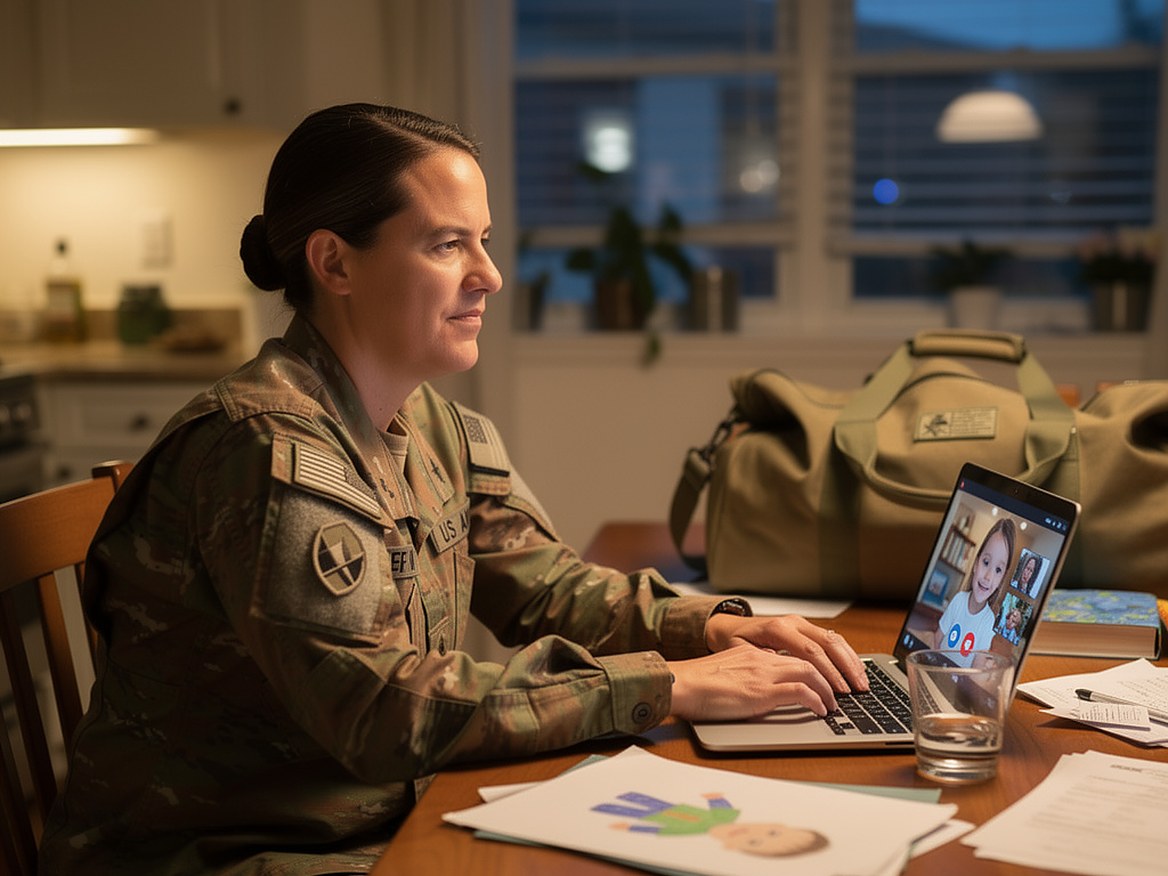
Deployment alone cannot decide best interests, and no permanent custody order can be entered during a deployment without the deploying parent’s consent.
“In a proceeding for custodial responsibility of a child of a service member, a parent’s past deployment or possible future deployment in itself may not serve as the sole basis in determining the best interest of the child” (C.R.S. § 14-13.7-107). During a deployment the court may enter an interim order but “may not issue a permanent order granting custodial responsibility without the consent of the deploying parent” (C.R.S. § 14-13.7-302(1)). Federal law adds that a temporary order based solely on a deployment expires no later than the deployment justifies, and applies any higher state standard (50 U.S.C. § 3938).
Notice and a plan. With a custody order in place, the deploying parent must notify the other parent in a record “not later than twelve calendar days after receiving deployment orders,” unless the circumstances of service prevent it, and each parent provides a plan for the deployment (C.R.S. § 14-13.7-105). If an order bars disclosing the other parent’s address, notice goes to the court.
An interim order, quickly. A motion filed before departure gets an expedited hearing, with electronic testimony. A prior order on custody during deployment binds the court unless the modification standards are met, and a prior written agreement is enforced unless contrary to the child’s best interest (C.R.S. § 14-13.7-305).
Delegating the time. On the deploying parent’s motion the court may give caretaking authority to an adult family member, or an adult who has had physical care of the child for more than 182 days, limited to the deploying parent’s own time unless the other parent agrees (C.R.S. § 14-13.7-306). A power of attorney works only if no other parent has custodial responsibility or an order bars contact with the other parent (C.R.S. § 14-13.7-204).
The return. The court “shall immediately issue an interim order granting the deploying parent reasonable contact with the child consistent with the deployed parent’s post deployment leave” (C.R.S. § 14-13.7-403), and absent an agreement the interim order ends thirty-five days after notice of return (C.R.S. § 14-13.7-404). Keeping the interim arrangement is an ordinary modification (Modifying Custody); a permanent change of station that moves the child is a relocation.
The family care plan is not a custody order. Department of Defense Instruction 1342.19 requires one from single parents, dual-military couples with dependents, and members with custody of a child whose other parent is not the current spouse. It tells commanders to “[i]nform Members of the overriding authority of State courts to determine child custody arrangements, notwithstanding a family care plan,” and warns that leaving the other parent out can “undermine, or even render useless, the family care plan.” The plan and the parenting plan are written to match.
Abuse in a military family runs through the command and the civilian courts at once. Since August 12, 2026 Colorado law connects them.
| The tool | What it does | Authority |
|---|---|---|
| Military protective order | Issued by a commander on DD Form 2873; civilian authorities must be notified within seven days, and again on transfer. | DoDI 6400.06; 10 U.S.C. § 1567a |
| Colorado protection order | Has “the same force and effect on a military installation” as off it. A military protective order is now evidence a Colorado court “shall consider” on a temporary order, and police must search for one when they suspect domestic violence. | 10 U.S.C. § 1561a(a); C.R.S. § 13-14-104.5(7)(a); C.R.S. § 18-6-806(2) |
| Firearms | A misdemeanor domestic-violence conviction bars firearms with no exception for government-issued weapons, which can end a career; a qualifying protection order has an official-use exception. | 18 U.S.C. §§ 922(g)(8)–(9), 925(a)(1) |
| Money for abused dependents | Transitional compensation for twelve to thirty-six months after a member is separated for a dependent-abuse offense; and a court-ordered share of retired pay a retirement-eligible member loses for abuse. | 10 U.S.C. §§ 1059, 1408(h) |
| Reporting and parenting | The Family Advocacy Program offers restricted and unrestricted reporting. A conviction in “a military or federal jurisdiction” triggers the parenting-time objection procedure like any other. | DoDI 6400.06; C.R.S. § 14-10-129(3)(a) |
The civilian side, including what a finding of domestic violence does to custody since May 2026: Domestic Violence & Divorce and Protection Orders. If you are in danger, call 911; the National Domestic Violence Hotline is 1-800-799-7233.
Six things, in the order they come up. Not legal advice for your case; the mistakes I have watched for thirty years.
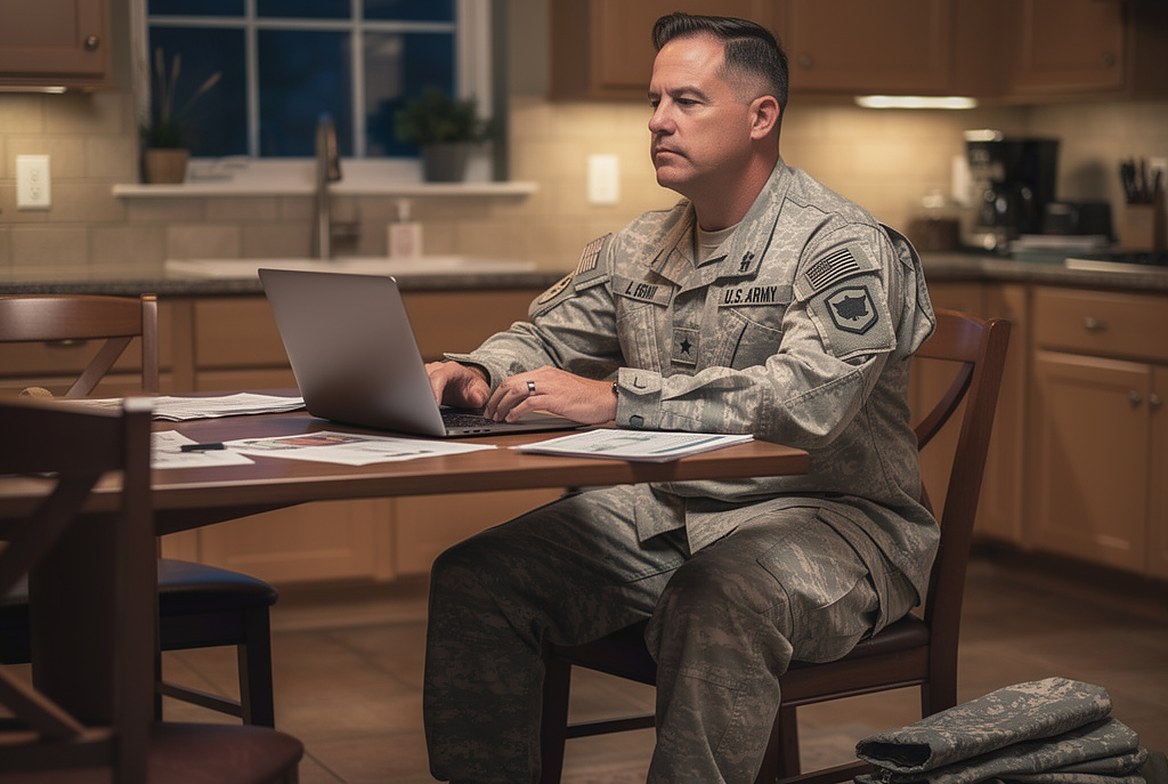
Domicile for the decree; residence, domicile or consent for the pension; the home state for the children. The wrong court can grant a divorce it cannot finish.
DFAS does not treat a retired-pay order as served without a certification that the member’s rights under the Act were observed. It is one sentence.
The former spouse sends the deemed-election request, with the order, early. Relying on the member is how coverage is lost.
After Howell and Tozer a court cannot make a former spouse whole for a later VA waiver. The risk is addressed at the decree, or not at all.
Housing and food allowances are income for support. The number that matters is the whole pay, not the taxable wages.
A prior order on custody during deployment binds the court. Notice, delegation to a grandparent, video contact and the return are easier to agree on before the orders arrive.
My spouse is stationed here, so I can file here.
Stationed is not domiciled. One spouse needs ninety-one days of Colorado domicile; the civilian spouse’s own domicile often meets the rule.
A deployed spouse cannot be divorced.
The SCRA gives a stay of at least ninety days and a lawyer before any default. It is time to take part, not a veto.
Under ten years of marriage, there is no share of the pension.
The 10/10 rule decides whether DFAS pays the former spouse directly. The court can divide the pay either way.
The former spouse gets half the retirement.
Colorado divides the marital share, on pay frozen at the decree for a member not yet retired; fifty percent is a cap on what DFAS pays.
The service decides child support.
The service rules are interim command standards. Colorado’s guidelines decide support in court.
Deployment is a reason to change custody.
Deployment alone cannot decide best interests, and no permanent order can enter during a deployment without the deploying parent’s consent.

A military divorce is lost on paper more often than in court: an order the government will not pay, an election filed in the thirteenth month.
Start with a confidential conversation: tell me about the service and the case →
Only if one of you is domiciled here, meaning living in Colorado with the intent to stay, for ninety-one days before the filing. Being stationed here under orders is not domicile by itself; the Colorado Supreme Court held that in 1973. A spouse who has made Colorado home can file on that spouse’s own domicile. Two more questions follow: whether a Colorado court can divide the military retired pay, which federal law allows only with the member’s residence other than by assignment, domicile or consent, and which state is the children’s home state.
Yes. The Servicemembers Civil Relief Act does not bar the filing; it protects a member who cannot take part. A member whose duties prevent appearing can ask for a stay of at least ninety days, supported by a letter from the member and one from the commanding officer. If the member does not appear at all, the court cannot enter a default without an affidavit about military service and, for a member in service, an attorney appointed to represent the member. A default entered in violation of those rules can be reopened.
No one is entitled to half. Colorado divides the part of the retired pay earned during the marriage as marital property, and federal law sets the limits: the court divides disposable retired pay, not gross; for a member not yet retired at the decree, the divisible pay is frozen at the member’s pay base and years of service on the decree date, plus cost-of-living adjustments; and the government will pay no more than fifty percent of disposable retired pay under property orders. How the marital share is split depends on the case.
It is a payment rule, not a division rule. The government pays a former spouse’s share of retired pay directly only if the marriage lasted at least ten years during which the member performed at least ten years of service creditable toward retirement. The service does not have to be active duty; creditable Guard and Reserve service counts. Below ten overlapping years the court can still award the former spouse a share of the retired pay. The member then pays it, and the order is enforced like any other.
For a decree that becomes final before the member retires, federal law fixes the retired pay a court may divide at the member’s retired pay base and years of service on the decree date, increased only by cost-of-living adjustments before and after retirement. Promotions and years served after the divorce belong to the member alone. For Guard and Reserve members the same rule runs on retirement points. It applies to any division of property that became final after December 23, 2016, including a legal separation decree.
Retired pay stops when the member dies, so the former spouse’s share stops too unless the decree requires former-spouse coverage under the Survivor Benefit Plan. The member’s own election must reach the service within one year after the decree. If the member does not make it, the former spouse can have it deemed made by sending a written request and a copy of the order, but only if the request is received within one year of the order. After that year the deemed election is no longer available.
In two situations. An unremarried former spouse married to the member for at least twenty years during which the member performed at least twenty years of creditable service, with no employer-sponsored health plan, keeps TRICARE as their own sponsor, with commissary and exchange privileges. If the overlap was at least fifteen but less than twenty years, TRICARE continues for one year after the decree, with no commissary or exchange. Remarriage ends eligibility. Others may elect continued coverage under CHCBP, within sixty days.
Yes. The child support statute counts expense reimbursements and in-kind payments received in the course of employment when they are significant and reduce personal living expenses, and the Court of Appeals has held that military housing and food allowances are part of gross income under that language. The maintenance statute has the same provision. Bring the Leave and Earnings Statement; the sworn financial statement has no separate line for allowances, so they are listed as income.
Not by an order compensating the former spouse. The Supreme Court held in Howell v. Howell that a state court may not order a veteran to indemnify a former spouse for the loss caused by a post-decree waiver of retired pay for disability benefits, and the Colorado Court of Appeals applied it in Tozer. A court may still take the waiver into account in maintenance. Whether a clause both spouses agreed to is enforceable has not been decided in a published Colorado appellate decision, so I treat it as an open question.
No. Federal law says transferred Post-9/11 GI Bill entitlement may not be treated as marital property or divided in a divorce, and the member may modify or revoke a transfer of unused entitlement at any time. A settlement that counts on a transfer staying in place for a child is counting on a promise federal law lets the member take back, so I do not treat it as an asset in the division.
Colorado’s deployed-parents act governs. With a custody order in place, the deploying parent must notify the other parent in a record within twelve calendar days of receiving orders, and each parent provides a plan for the deployment. The court can enter an interim order, on an expedited hearing if the motion is filed before departure, and can delegate the deploying parent’s time to a family member. It cannot enter a permanent change without the deploying parent’s consent, and deployment alone cannot decide best interests.
Usually in the district court for the county where one of you lives, not the county where the base is. Families in the Arapahoe County part of Aurora file in Arapahoe County District Court, the 18th Judicial District, at the justice center in Centennial. Fort Carson, Peterson and Schriever Space Force Bases and the Air Force Academy are in El Paso County, the 4th Judicial District. A Buckley family living in Parker files in Douglas County. The domicile rule has to be met either way.
The next page in this chapter, the pages that belong with it, and the blog posts on the same question.
In a hard-fought Colorado custody case the judge can appoint an attorney whose only client is the child's best interests. What a CLR does, how it differs from a…
Sept 18, 2026The SLAT Trap: When the Estate Plan Meets the DivorceSpousal Lifetime Access Trusts move wealth out of the taxable estate, with the marriage as the access mechanism. In a divorce, the donor loses the access,…
Sept 17, 2026Can You File for Divorce in Another State If You Live in Colorado?Where a divorce can be filed, where the money can be decided, and where the children's case belongs are three different questions. Colorado's 91-day domicile…
A consultation is a working session, in person in Greenwood Village or by video from wherever you are stationed: I go through the jurisdiction questions, the retired pay and the benefit dates with you, and tell you what I would file, where, and in what order. Your note reaches my office directly; during business hours we call you back within the hour, run the conflicts check, and set the meeting.
Talk to us about your case.
303-507-5529One call. A real person picks up, hears you out, and tells you how we would handle what you are facing and what to do first. No phone tree, no sales pitch, no obligation. Your first conversation is with our intake paralegal, who will get you to Aaron fast.
Rather write? Send a short note and during business hours we call you back within the hour.