$1,600
A time-rule share
Of a $6,000 monthly pension, for a marriage covering 192 of 360 months of service: the formula from Hunt, worked below.

A decree that says “half the 401(k)” divides nothing by itself. Each plan pays only on the order its own law requires: a QDRO for a private plan, PERA’s written agreement, two different federal orders for FERS and the TSP, the frozen-benefit formula for military pay, and no order at all for an IRA. The marital share, the drafting and the deadlines, plan by plan, with the numbers worked.
Talk to us about your case.
303-507-5529One call. A real person picks up, hears you out, and tells you how we would handle what you are facing and what to do first. No phone tree, no sales pitch, no obligation. Your first conversation is with our intake paralegal, who will get you to Aaron fast.
Rather write? Send a short note and during business hours we call you back within the hour.
A retirement division is not finished when the judge signs the decree. It is finished when the plan pays the right person the right amount, which can be twenty years later.
Every plan is a promise made by someone else: an employer, a trustee, the State of Colorado, the Office of Personnel Management, the Defense Finance and Accounting Service. A Colorado court can divide the marital share of the promise, but only in the form the promisor’s own law recognizes, and the plan administrator, not the judge, decides whether the order works. An order that is right in substance and wrong in form is paid late, paid to the wrong person, or not paid at all: a QDRO silent on survivor benefits when the participant dies, a PERA agreement delivered on day ninety-one, a military order without the figures DFAS requires, a federal order labeled a QDRO.
I have negotiated and litigated retirement divisions for thirty years, and as a Georgetown Tax LL.M. I price each account in its own tax currency. Retirement Assets is the overview. This page is the working detail: the order each plan requires and what it must say, the time rule and the premarital 401(k) in numbers, the survivor clauses, and the deadlines. Updated September 2026.
In Boulder County the plans are more often the University of Colorado 401(a), PERA, FERS and TIAA than a private 401(k). The orders are the same; the court is the 20th Judicial District, covered on the Boulder divorce page.

Of a $6,000 monthly pension, for a marriage covering 192 of 360 months of service: the formula from Hunt, worked below.
An $80,000 premarital 401(k) that grew to $620,000: $540,000 is marital, $126,283 more than the rule most people assume.
The written agreement goes to PERA within ninety days after the decree, or PERA pays nothing directly.
A former spouse’s own request to the military, within one year of the court order.
Before anyone agrees to a percentage, the first question is what kind of plan it is. The plan type decides the instrument, the law that governs it, and what can go wrong.
| Plan | The instrument | Governing law | What to know |
|---|---|---|---|
| Private defined benefit pension | Qualified domestic relations order (QDRO) | 29 U.S.C. § 1056(d)(3); IRC § 414(p) | Separate interest or shared payment; survivor benefits only if the order provides them |
| 401(k), private 403(b), profit sharing | QDRO | The same | Gains and losses from the valuation date; loans |
| Governmental 457(b) and 403(b); church plans | A domestic relations order under the plan’s procedures | Plan terms; § 414(p)(11) for tax | Not ERISA; the plan’s rules govern |
| IRA and Roth IRA | The decree and a transfer letter; no QDRO | IRC § 408(d)(6) | No 10% penalty exception for cash |
| Colorado PERA: the pension, PERAPlus 401(k) and 457, the DC plan | PERA’s mandatory Agreement and Order forms | C.R.S. § 14-10-113(6); PERA’s rules | Written agreement required; ninety days; PERA never accepts a QDRO |
| FERS or CSRS annuity | A court order acceptable for processing | 5 C.F.R. Part 838 | Express language; the survivor annuity’s timing |
| Thrift Savings Plan | A retirement benefits court order | 5 C.F.R. Part 1653 | Dollars or a percentage as of a date; earnings only if ordered; a $600 fee |
| Military retired pay | A court order, sent to DFAS with DD Form 2293 | 10 U.S.C. § 1408 | Disposable retired pay; the frozen benefit; 10/10; the 50% cap |
| Nonqualified deferred compensation | The plan’s terms | Treas. Reg. § 1.409A-3(j)(4)(ii) | Payment may be accelerated to fulfill a domestic relations order; taxed to the former spouse when paid (Rev. Rul. 2002-22) |
Social Security cannot be divided, and railroad retirement follows its own federal rules; Retirement Assets covers both.
A retirement benefit is marital to the extent it was earned during the marriage, and a vested but unmatured pension is marital property to the extent it was funded during the marriage (In re Marriage of Grubb, 745 P.2d 661 (Colo. 1987)). How the share is measured depends on whether the plan promises a benefit or holds an account.

Offset the present value now, divide each payment later by the time rule, or reserve jurisdiction; once the time rule is used, the fraction cannot be altered.
In In re Marriage of Hunt, 909 P.2d 525 (Colo. 1995) the Supreme Court set out three methods. Immediate offset: an actuary fixes the present value of the marital share, priced for the risk of forfeiture, and the other spouse takes equal value in other assets; it suits a small pension or a clean break. Deferred distribution: the court predetermines the percentage of each payment the other spouse will receive once the pension is vested and matured. Reserved jurisdiction: the court decides later.
The time rule. Marital months of service over total months at retirement, times the monthly benefit, times one-half. Under deferred distribution the economic partnership continues, so later increases and decreases are shared, and once used the formula cannot be altered for “economic fault.” The Court of Appeals calls the coverture fraction the accepted means (In re Marriage of Zappanti, 80 P.3d 889 (Colo. App. 2003)), and disapproved a subtraction method for a pension because it grossly overstated the wife’s share (In re Marriage of James, 950 P.2d 624 (Colo. App. 1997)).
| Step | Figure |
|---|---|
| Hired | January 2006 |
| Married | June 2010 |
| Decree | June 2026: 192 months of service during the marriage |
| Retires | January 2036, after 360 months of service |
| Coverture fraction: 192 ÷ 360 | 53.33% |
| Times one-half | 26.67% |
| Times the $6,000 monthly benefit at retirement | $1,600 a month to the former spouse |
The denominator is service at actual retirement, so later raises are shared through the fraction. PERA’s booklet: 120 ÷ 240 × 50% × $2,500 = $625 a month.
For an account the statute does the work: an asset acquired before the marriage is marital to the extent its present value exceeds its value at the time of the marriage (C.R.S. § 14-10-113(4)).

The balance on the wedding day is separate; everything above it at the decree, including the growth on those premarital dollars, is marital.
The cases. The amount accumulated before the marriage is separate property (In re Marriage of Rogers, 709 P.2d 1383 (Colo. App. 1985)). A 401(k) is a defined contribution plan whose marital interest the court must determine but, unlike a pension, it need not consider future appreciation (In re Marriage of Casias, 962 P.2d 999 (Colo. App. 1998)). The Court of Appeals applied the statute to a premarital retirement account as a whole, with no error in using the change in the whole account rather than tracing security by security (In re Marriage of Powell, 220 P.3d 952 (Colo. App. 2009)).
The proof. The spouse claiming the premarital balance carries the burden of tracing it back to the original asset, and the statement nearest the wedding date decides most of these claims. Plans purge old records, so I request it in the first month of the case.
| $80,000 at the June 2012 wedding; $620,000 at the 2026 decree | Separate | Marital |
|---|---|---|
| Colorado, C.R.S. § 14-10-113(4) | $80,000 | $540,000 |
| The rule many people assume, “my $80,000 and its growth stay mine” ($80,000 at 7% for 14 years) | $206,283 | $413,717 |
| Difference | $126,283 more marital property under the Colorado rule |
In Colorado the growth on premarital money is marital; only the wedding-day balance is separate.
A domestic relations order is a judgment, decree or order under state domestic relations law that relates to support or marital property rights (29 U.S.C. § 1056(d)(3)(B)(ii)). It becomes a QDRO when the plan administrator finds that it meets the statute, which the tax code repeats at § 414(p).
| The statute | What it requires | What I put in the order |
|---|---|---|
| Must clearly specify (§ 1056(d)(3)(C)) | The names and last known mailing addresses of the participant and each alternate payee; the amount or percentage, or how it is determined; the number of payments or the period; each plan it applies to. | The plan’s exact legal name; the marital share as a formula or a percentage as of a stated valuation date. |
| May not require (§ 1056(d)(3)(D)) | A benefit or option the plan does not offer; increased benefits; benefits already awarded to another alternate payee. | The plan’s model order, read first, and pre-approval before the decree. |
| Early payment (§ 1056(d)(3)(E)) | Payment may begin at the participant’s earliest retirement age, computed on benefits actually accrued and without the present value of any employer subsidy for early retirement. | Subsidy-reallocation language, so the former spouse shares a subsidy if the participant later retires early. |
| Survivor protection (§ 1056(d)(3)(F)) | To the extent the order provides, a former spouse is treated as a surviving spouse for the plan’s survivor annuities, and one married at least a year meets the one-year marriage rule. | An express survivor clause, before and after retirement, and who bears its cost. |
| Procedure (§ 1056(d)(3)(G)–(H)) | A decision within a reasonable period, with the amounts separately accounted for; after 18 months a later determination applies only prospectively. | Entry with the decree and certified copies to the plan that week. |
The plan administrator, not the court, decides whether the order qualifies.
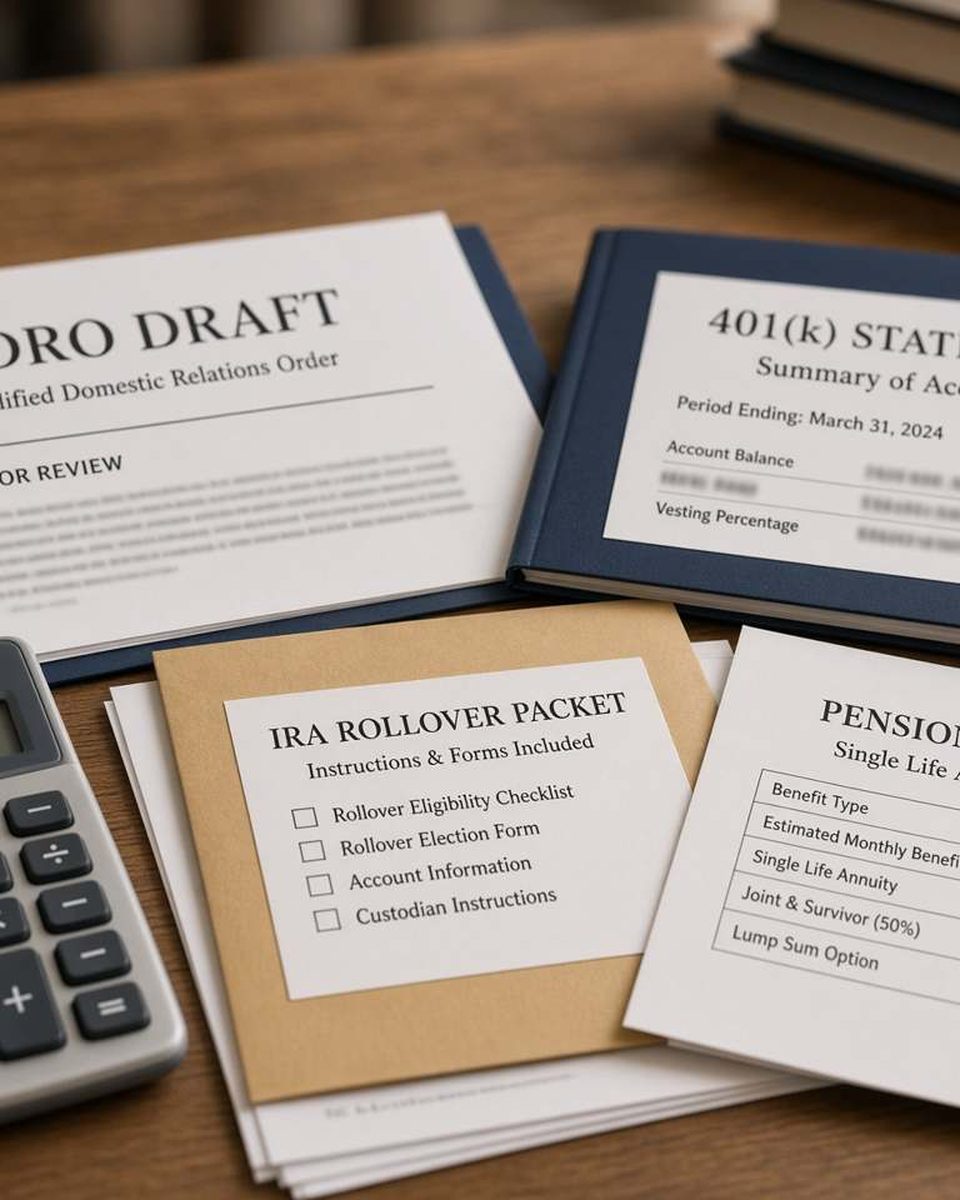
The form of the award decides when the former spouse is paid and whether the payments survive the participant.
Separate interest or shared payment. A separate interest divides the benefit itself: the former spouse chooses when and how to be paid, on the former spouse’s own life. A shared payment is a percentage of each payment the participant receives, and stops when those payments stop. Before retirement, where the plan allows it, I prefer the separate interest.
Survivor benefits, and timing. Leave survivor protection out of the order and the pre-retirement death benefit is lost. In Hopkins v. AT&T Global Information Solutions Co., 105 F.3d 153 (4th Cir. 1997) the surviving-spouse benefits vested in the participant’s current spouse when he retired, and a later order could not move them. A Labor Department regulation lets an order qualify whenever it is issued, even after death (29 C.F.R. § 2530.206(c)(1)), but it cannot take back a benefit that has vested in someone else.
Subsidies and increases. An early-retirement subsidy is excluded unless the order reallocates it. A percentage of each payment carries later increases; a fixed dollar amount does not, unless the order says so.
An account is valued at the decree, but the plan divides it weeks or months later. The order says who carries the market in between.
| $600,000 at the decree, divided 50%; the account falls 15% before the plan segregates the share | Former spouse | Participant |
|---|---|---|
| 50% with gains and losses from the valuation date | $255,000 | $255,000 |
| A fixed award of $300,000 | $300,000 | $210,000 |
The same drop, two different results, decided by one clause.
Loans, later contributions, death. The order decides whether an outstanding loan counts in the balance; contributions after the valuation date are the participant’s. A participant who dies, retires or cashes out before an order is qualified can defeat an award that existed only in the decree, so the order is entered with the decree and pre-approved where the plan allows.
Cost and beneficiaries. A defined contribution plan may charge the reasonable cost of a QDRO determination to the participant’s account. Typical drafting fees run about $500 to $1,500 per plan, and an actuary’s present-value report about $300 to $1,500 or more: typical ranges, not quotes. After the decree every beneficiary designation is changed; for an ERISA plan the plan’s documents control over state revocation rules (Egelhoff v. Egelhoff, 532 U.S. 141 (2001); Kennedy v. Plan Administrator for DuPont, 555 U.S. 285 (2009)), and elsewhere Colorado revokes a former spouse’s designation unless an instrument, order or contract says otherwise (C.R.S. § 15-11-804(2)(a)).
An IRA transferred to a spouse or former spouse under a decree, or a written instrument incident to one, is not a taxable transfer and becomes the recipient’s account (§ 408(d)(6)). The transfer is made after the decree, not under temporary orders, by retitling or a trustee-to-trustee transfer (IRS Pub. 590-A).
| A 45-year-old former spouse needs $50,000; 22% federal, 4.4% Colorado | Net from $50,000 withdrawn | Withdrawal needed to net $50,000 |
|---|---|---|
| Paid in cash from the 401(k) under the QDRO: no 10% penalty | $36,800 | $67,935 |
| Rolled to an IRA first, then withdrawn: the 10% penalty applies | $31,800 | $78,616 |
The QDRO exception (§ 72(t)(2)(C)) does not reach distributions from an IRA (§ 72(t)(3)(A)). Take the cash under the QDRO, then roll the rest.
Taxes and support. A former spouse paid under a QDRO is taxed on it (§ 402(e)(1)(A)); how the Roth five-year clock runs after a divorce transfer is unsettled, so keep the original owner’s records. For child support, earnings in a retirement account are not income until distributed, and a penalty-free distribution a parent chooses not to take counts only if the parent is not otherwise employed full time and the account was not received in the division of marital property (C.R.S. § 14-10-115(5)(a)(II)(E)). The maintenance statute’s parallel provision (C.R.S. § 14-10-114(8)(c)(II)(E)) lacks that last carve-out. The tax side of every account is on Divorce & Taxes.
A Colorado public-employee benefit is divisible directly by the plan only upon the parties’ written agreement (C.R.S. § 14-10-113(6)(a)(I)), submitted within ninety days after the decree (C.R.S. § 14-10-113(6)(c)(I)). Without it, a court has no jurisdiction to enter an order dividing the benefit (C.R.S. § 14-10-113(6)(f)).
| PERA’s rule | What it means |
|---|---|
| One method only (C.R.S. § 14-10-113(6)(c)(III)) | A defined benefit agreement chooses exactly one: a fixed amount; a fixed percentage; the time-rule formula (months of service credit during the marriage over months of service credit at retirement); a date-of-decree formula; or another agreed formula. |
| PERA’s forms, unchanged | PERA will not accept a QDRO under any circumstances. Its Agreement and Order forms are used without change, and certified copies reach PERA at least 30 days before the first benefit payment. |
| When the former spouse is paid | Not until the member retires or takes a refund, except at the alternate retirement age: a member 65 or older and still working, and then monthly only. Payment follows the member’s election. |
| Death | The death of either the member or the former spouse stops all future payments to the former spouse; if the former spouse dies first, the payment reverts to the retiree. |
| PERAPlus 401(k), 457 and the DC plan | Paid immediately once the order is final and the forms are returned, pro rata across funds and pre-tax and after-tax money. |
| No 50% cap | The only limit: the former spouse cannot receive more than the member would. PERA does not compute present value; an offset needs an actuary. |
| The statutes behind it | The exception to PERA’s protection from legal process (C.R.S. § 24-51-212); court-ordered cobeneficiary changes (C.R.S. § 24-51-802); the Denver Public Schools division (C.R.S. § 24-51-1733). |
From the statute and PERA’s booklet on benefits and divorce (revised September 2022). PERA urges pre-approval of the forms.
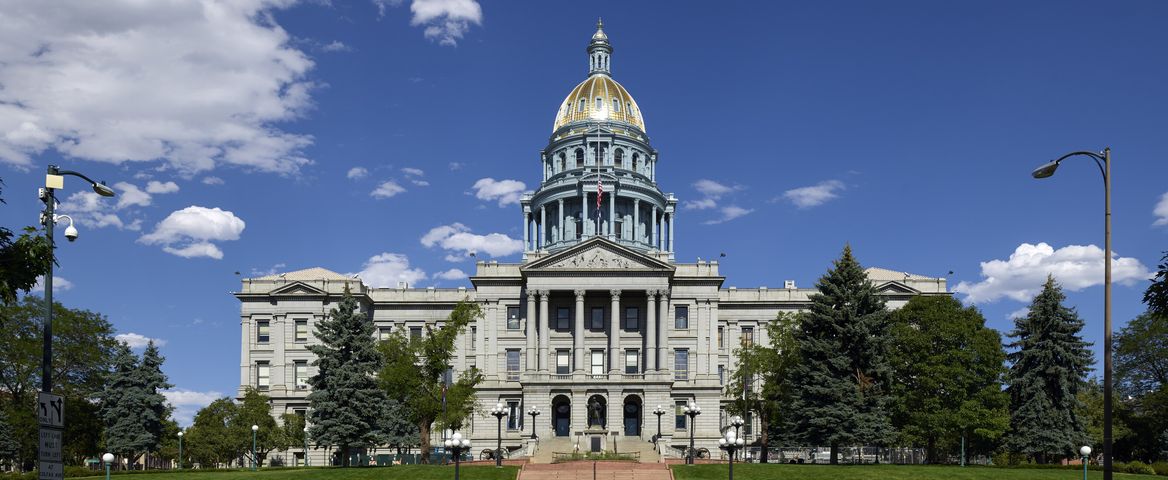
No agreement means no order against PERA; the court can still order the member to pay, and only the court can change a retiree’s cobeneficiary.
No agreement. Without a signature there is no order against PERA, but the court can offset the value in other assets, or order the member to pay the other spouse as each retirement check arrives, on the Hunt deferred-distribution method (In re Marriage of Tagen, 62 P.3d 1092 (Colo. App. 2002)). A missed ninety-day deadline leaves the same fallback, or vacating and re-entering the decree.
The retiree’s cobeneficiary. The court may order or allow a retiree to change or remove a cobeneficiary; the Supreme Court held that the authority belongs to the trial court, not the retiree, and that the court is not required to permit the change (In re Marriage of Mack, 2022 CO 17).
A federal employee usually has two benefits and needs two orders: one to the Office of Personnel Management for the annuity, one to the Thrift Savings Plan for the account. Neither agency accepts an order written for a private plan.
| FERS or CSRS annuity (5 C.F.R. Part 838) | Thrift Savings Plan (5 C.F.R. Part 1653) | |
|---|---|---|
| The label trap | An order labeled a QDRO, or written on a QDRO form, is not acceptable unless it expressly states that its CSRS or FERS provisions are governed by Part 838 (§ 838.302). | The order must expressly refer to the “Thrift Savings Plan” and be written in terms appropriate to a defined contribution plan (§ 1653.2(a)). |
| What it must say | Expressly divide the annuity and direct OPM to pay: a fixed amount, a percentage or fraction, or a formula whose variables are on the face of the order or in OPM’s files; OPM will not read state law to compute it (§§ 838.303–.305). | Dollars, a percentage as of a date, or a survivor annuity; never a particular fund, source or traditional-or-Roth balance; paid pro rata (§ 1653.2). |
| The marital share | The pro rata share: one-half of marital months of service over total months, the federal twin of the time rule (§ 838.621). | Loans count in the balance, and no earnings are credited, unless the order says otherwise (§ 1653.4). |
| Increases and refunds | A fixed-dollar award forfeits cost-of-living adjustments unless expressly ordered (§ 838.622); bar a refund of contributions, or the employee can cash out. | One payment, no earlier than 30 days after the decision letter; the former spouse may roll it over (§ 1653.5). |
| Survivor and cost | A former-spouse survivor annuity must be expressly awarded, before retirement or death or in the first property order; it ends on remarriage before 55 and is paid for by reducing the annuity. | A $600 fee, charged to the participant unless the order divides it (§ 1653.6). |
The TSP’s model order awards a percentage of the account “as of” a date, with an optional earnings sentence.
A state court may treat disposable retired pay as marital property (10 U.S.C. § 1408(c)(1)) only with jurisdiction over the member through residence not due to a military assignment, domicile, or consent (§ 1408(c)(4)). Federal law then decides how much is divisible, who pays it, and what survives.
The frozen benefit. For a decree that becomes final before the member retires, the pay to be divided is “the amount of retired pay to which the member would have been entitled using the member’s retired pay base and years of service on the date of the decree,” increased by the cost-of-living adjustments before and after retirement; for a reservist, the pay base and service points on the decree date (§ 1408(a)(4)(B), added for decrees after December 23, 2016). The order recites the member’s high-3 pay base and years of service, or points, as of the decree, in the form DFAS publishes. I have found no Colorado appellate decision applying the rule; the statute controls.
| The rule | What it says | What it means |
|---|---|---|
| Disposable retired pay (§ 1408(a)(4)(A)) | Retired pay less, among other things, pay waived for VA disability compensation and disability-based retired pay. | The divisible base can shrink after the decree. |
| The 10/10 rule (§ 1408(d)(2)) | DFAS pays a property award directly only if the marriage overlapped at least 10 years of creditable service. | Under 10/10 the award is still valid; the member pays it. |
| The 50% cap (§ 1408(e)(1)) | The total paid under all court orders may not exceed 50% of disposable retired pay. | The most DFAS will pay under every order combined; the division is planned around it. |
| Survivor Benefit Plan | A retiree’s former-spouse election within one year after the decree (§ 1448(b)(3)(A)(iii)); for a member not yet retired, the election at retirement. If the member fails, the former spouse may request a deemed election, received within one year of the order (§ 1450(f)(3)(C)). | The former spouse files that request personally. |
| DFAS timing (§ 1408(d)(1)) | Payment within 90 days of effective service, if the member is retired. | Apply with the certified order. |
| High-3 system, 2.5% a year: divorce at 16 years (192 months), 144 months of marriage overlap, high-3 $7,500; retires at 24 years, high-3 $10,000 | Former spouse’s share |
|---|---|
| Frozen rule: 2.5% × 16 × $7,500 = $3,000 of divisible pay; 50% × 144/192 × $3,000 | $1,125 a month, plus the cost-of-living increases the statute adds |
| The old time-rule approach: 50% × 144/288 × (2.5% × 24 × $10,000 = $6,000) | $1,500 a month |
| Blended Retirement System member (2.0% multiplier), frozen rule | $900 a month |
Before the cost-of-living increases, the frozen share is about 19% of the $6,000 the member actually receives. Illustrations; the real figures come from the member’s records.
VA disability. A state court may not order a veteran to indemnify a former spouse for retired pay later waived to receive VA disability (Howell v. Howell, 581 U.S. 214 (2017)), and the Court of Appeals held equitable reimbursement preempted too (In re Marriage of Tozer, 2017 COA 151). A court may still account for a possible waiver in setting spousal support, and VA disability benefits are income for child support (In re M.E.R-L., 2020 COA 173). The risk is priced at the decree.
Each plan’s procedures and model order; current statements; the wedding-date statement; PERA service credit; the military pay base and service.
Each order drafted in its plan’s own form and sent for pre-approval where the plan offers it; the PERA forms signed.
The QDROs and the federal orders entered with or before the decree; the PERA Agreement and Order filed with it.
To each plan, OPM, the TSP and DFAS (with DD Form 2293). PERA’s outside limit is ninety days after the decree, and at least 30 days before the first benefit payment.
For military pay, the retiree’s former-spouse election within one year after the decree, and the former spouse’s own deemed-election request within one year of the order.
The qualification letter within a reasonable period; the TSP pays no sooner than 30 days after its decision letter; DFAS within 90 days if the member is retired.
New beneficiary designations on every account; cash taken under the QDRO before any rollover; the next return planned with the CPA.
Six things, in the order they come up. Not legal advice for your case; the mistakes I have watched for thirty years.

Each plan pays only on its own order, entered with the decree and delivered that week.
It proves the premarital line, and plans purge it first.
A shared payment dies with the participant unless the order protects the former spouse.
The court cannot divide it over a spouse’s objection.
Recite the retired pay base and years of service, and calendar the deemed SBP election yourself.
The penalty exception covers the plan distribution, not an IRA.
The decree divides the 401(k).
It divides the right to it. The plan pays only on a qualified order.
My premarital 401(k) and its growth stay mine.
Only the wedding-day balance is separate. In the example, the difference is $126,283.
A QDRO can divide any retirement account.
Not an IRA, which moves under the decree; not PERA, which moves only by written agreement; not military pay, which moves under federal law.
The judge can split PERA like anything else.
The court has no jurisdiction to divide a public-employee benefit without the parties’ written agreement.
The military will pay my share at the member’s final rank.
For a decree before retirement, the divisible pay is frozen at the pay base and years of service on the decree date, plus cost-of-living increases.

A pension is a promise made by someone else. The order has to be written in that promisor’s language, and delivered before the promise changes.
Start with a confidential conversation: tell me what the plans are →
A qualified domestic relations order is the court order a private retirement plan requires before it will pay part of a participant’s benefit to a spouse or former spouse. The decree decides the division; the QDRO tells the plan how to carry it out, in terms the plan will accept. You need one for a private pension, a 401(k), a private 403(b) or a profit-sharing plan. You do not need one for an IRA, and Colorado PERA, the federal plans and military retired pay each use their own forms instead.
Colorado uses the three methods the Supreme Court described in Hunt: an immediate offset at present value, deferred distribution by the time rule, or reserved jurisdiction. Under the time rule the former spouse receives one-half of a fraction, the months of service during the marriage over the total months at retirement, times the benefit actually paid. In the example on this page, 192 of 360 months on a $6,000 monthly pension produces $1,600 a month.
The balance on the wedding date is your separate property. Everything above it at the decree, including the growth on your premarital dollars, is marital: that is the Colorado statute, and the Court of Appeals has applied it to retirement accounts as a whole. On an $80,000 premarital balance that grew to $620,000, $540,000 is marital, $126,283 more than if the growth on the premarital money stayed separate. The statement nearest the wedding date is the proof, so request it early.
Yes, if it is paid to you from the plan under the QDRO: the tax code exempts distributions to an alternate payee from the 10 percent additional tax, though ordinary income tax applies. If you roll the money into an IRA first and then withdraw it before 59 and a half, the penalty applies. At the rates in the example on this page, $50,000 withdrawn nets $36,800 under the QDRO and $31,800 from an IRA. Take what you need from the plan, then roll the rest.
No. A Colorado court has no jurisdiction to order PERA to divide a benefit without the parties’ written agreement, on PERA’s own forms, submitted within ninety days after the decree. Without the agreement, the court can offset the value with other assets, or order the member to pay you directly as each retirement check is received. That order binds your former spouse, not PERA, so collecting it depends on enforcement against the member.
For a decree that becomes final before retirement, federal law freezes the divisible pay at the member’s retired pay base and years of service on the date of the decree, increased only by cost-of-living adjustments. Promotions after the divorce are not shared. DFAS pays a former spouse directly only after ten years of marriage overlapping ten years of service, and never more than half of disposable retired pay under all orders combined. The order must recite the figures as of the decree.
It depends on the order. For a private pension, a former spouse is protected by the plan’s survivor annuities only to the extent the QDRO says so, and some survivor rights vest in a current spouse at retirement. For PERA, the death of either the member or the former spouse stops all future payments to the former spouse, so any protection has to be built into the settlement. For military pay, survivor protection comes only through the Survivor Benefit Plan, which has one-year deadlines.
No. An IRA is transferred under the decree itself: a transfer to a spouse or former spouse under a divorce decree, or a written instrument incident to one, is not taxable, and the account becomes the recipient’s. The custodian retitles the account or makes a trustee-to-trustee transfer. Do it after the decree, not under temporary orders, and never by withdrawal, which is taxed to the owner and may carry the penalty.
Drafting takes weeks; the plan’s review can take months. A plan must decide within a reasonable period and separately account for the amounts in the meantime, for up to 18 months. The TSP pays no sooner than 30 days after its decision letter and charges $600; DFAS begins payments within 90 days of service of a complete application if the member is retired. Typical drafting fees run about $500 to $1,500 per plan; that is a typical range, not a quote.
One year, twice over. A retiree switching coverage to a former spouse must make the election within one year after the decree. If the member fails or refuses, the former spouse can request a deemed election, but the military must receive that request within one year of the court order. The former spouse should file it personally and keep proof of delivery rather than rely on the member.
The next page in this chapter, the pages that belong with it, and the blog posts on the same question.
In a hard-fought Colorado custody case the judge can appoint an attorney whose only client is the child's best interests. What a CLR does, how it differs from a…
Sept 18, 2026The SLAT Trap: When the Estate Plan Meets the DivorceSpousal Lifetime Access Trusts move wealth out of the taxable estate, with the marriage as the access mechanism. In a divorce, the donor loses the access,…
Sept 17, 2026Can You File for Divorce in Another State If You Live in Colorado?Where a divorce can be filed, where the money can be decided, and where the children's case belongs are three different questions. Colorado's 91-day domicile…
A consultation is a working session, in person in Greenwood Village or by video: bring the statements and the plan documents, and I will tell you what is marital in each account, which order each plan needs, what it must say, and the deadlines that cannot be missed. Your note reaches my office directly; during business hours we call you back within the hour, run the conflicts check, and set the meeting.
Talk to us about your case.
303-507-5529One call. A real person picks up, hears you out, and tells you how we would handle what you are facing and what to do first. No phone tree, no sales pitch, no obligation. Your first conversation is with our intake paralegal, who will get you to Aaron fast.
Rather write? Send a short note and during business hours we call you back within the hour.