½
Of the difference
The equalization payment is half the difference between the two columns, not half the house.

Who keeps the house is decided on a balance sheet, not a listing. The value comes from a licensed appraiser, not a broker’s opinion; costs of sale come off only if a sale is real; and the payment is half the difference between two columns, which two contestable assumptions move from $22,750 to $85,260 in the example below. The appraisal, the arithmetic, the refinance and the deed.
Talk to us about your case.
303-507-5529One call. A real person picks up, hears you out, and tells you how we would handle what you are facing and what to do first. No phone tree, no sales pitch, no obligation. Your first conversation is with our intake paralegal, who will get you to Aaron fast.
Rather write? Send a short note and during business hours we call you back within the hour.
The number that decides who keeps the house is not the house’s value. It is the equalization payment, and it comes from a balance sheet most people never see.
Every asset and every debt goes on one sheet, in two columns, one for each spouse. The house goes in the column of the spouse who keeps it, at its equity; the retirement accounts, the brokerage account, the cars and the credit cards go wherever the settlement puts them. The payment is half the difference between the two totals. Every fight about the house is really a fight over one line of that sheet: the appraised value, whether costs of sale come off it, whether the accounts beside it are counted before or after tax, and how and when the spouse who keeps it pays the spouse who leaves.
I have built these balance sheets for thirty years and cross-examined the appraisers and accountants behind their numbers, and I hold a Georgetown Tax LL.M. This page is the working detail: appraisal versus broker opinion, the appraiser to hire, costs of sale under Colorado law, the balance sheet worked two ways, and a buyout that actually closes. Updated September 2026. The broader rules (title, the premarital home, temporary use, the four ways a house case ends) are on Real Estate; the tax on a later sale is on Divorce & Taxes.
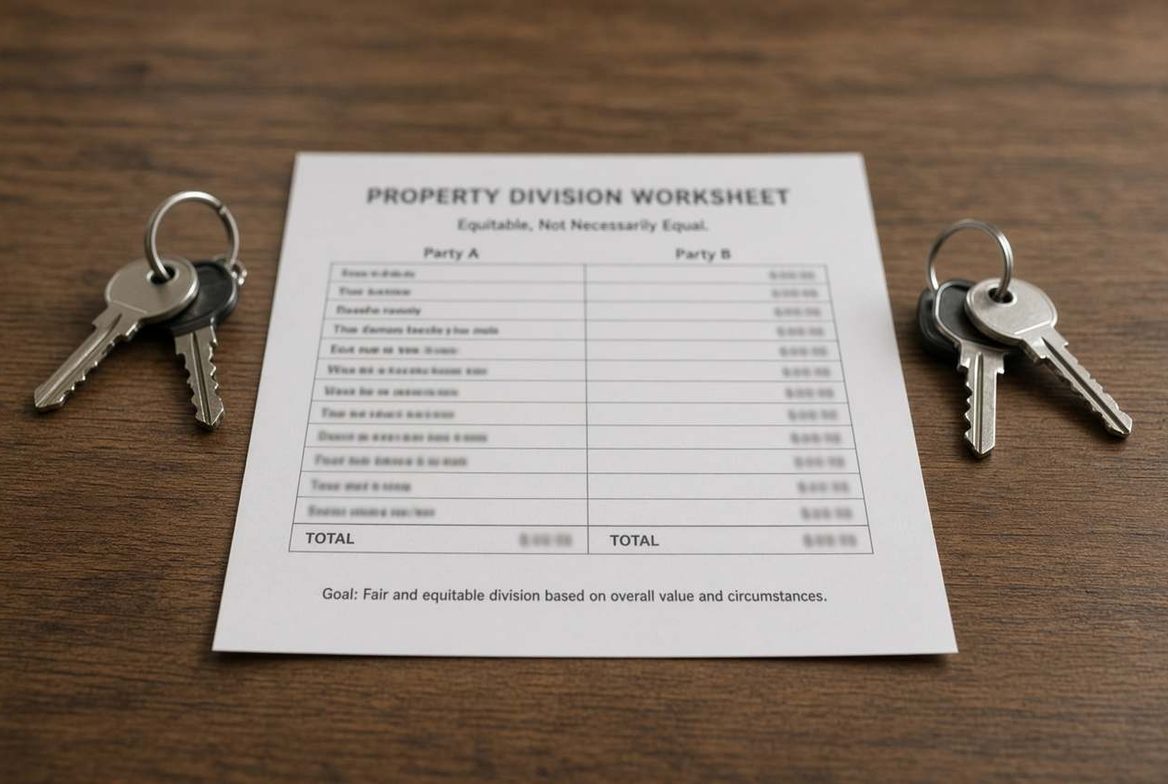
The equalization payment is half the difference between the two columns, not half the house.
$22,750, $52,500, $55,510 or $85,260, depending on whether costs of sale and tax come off. Same house, same accounts.
A spouse who lived there two years keeps the tax exclusion about three years after moving out, longer if the decree grants use.
Colorado licenses real estate appraisers, and says who is not one. A licensed broker who gives an opinion of value that is not represented as an appraisal and is not used to obtain financing is not an appraiser (C.R.S. § 12-10-602(9)(b)(II)), and neither is a CPA who does not call an opinion of real estate value an appraisal. A broker’s price opinion or comparative market analysis is lawful, useful and cheap. It is not an appraisal, and in a contested hearing it is weighed as what it is.
| The opinion | Who gives it | Standard | Weight in a contested case |
|---|---|---|---|
| Appraisal | A certified residential appraiser; a certified general appraiser for two to four units, acreage or mixed use | USPAP, the standards adopted through the federal appraisal reform act of 1989 (C.R.S. § 12-10-602(10)) | The evidence a court expects; the appraiser can be deposed and cross-examined on every adjustment |
| Broker price opinion or CMA | A licensed broker | The broker’s license; by statute, not an appraisal | A market opinion, useful for negotiating and for a listing price; light against a licensed appraisal |
| Owner’s opinion | A spouse who owns the house | None | Admissible, and within the court’s discretion to accept (In re Marriage of Lewis, 66 P.3d 204 (Colo. App. 2003)), but light |
| Retrospective appraisal | A certified appraiser, valuing as of a past date | USPAP | How a premarital home’s value on the wedding date is proved, when its growth is the marital share (C.R.S. § 14-10-113(4)) |
Colorado has four credential levels: certified general, certified residential, licensed appraiser, and licensed ad valorem appraiser, a credential only assessor and state property-tax staff may hold and which cannot be used to appraise outside their official duties (C.R.S. § 12-10-606(1)).

A certified appraiser with divorce and testifying experience, an interior inspection, the statutory date, and a written fee that includes testimony.
Credentials. Certified residential for a house; certified general for two to four units, acreage or mixed use. Get the license number and check it.
Experience. Divorce work and testimony: how many depositions and trials, and whether the appraiser has done retrospective appraisals, which a premarital home needs.
Scope. An interior inspection; a USPAP-compliant report; an intended use stated as dissolution of marriage; and an effective date that matches the statutory valuation date, the decree or the earlier property hearing (C.R.S. § 14-10-113(5)).
The fee. In writing, with the rates for deposition and trial. The report is the cheap part of an appraisal; defending it is the expensive part.
One or two. A joint appraiser costs one fee and is often decisive; it suits an ordinary house in an active market. One each is usual where the gap matters: a high-end, unique or rural property. A review appraisal under USPAP Standard 3, in which a second appraiser tests the first report without appraising the house again, is the economical way to learn whether the other side’s number will survive cross-examination.
| Property type (Colorado) | VA appraisal fee, effective May 1, 2026 |
|---|---|
| Single-family home | $800 |
| Condominium | $800 |
| Manufactured home | $850 |
| Two to four units | $1,000 |
| Turnaround | 7 business days; 6 in Adams, Arapahoe, Denver, Douglas, El Paso and Jefferson counties; 12 in some rural counties |
The VA’s schedule for lender appraisals: a benchmark, not a litigation fee. A divorce appraisal costs more, and testimony is billed by the hour.
Appraisers adjust for condition and deferred maintenance; the spouse who documents the problems first usually sets the adjustment.
Appraisers rate condition on the C1–C6 scale of the standard lender forms and adjust for deferred maintenance. Before the inspection, document what the appraiser may not see in an hour: the roof, the furnace and air conditioning, water damage, a failing foundation, work done without permits. Photographs with dates and written contractor bids are the evidence; a spouse’s description at the hearing is not. Unpermitted work is a real issue, both for value and for the lender who will be asked to refinance it. The spouse who is leaving should ask for access to document the same things, because a house described only by the spouse who keeps it tends to be described as needing work.
When one spouse keeps the house, the other often objects that a commission and closing costs should come off its value, and the spouse keeping it objects to deductions everywhere else. Colorado courts have given the same answer for fifty years: it depends on whether a sale is actually going to happen.
| Case | What the court held |
|---|---|
| Rhoades v. Rhoades, 188 Colo. 423, 535 P.2d 1122 (1975) | No error in declining to deduct normal seller’s costs, estimated at about $5,000, from a house awarded to one spouse: the costs were speculative, because the owner might never sell, or might sell without an agent. |
| In re Marriage of Woodrum, 618 P.2d 732 (Colo. App. 1980) | The court has discretion to decide whether net equity or gross equity produces the more equitable distribution. |
| In re Marriage of Bayer, 687 P.2d 537 (Colo. App. 1984) | Gross equity was proper for a condominium where there was no evidence of a potential sale; the same opinion refused a tax reduction on retirement funds that depended on a withdrawal nobody showed would happen. |
| In re Marriage of Finer, 920 P.2d 325 (Colo. App. 1996) | Whether the property will actually be sold, producing a net equity, is central; the court may consider the effect of seller’s costs and, in its discretion, tax consequences. |
The cases give the trial court discretion; none requires a deduction.
The rule of thumb. A sale that is ordered, listed, or inevitable because the spouse keeping the house cannot carry it supports net equity. “Maybe someday” gets gross equity. The same logic governs tax-affecting the retirement accounts beside it: evidence of an actual withdrawal, or no deduction. A settlement is bound by neither rule, and the balance sheet below shows why both are worth negotiating.
A commission on a sale nobody plans is not a cost. A sale the decree orders is.
Colorado divides marital property in such proportions as the court deems just after considering all relevant factors, including each spouse’s economic circumstances and the desirability of awarding the family home, or the right to live in it for reasonable periods, to the spouse with whom the children live most of the time (C.R.S. § 14-10-113(1)). The division must be just and equitable but need not be equal (In re Marriage of McGinnis, 778 P.2d 281 (Colo. App. 1989)); the court is not expected to value with razor-sharp exactness (Moss v. Moss, 190 Colo. 491, 549 P.2d 404 (1976)); and it looks at economic circumstances as of the hearing (In re Marriage of Wells, 850 P.2d 694 (Colo. 1993)). The balance sheet is how a court, and a settlement, sees the whole estate at once.

Every asset and debt in the column of the spouse who keeps it; the payment is half the difference between the totals.
List every asset and debt once, at its value on the valuation date, in the column of the spouse who will keep it. Total each column. If the totals differ, the spouse with the larger column pays the other half the difference, and both finish with the same net amount. If the court or the parties decide on an unequal division, the same sheet shows exactly how unequal.
What goes on it. Every marital asset and debt at its value on the valuation date. Separate property stays off the sheet except for its marital growth (C.R.S. § 14-10-113(4)); a debt goes in the column of the spouse who will pay it; a retirement account goes in at the share the order will actually transfer.
How the payment moves. In the example below, the wife keeps the house and her own 401(k); the husband keeps his larger 401(k) and the joint brokerage account. At face value her column is $105,000 larger, so she owes him $52,500. Every dollar of appraised value moves the payment by fifty cents: had the house appraised at $875,000 instead of $850,000, her column would rise by $25,000 and her payment by $12,500. That is why the appraisal fight is worth having, and why it is worth only half of what it looks like.
| Asset or debt | Wife | Husband |
|---|---|---|
| Residence: value $850,000 less a $350,000 mortgage, kept by W | $500,000 | |
| W’s 401(k), pre-tax | $300,000 | |
| H’s 401(k), pre-tax | $500,000 | |
| Joint brokerage account, $200,000 (basis $120,000), to H | $200,000 | |
| H’s truck: $40,000 less a $15,000 loan | $25,000 | |
| W’s car | $20,000 | |
| Checking, split | $15,000 | $15,000 |
| Credit card, to H | −$10,000 | |
| Column totals | $835,000 | $730,000 |
| Equalization payment: half the $105,000 difference | −$52,500 | +$52,500 |
| Each spouse after the payment | $782,500 | $782,500 |
A hypothetical estate with round numbers, at face value: every dollar counted as a dollar, whatever its tax.
Face value counts a pre-tax 401(k) dollar, a dollar of home equity and a dollar of low-basis stock as the same dollar. They are not. The second version values each 401(k) at 25 percent below face, an assumed combined federal and Colorado rate on withdrawals, and takes 19.4 percent (15 percent federal capital-gains tax plus Colorado’s 4.4 percent) of the brokerage account’s $80,000 built-in gain. The house is left at its equity: no sale is planned.
| Asset or debt | Wife | Husband |
|---|---|---|
| Residence equity, no sale planned | $500,000 | |
| W’s 401(k), less 25% | $225,000 | |
| H’s 401(k), less 25% | $375,000 | |
| Brokerage, less 19.4% of the $80,000 gain ($15,520) | $184,480 | |
| Car, truck, checking, credit card (unchanged) | $35,000 | $30,000 |
| Column totals | $760,000 | $589,480 |
| Equalization payment: half the $170,520 difference | −$85,260 | +$85,260 |
| Each spouse after the payment | $674,740 | $674,740 |
The 25% and 19.4% rates are assumptions to negotiate, not rules; a court is not required to use either.
Match the currency of the payment. If W pays the $85,260 out of her 401(k) rather than in cash, she must transfer $113,680 of pre-tax dollars to deliver $85,260 of value at 25 percent. A payment made in one currency and credited in another is the most common mistake on these sheets. The retirement transfer itself is made by a qualified domestic relations order; see QDROs & Dividing Retirement Plans.
| Valuation basis | W’s column | H’s column | Equalization payment |
|---|---|---|---|
| Face value | $835,000 | $730,000 | W pays H $52,500 |
| Tax-affected: 401(k)s at 25%, brokerage gain at 19.4% | $760,000 | $589,480 | W pays H $85,260 |
| Face value, less 7% costs of sale on the house | $775,500 | $730,000 | W pays H $22,750 |
| Tax-affected, less 7% costs of sale | $700,500 | $589,480 | W pays H $55,510 |
Two contestable assumptions move the payment from $22,750 to $85,260. The court may make neither adjustment; a settlement should price both.
Interactive balance sheet: below
A buyout is a small real estate closing with a divorce decree attached. It fails in the same places every time, and each failure has a sentence in the agreement that prevents it.
The decree binds the spouses, not the lender. Until the loan is refinanced both spouses remain liable on it, and a late payment lands on both credit reports. The spouse keeping the house gets a lender’s pre-qualification before the agreement is signed, not after.
A date by which the refinance must close; if it is missed, a listing by a stated date with a price-reduction schedule and a named listing agent; who pays the mortgage, taxes and insurance until then; and an indemnity for the departing spouse.
The court has discretion to award interest on equity paid over time (In re Marriage of Lucas, 631 P.2d 1175 (Colo. App. 1981); In re Marriage of Garcia, 638 P.2d 848 (Colo. App. 1981)). Whether an unsecured promise in a decree creates a lien depends on the facts; the Supreme Court found an equitable lien on the facts of Leyden v. Citicorp Industrial Bank, 782 P.2d 6 (Colo. 1989). A deferred payment is secured by a recorded deed of trust instead.
A quitclaim or special warranty deed is delivered when the refinance funds, and recorded; the documentary fee is one cent per $100 of consideration (C.R.S. § 39-13-102). The divorce severs a joint tenancy between the former spouses into a tenancy in common (C.R.S. § 15-11-804(2)(b)), but a good-faith buyer or lender relying on the survivorship title is protected until a writing declaring the severance is recorded (C.R.S. § 15-11-804(3)).
The transfer is tax-free under § 1041, and the spouse keeping the house adds the other spouse’s adjusted basis in the half-share (Pub. 523). Debt incurred to buy out a spouse’s interest in a divorce can be treated as home-acquisition debt, within the $750,000 limit (Pub. 936). A later sale gets $250,000 as a single filer; ownership tacks, but the use test is the keeper’s own.
A deferred sale keeps the absent spouse’s exclusion alive only if the decree grants the occupying spouse use of the house (§ 121(d)(3)(B)). The possession date, the repairs and the carrying costs go in the same paragraph.
For an owner 65 or older, Colorado’s senior exemption covers 50 percent of the first $200,000 of actual value after ten years of ownership and occupancy. The spouse of an owner of record who occupies the home counts as an owner-occupier, which may let the keeping spouse count the married years, and a change of ownership needs a timely application (C.R.S. § 39-3-203). Confirm the answer with the county assessor before the deed is recorded.
An asset omitted from the disclosures or misstated can be reallocated for five years after the decree under C.R.C.P. 16.2(e)(10). The balance sheet is complete, or it is reopened.

The lender enforces the note against both spouses until it is refinanced; the fallback in the decree is the departing spouse’s protection, and the tax exclusion is on a clock.
What happens. The keeping spouse cannot qualify, rates move, or the deadline simply passes. The lender is not a party to the decree and keeps both names on the note. Without a fallback, the departing spouse’s tool is an enforcement motion asking the court to order a sale. With one, the listing date, the price reductions and the named agent take effect on their own terms, and the decree already says who signs.
The tax clock. A spouse who moved out and is waiting to be paid is also watching a tax clock. The use test looks back five years from the sale, so a spouse who lived in the house at least two years keeps the $250,000 exclusion for about three years after leaving; after that, unless the decree granted the other spouse use, it is gone. In the worked example on Divorce & Taxes, a husband who moved out in August 2024 and sells his half in October 2029, under a decree silent on use, is taxed on $287,000 of gain instead of $37,000. The two spouses’ combined tax is $71,576 against $14,356 with the sentence.
Six things, before anyone says they want to keep it. Not legal advice for your case; the mistakes I have watched for thirty years.

A broker’s price opinion is not an appraisal by statute. In a contested case, hire a certified appraiser with divorce and testifying experience.
The roof, the furnace, the water damage, the unpermitted basement: dated photographs and contractor bids before the appraiser arrives.
Courts deduct them when a sale is real. In a settlement, negotiate them together with the tax on the accounts beside the house.
At face value and after tax. The payment is half the difference, and the difference depends on which sheet you use.
The decree does not take the other spouse off the note. The refinance is a condition, with a deadline and a fallback.
Three sentences that protect the title, the payment and the tax exclusion.
The listing agent’s number is the value.
A broker’s opinion is lawful and useful, and by statute it is not an appraisal.
The court will take the commission off my spouse’s share.
Only if a sale is actually going to happen. A house nobody is selling is valued at gross equity.
Equal columns mean an equal division.
Not when one column is pre-tax retirement and the other is home equity. After tax, the same estate can move the payment by tens of thousands of dollars.
The decree takes me off the mortgage.
The decree binds your spouse, not the bank. Until the loan is refinanced, you are both liable to the lender.
Once I move out, my tax exclusion is safe.
For about three years after you leave, unless the decree grants your spouse use of the house. Then it is gone.

The house is decided on a balance sheet. The payment is half the difference, and the difference is a set of assumptions.
Start with a confidential conversation: tell me about the house →
Every asset and debt goes on a balance sheet with a column for each spouse, showing who keeps what. Each column is totaled, and the spouse with the larger column pays the other half the difference, so both end with the same net amount. The court can divide unequally, because Colorado requires a division that is equitable, not necessarily equal, but the balance sheet is the starting point either way. In the worked example on this page, columns of $835,000 and $730,000 produce a payment of $52,500.
For a settlement both spouses trust, a broker’s price opinion may be enough. For a contested case, get an appraisal. Colorado law says a broker’s opinion of value that is not represented as an appraisal and is not used to obtain financing is not an appraisal, and a court weighs it accordingly. A certified residential appraiser works under the national appraisal standards, can be deposed on every adjustment, and produces the evidence a court expects.
A joint appraiser costs one fee, is often decisive, and suits an ordinary house in an active market. Two appraisers are usual when the gap between honest opinions could exceed the cost of a hearing, as with a high-end, unique or rural property. A middle path is a review appraisal, in which a second appraiser tests the first report’s comparable sales and adjustments without appraising the house again. It is the economical way to learn whether the other side’s number will survive cross-examination.
As a benchmark, the VA’s fee for a lender appraisal in Colorado, effective May 1, 2026, is $800 for a single-family home or a condominium, $850 for a manufactured home and $1,000 for two to four units, with a turnaround of six business days in the core metro counties. A divorce appraisal usually costs more, and deposition and trial time are billed by the hour. Get the fee, including testimony, in writing before you hire the appraiser.
Usually not. Colorado courts have discretion to value the house at net equity, after the costs of sale, but they do so when a sale is actually going to happen, as when the decree orders one or the spouse keeping the house cannot carry it. The Colorado Supreme Court called ordinary seller’s costs speculative where the owner might never sell, or might sell without an agent. In a settlement the costs are negotiable; in the worked example they move the payment by $29,750.
A court is not required to tax-affect, and Colorado courts usually decline without evidence of an actual withdrawal. A settlement should, because a pre-tax dollar in a 401(k) is worth less than a dollar of home equity. In the worked example, valuing the 401(k)s 25 percent below face and taxing the brokerage account’s built-in gain at 19.4 percent raises the payment from $52,500 to $85,260. If that payment then comes out of a 401(k), it takes $113,680 of pre-tax dollars.
Only the lender can release you, usually through a refinance in the other spouse’s name alone. The decree binds the spouses, not the lender, so until the refinance closes you are both liable and a late payment affects both credit reports. The agreement should require a lender’s pre-qualification before signing, set a refinance deadline, and say what happens if it is missed: usually a listing by a set date, with a price-reduction schedule and a named agent.
Then the fallback in the decree is what protects you. If it provides for a sale when the deadline is missed, the listing date, the price reductions and the named agent take effect, and the court can enforce them. If it says nothing, the remedy is an enforcement motion asking the court to order a sale. Meanwhile your tax exclusion is running down: about three years after you moved out, unless the decree grants the other spouse use of the house, it is gone.
Yes. Colorado’s probate code severs a joint tenancy between former spouses on divorce, turning it into a tenancy in common, but a buyer or lender who relies in good faith on the survivorship title is protected until a writing declaring the severance is recorded. Record the deed at the refinance closing, when the payment is made. The state documentary fee is one cent per $100 of consideration.
No. A transfer between spouses incident to the divorce is not a taxable event for either spouse, and the spouse keeping the house takes over the other spouse’s basis in the half-share. The gain is deferred, not forgiven: a later sale gets a $250,000 exclusion as a single filer if the keeping spouse meets the tests. Money borrowed to buy out a spouse’s interest in a divorce can be treated as home-acquisition debt for the mortgage interest deduction.
The next page in this chapter, the pages that belong with it, and the blog posts on the same question.
In a hard-fought Colorado custody case the judge can appoint an attorney whose only client is the child's best interests. What a CLR does, how it differs from a…
Sept 18, 2026The SLAT Trap: When the Estate Plan Meets the DivorceSpousal Lifetime Access Trusts move wealth out of the taxable estate, with the marriage as the access mechanism. In a divorce, the donor loses the access,…
Sept 17, 2026Can You File for Divorce in Another State If You Live in Colorado?Where a divorce can be filed, where the money can be decided, and where the children's case belongs are three different questions. Colorado's 91-day domicile…
A consultation is a working session, in person in Greenwood Village or by video: bring the deed, the mortgage statement, any appraisal and a list of the accounts, and I will build the balance sheet with you, at face value and after tax, and tell you what the payment is likely to be and what the buyout paperwork must say. Your note reaches my office directly; during business hours we call you back within the hour, run the conflicts check, and set the meeting.
Talk to us about your case.
303-507-5529One call. A real person picks up, hears you out, and tells you how we would handle what you are facing and what to do first. No phone tree, no sales pitch, no obligation. Your first conversation is with our intake paralegal, who will get you to Aaron fast.
Rather write? Send a short note and during business hours we call you back within the hour.