Modifying custody in Colorado: which motion, which standard.
Colorado does not say custody. It says APR, the allocation of parental responsibilities: parenting time (where the child lives and the schedule with each parent) and decision-making responsibility (education, medical care, religion and the other major decisions). There is no motion to modify custody. There are five: change the schedule, change the parent the child lives with most of the time, restrict a parent’s time, change who decides, or relocate. They run on three standards — best interests, the statute’s four doors, and endangerment — with two different two-year clocks and an affidavit screen that can end a case before it starts. The page below sets out each one in the words the statute uses, the cases that decide what they mean, and what the court has to see.
One call. A real person picks up, hears you out, and tells you how we would handle what you are facing and what to do first. No phone tree, no sales pitch, no obligation. Your first conversation is with our intake paralegal, who will get you to Aaron fast.
The parenting plan was written for a child who no longer exists.
An allocation of parental responsibilities — an APR order, in the courthouse’s shorthand — is written for the child in front of the court: a four-year-old who needs short, frequent exchanges, a parent whose job ends at five, two houses eleven minutes apart. Children age, jobs change, a parent remarries or moves to Longmont, a teenager stops wanting the Wednesday overnight. Colorado’s custody statute anticipates all of it, and answers each situation differently. The schedule itself can be changed whenever the change serves the child. The larger questions — which parent the child lives with, who makes the decisions, whether a parent’s time is restricted — carry higher standards, affidavit requirements and waiting periods, because the legislature decided that stability is itself in a child’s interest.
The most important recent change is a May 2026 Colorado Supreme Court decision, In re Marriage of Dale, 2026 CO 35. The bottom line is simple. If a parent asks the court to cut the other parent’s overnights — even a large cut — and the same parent keeps majority time, that is a modification, decided on the child’s best interests. Nobody has to prove the other parent is dangerous. The higher endangerment standard applies only when the court is asked to change the kind of parenting time: to stop it, to require supervision, to bar overnights, or to limit where it can happen. Fewer days, with the same majority-time parent, is best interests. Conditions on the days, or no days, is endangerment. (A cut that moves the children’s main home to the other parent is a different motion, with its own test, below.)
The ordinary days are the evidence
4
Ways to change the primary parent
To move the child’s main home from one parent to the other, the court must find changed circumstances and one of four things: the parents agree; the child already lives with the other parent, with consent; the primary parent is relocating; or the child’s current home endangers the child.
14 days
The emergency motion
A motion alleging imminent danger must be heard and ruled on within fourteen days, with supervised time in the meantime.
2 years
The repeat-motion bars
No second majority-time or decision-making motion within two years of the last one, measured from the prior motion, not the decree.
Changing the schedule: best interests, nothing more.
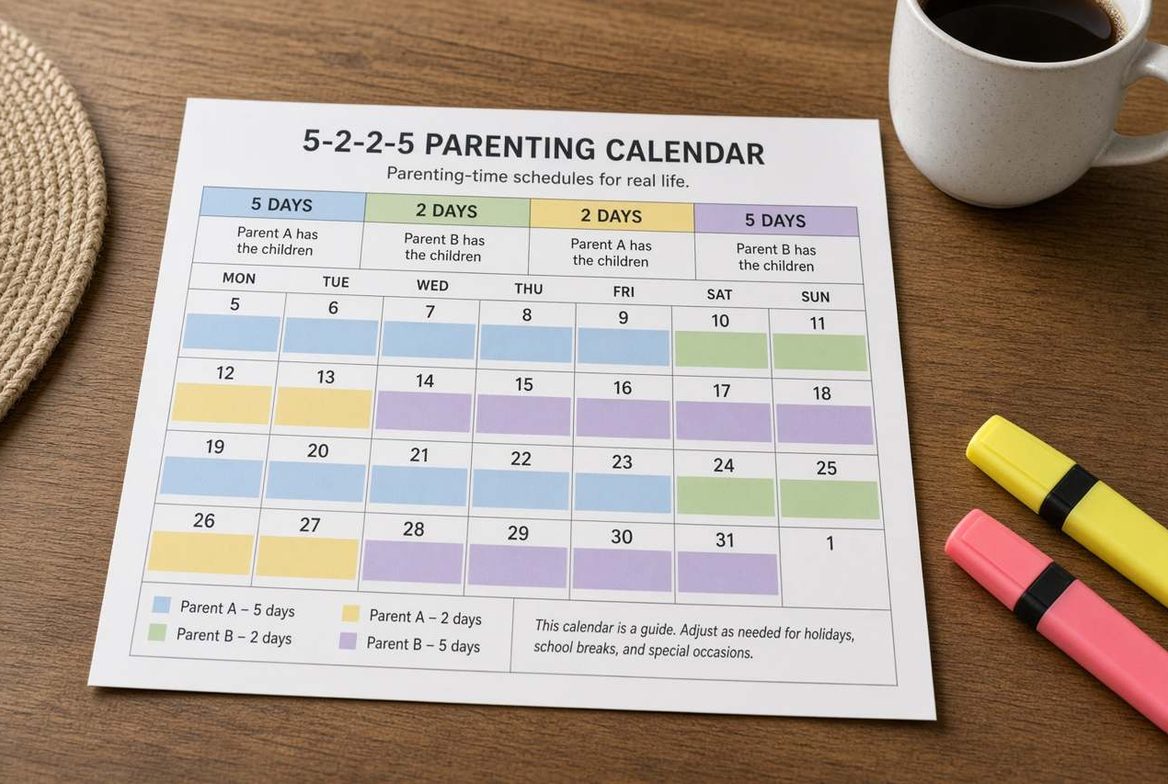
The court may make or modify an order granting or denying parenting time whenever the modification would serve the best interests of the child. That single sentence governs every change that leaves the majority-time parent in place: exchanges, holidays, a midweek overnight, summer blocks, a move from a 5-2-2-5 to a week-on, week-off, the right of first refusal, travel notice, and, after Dale, the number of overnights each parent has.
Decided on the months before the motion, not the hearing
What "best interests" means in a modification.
The same factors as the original order, asked about what has changed since it. No changed-circumstances threshold, no two-year wait, no affidavit screen, and, after Dale, any cut in overnights.
The statute lists the factors, and a modification is decided on the same list the original order was, with one difference: the court is looking at what has changed since the last order and whether the child is better served by a different schedule now. The factors are not weighted; the court weighs them. In a modification the ones that decide cases are the child’s adjustment to home, school and community, each parent’s past pattern of involvement since the last order, the practical proximity of the two homes, the child’s own reasoned wishes, and each parent’s ability to put the child’s needs first.
No changed-circumstances threshold. Unlike a majority-time change, a schedule modification does not require proof that circumstances changed since the decree. It requires proof that the new schedule serves the child. In practice the court still asks why now, and a motion with no answer to that question reads as a parent who wants a do-over of the permanent orders.
No two-year wait, no affidavit screen. Neither of the two-year bars applies to a schedule change that keeps the majority-time parent, and the adequate-cause affidavit statute is written for the majority-time and decision-making motions. A schedule motion is set for hearing in the ordinary course.
The Dale line, in plain terms. Before 2026 some judges treated a big cut in a parent’s overnights as a “restriction” and required proof of endangerment before ordering it. The Supreme Court ended that. The rule now: a change in how many overnights a parent has, however large, is decided on the child’s best interests. Endangerment is required only when the court is asked to change the kind of parenting time: to stop it, to require supervision, to bar overnights, or to limit where it can take place. In Dale a cut from 160 overnights to about 115 was a modification, not a restriction. The practical result: a parent whose time is being cut cannot defend by saying that no one claims they are dangerous. The case is decided on the record of what has actually served the child.
The factors, as the statute lists them.
Factor
What the court weighs
(I)
The wishes of the child’s parents
(II)
The wishes of the child, if the child is sufficiently mature to express reasoned and independent preferences as to the schedule
(III)
The child’s relationships with each parent, siblings and anyone else who significantly affects the child’s best interests
(III.5)
Any report of domestic violence from a child and family investigator, an evaluator or the child’s legal representative
(IV)
The child’s adjustment to home, school and community
(V)
The mental and physical health of everyone involved; a disability alone is not a basis to deny or restrict parenting time
(VI)
Each parent’s ability to encourage the sharing of love, affection and contact with the other parent, except where protecting the child
(VII)
Each parent’s past pattern of involvement with the child, reflecting values, time commitment and mutual support
(VIII)
The physical proximity of the parents’ homes as it relates to the practical considerations of parenting time
(XI)
Each parent’s ability to place the needs of the child ahead of his or her own
The best-interests factors as the statute numbers them; (IX) and (X) were repealed. Since May 2026 a finding of domestic violence, which now includes coercive control and economic abuse whether or not the conduct was a crime, must be made on the record by a preponderance of the evidence, and the court must then impose conditions on parenting time that ensure the safety of the child and the abused parent.
Where the child’s wishes are heard, when the court orders it
Three schedule motions I see most.
An older child, a parent whose life changed, or a plan the child has stopped living. All three are decided on best interests, and the third can become an integration case.
The child is older. A schedule built for a preschooler — short blocks, no long stretches away from either parent — is often wrong for a ten-year-old with activities and a twelve-year-old with opinions. Courts change these readily when the proposed plan is concrete and the child’s life since the decree supports it.
One parent’s life changed. A new job with travel, a shift schedule, a move across the metro that makes the midweek exchange a ninety-minute drive. The statute’s proximity factor is written for exactly this, and the answer is usually a re-shaped schedule with the same total time, not a reduction.
The schedule is not the one the child actually lives. The plan says 5-2-2-5; the reality is that the child has spent most school nights at one home for a year. Courts modify to the schedule the child lives, and, since 2026, every overnight moves the child support number, so the worksheet is filed with the motion. Where the drift went far enough to change the majority-time parent, the integration door below is the path.
After Dale, a cut in overnights is decided on the record of the ordinary days, not on the absence of danger.
Changing the majority-time parent: the four doors.
A modification that substantially changes parenting time and changes the party with whom the child resides a majority of the time is the motion the legislature made hard, on purpose. The court must find, on facts that arose since the prior decree or were unknown to the court at the time, that a change has occurred in the circumstances of the child or the majority-time parent and that the modification is necessary to serve the child’s best interests. And even with that showing, the statute tells the court to retain the existing schedule unless one of four things is true.
The door
What the statute says
What proves it
Authority
(a) Agreement
The parents agree to the modification.
A signed stipulation and a new plan; the court reviews it for the child’s best interests and enters it. No hearing in the usual case.
Best interests
(b) Integration with consent
The child has been integrated into the family of the moving parent with the consent of the other parent.
The child has settled into your home as though it were the primary home, and the other parent voluntarily placed the child there and let it happen. Consent need not be explicit, and a transfer labeled temporary can still be integration. The calendar, the school records and the messages that show who did what, for how long.
The majority-time parent is intending to relocate with the child to a residence that substantially changes the geographical ties between the child and the other parent.
Written notice with the reasons and a proposed plan; the nine relocation factors plus best interests; no presumption for or against the move; both parents share the burden. Its own page: Relocation & Move-Away.
Ciesluk, 113 P.3d 135 (Colo. 2005)
(d) Endangerment
The child’s present environment endangers the child’s physical health or significantly impairs the child’s emotional development, and the harm likely to be caused by a change of environment is outweighed by the advantage of a change to the child.
Evidence of the danger in the present home and evidence that moving the child does more good than harm: medical, school and treatment records, witnesses, an evaluator’s report. The hardest door and the most often over-claimed.
The child’s wishes do not open a door on their own; they are weighed inside the best-interests analysis once a door is open. A parent’s violations of the plan are evidence, not a door: the Court of Appeals reversed an order that flipped primary residence as a punishment for a parent’s attitude without the statute’s findings.
The affidavit is the case in miniature
The affidavit screen.
For a majority-time or decision-making motion the court must deny the motion on the affidavits unless they establish adequate cause. The affidavit is the case in miniature.
A motion to change the majority-time parent or decision-making must be filed with an affidavit setting forth facts supporting the requested modification. The other parent may file opposing affidavits. Then the statute gives the court an instruction most people have never heard of: it shall deny the motion unless it finds that adequate cause for hearing the motion is established by the affidavits.
That means the affidavit is the case in miniature. It is where cases are lost before a hearing is set: an affidavit that says the other parent is unstable, that the child is unhappy, that things have changed, establishes nothing. An affidavit that gives dates, names the school counselor, attaches the messages and states which door it is walking through establishes adequate cause. I write these the way I write a trial brief, because that is what the court reads them as.
The verification trap. The motion and affidavit must be sworn. An unverified motion has been held insufficient on its own. The state’s form (JDF 1406, with the affidavit built in) exists for a reason; a contested motion gets a drafted affidavit with exhibits, still sworn.
The affidavit is the case in miniature. Dates, names, sources, exhibits. No adjectives.
Restricting a parent’s time: endangerment, and the fourteen-day motion.
The court shall not restrict a parent’s parenting time rights unless it finds that the parenting time would endanger the child’s physical health or significantly impair the child’s emotional development, and the order must enumerate the specific factual findings supporting the restriction. After Dale a restriction means supervision, no overnights, limits on where or in what environment time happens, or no contact at all. Everything short of that is a modification on best interests.
Findings, enumerated, on the record
What endangerment looks like in the cases.
Not an accusation but an effect on the child, proved with evidence. Courts prefer the least restrictive order that protects the child.
Not an accusation; an effect on the child. In Parr & Lyman (2010) the Court of Appeals reversed a supervision order based on a parent’s medical-marijuana use, because supervision is a qualitative change in the nature of parenting time that implicates the endangerment standard and there was no evidence the use endangered the child. The lesson runs both ways. A parent seeking a restriction has to prove the link between the conduct and the child: the DUI with the child in the car, the untreated condition and what it did in the home, the injury, the disclosure to a teacher. A parent defending against one attacks the link.
What usually carries it. Substance abuse with evidence of impairment around the child; physical abuse or credible disclosures; domestic violence in the home, which since May 2026 the court must find on the record and act on; neglect the school or a doctor has documented; a household member who is a danger; a parent’s untreated mental illness with a demonstrated effect on the child. What usually does not: a messy house, a new partner the other parent dislikes, a different parenting philosophy, a single missed exchange.
Conditions rather than a stop. Restrictions come in degrees, and courts prefer the least restrictive order that protects the child: supervised exchanges, a sobriety-monitoring condition, no overnights while a treatment program runs, a step-up plan back to the ordinary schedule. A motion that asks for the least restrictive order that works is more likely to be granted than one that asks for everything.
The emergency motion, step by step.
Step
What happens
The rule
File
A motion to restrict parenting time that alleges the child is in imminent physical or emotional danger due to the parenting time, stated with particularity: facts, not conclusions. The Supreme Court has held that when the motion meets the civil rules’ particularity requirement, the court has no choice but to hold a hearing within fourteen days.
Any parenting time during the fourteen days after filing is supervised by an unrelated third party the court deems suitable or by a licensed mental health professional. This is automatic; the moving parent must allege, not prove, imminent danger to trigger it.
Thorburn, 2022 COA 80
The hearing
Heard and ruled on not later than fourteen days after filing. At the hearing the moving parent must prove endangerment under the ordinary restriction standard; the automatic supervision does not decide anything.
If the court finds the motion was substantially frivolous, substantially groundless or substantially vexatious, it shall require the moving party to pay the other party’s reasonable attorney fees and costs. Not may: shall.
Where a parent has been convicted of a listed offense or a crime with a domestic-violence finding, the other parent may file an objection; the convicted parent has twenty-one days to respond, parenting time is suspended if there is no response, a contested objection is heard within thirty-five days, and the convicted parent carries the burden of proving that parenting time is in the child’s best interests.
The fourteen-day motion is a serious tool and a dangerous one. Filed on real facts it protects a child within two weeks. Filed as a tactic it costs the filer the other side’s fees and, often, credibility with the judge who will decide everything else in the case. Supervised time itself has its own page: Supervised Parenting Time.
Filed on real facts, the fourteen-day motion protects a child within two weeks. Filed as a tactic, it costs you the other side’s fees, by statute.
Changing decision-making: its own statute, its own doors.
Decision-making — the authority over education, medical care, religion and the other major decisions — is allocated jointly or to one parent, by subject or as a whole, and it is modified under a separate section with a separate two-year rule. The test is the same changed-circumstances-and-necessity finding as a majority-time change, and the court retains the existing allocation unless one of five things is true.
The door
What the statute says
What it looks like
(a) Agreement
The parties agree to the modification.
A stipulation, usually paired with a schedule change.
(b) Integration
The child has been integrated into the family of the moving party with the consent of the other party and the situation warrants a modification.
The child now lives primarily with you, with the other parent’s consent, and the decisions have followed the child.
(b.5) A matching parenting-time change
A parenting-time modification under the parenting-time statute that warrants a modification of decision-making.
The schedule changed enough that joint decisions no longer make sense: a long-distance plan, or a majority-time change.
(b.7) Consistent consent
A party has consistently consented to the other party making individual decisions for the child which the party was to make individually or the parties were to make mutually.
One parent has chosen the doctors, the schools and the therapists for years while the other signed off or said nothing. The record of the decisions is the evidence.
(c) Endangerment
The retention of the allocation of decision-making responsibility would endanger the child’s physical health or significantly impair the child’s emotional development and the harm likely to be caused by a change of environment is outweighed by the advantage of a change.
A parent who refuses medical care the child needs, who cannot be reached for consent, or whose decisions have harmed the child. In Crouch (2021) the Court of Appeals held that a dispute over vaccination is decided under this endangerment standard, and that imposing a heavier burden on the objecting parent was error.
Since May 2026 a court that finds domestic violence may not order mutual decision-making over the objection of the abused parent unless it makes specific findings that mutual decision-making can occur without coercion, intimidation, retaliation or risk of harm.
The record of the decisions is the evidence
School choice, medical care, and the alternatives to a motion.
Most decision-making fights are about the school. A parenting coordinator or an agreed decision-maker resolves the individual decision faster than a motion, and enforcement cannot reallocate decision-making.
The school dispute. The most common decision-making fight in the Denver metro is where the child goes to school, usually after one parent moves within the metro. With joint decision-making neither parent may enroll the child over the other’s objection; the plan’s dispute-resolution clause runs first, then a motion. Courts decide the enrollment question on best interests and sometimes reallocate education decisions to one parent under door (b.7) or (c) when the record shows one parent has always handled it or the other cannot.
The parenting coordinator. The court may appoint a parenting coordinator, with or without consent when the parties have failed to adequately implement the plan and mediation has failed or is inappropriate, to help the parents resolve disputes themselves. The coordinator facilitates; the coordinator does not decide.
The decision-maker. With both parents’ written consent the court may appoint a decision-maker with binding authority to resolve disputes about implementing or clarifying the existing orders. A decision is reviewable de novo on a motion filed within thirty-five days. For parents who fight over every exchange time and every activity, this is faster and cheaper than a motion each time, and the Court of Appeals has held that the de novo review must be an evidentiary hearing.
What the enforcement statute cannot do. A parenting-time enforcement motion can produce make-up time, fines, fees and a hearing on modification, but it cannot itself reallocate decision-making; that goes back to the decision-making statute, whose endangerment standard the Court of Appeals has called more stringent.
The two-year clocks, compared.
Two different bars, and neither starts at the decree. The Court of Appeals held in F.A.G., 148 P.3d 375 (Colo. App. 2006) that the entry of permanent orders does not trigger the start of a two-year period.
Changing the majority-time parent
Changing decision-making
What starts the clock
A prior motion for a substantial modification of parenting time that also changes the majority-time parent, whether or not it was granted.
A prior motion to modify decision-making, whether or not it was granted.
The bar
No subsequent motion of that kind within two years after disposition of the prior motion.
No subsequent motion within two years after disposition of the prior motion.
Exceptions
On affidavits: the child’s present environment may endanger the child’s physical health or significantly impair emotional development; or the majority-time parent is intending to relocate in a way that substantially changes the geographical ties.
On affidavits: reason to believe that continuing the prior decree may endanger the child’s physical health or significantly impair emotional development. No relocation exception.
Does not apply to
A schedule change that keeps the majority-time parent, a restriction motion, a relocation motion, a stipulation.
A parenting-time motion of any kind, a stipulation.
The clocks run from the disposition of the earlier motion: a denial restarts them. A parent who lost a majority-time motion in March waits until the March after next, unless the affidavits show endangerment or a relocation.
Changing the plan by agreement: the stipulation.
Most modifications are agreed. The parents sign a new plan, the court reviews it for the child’s best interests, and it is entered without a hearing. The rules around it still matter.
Entered on the papers, in the usual case
How a stipulated change works.
Most modifications are agreed and entered on the papers. Until the court enters the stipulation, the old order controls, and the support worksheet goes with it.
The filing. A stipulation to modify parenting time (JDF 1423) or decision-making (JDF 1415), with the revised plan (JDF 1113) attached and, where the overnights changed, a child support worksheet. The court reviews the agreement for the child’s best interests; it enters most of them on the papers and sets a short hearing when something in the plan concerns it, usually a support figure below the guideline or a schedule that looks like one parent giving up.
Until it is entered, the old order controls. Parents who trade weekends by text for a year have not changed the plan; they have created a year of evidence about what the schedule actually is. That evidence cuts both ways in a later dispute, and support does not follow the informal schedule until someone files. Paper the agreement; it is a short filing.
What an agreement cannot do. It cannot bind the court on a later modification, cannot waive child support below what the guideline allows without findings, and cannot contract away the two-year bars or the affidavit screen for a future contested motion. It can, and should, name a dispute-resolution process — mediation, a parenting coordinator, an agreed decision-maker — so the next disagreement does not start with a motion.
The support worksheet goes with it. Since March 2026 every overnight moves the number, and a stipulated schedule change without a stipulated support change leaves one parent paying on a schedule that no longer exists. The two are filed together.
Evidence and evaluators: what the court will actually look at.
Custody modifications are decided on records more than on testimony. The parent who has kept them wins the close cases.
Every exchange on time: the record is the ordinary days
The record of the ordinary days.
Custody modifications are decided on records more than testimony: the calendar as lived, the messages, the school and medical records, the child’s own words to a professional.
A calendar of the schedule as it was actually lived, overnight by overnight, since the last order. The messages between the parents, unedited, written as if a judge will read them, because one will. School records: attendance, the parent-teacher conferences each parent attended, who is listed as the contact, who picks up. Medical records: who took the child, who consented, who paid. Activity schedules and who drove. A parent’s own work calendar for the same period. Photographs with dates. Where a child’s wishes matter, the child’s own words to a counselor or a teacher, not a recording made by a parent.
The child’s wishes. The court may interview the child in chambers, with a record made, and may permit counsel to be present. Whether to ask for the interview is a judgment call I make case by case: it can settle a close case, and it can put a child in the middle of one. More often the child’s wishes reach the court through an investigator or evaluator.
What weighs against you. Disparaging the other parent in front of the child or in writing; refusing exchanges; unilateral changes to school or medical care; moving the child without notice; a fourteen-day motion filed on thin facts. The ability to encourage the child’s relationship with the other parent is a statutory factor, and courts apply it hard.
The people the court appoints.
Appointment
Who
What it produces
Cost and timing
Child and family investigator (CFI)
An attorney, a mental health professional or another trained individual appointed by the court
An investigation and a report with recommendations, as specifically directed by the court’s order; interviews with parents, child and collaterals, home visits, records
Presumptive cap of $3,309 per appointment for a privately paid CFI, plus $500 for testimony, under Chief Justice Directive 04-08 as amended August 26, 2026, exceeded only on written findings of extraordinary circumstances; state-paid for indigent parties; report due per the order or at least thirty-five days before the hearing
Parental responsibilities evaluator (PRE)
A licensed mental health professional
A full evaluation, often with psychological testing, and a report with recommendations
No presumptive cap; typically many times a CFI’s cost and several months; used where mental health, substance use or abuse allegations are central
Child’s legal representative
An attorney for the child’s best interests
Advocacy for the child’s interests, including a position on the motion; may report domestic violence under factor (III.5)
Court-ordered; fees allocated between the parents
Parenting coordinator / decision-maker
A neutral appointed by the court; the decision-maker only by written consent
Dispute resolution between hearings; a decision-maker’s binding decision on implementing existing orders, reviewable de novo within thirty-five days
Two-year appointments; fees allocated between the parents
Metro judges commonly appoint a CFI in a contested majority-time or relocation case involving a school-age child. Ask for the appointment early: the report deadline drives the hearing date.
Notice within twelve days of the orders
Deployment: a separate act.
A deploying parent gets interim orders under the deployed-parents act, which ends thirty-five days after the parent’s return, and deployment alone can never decide best interests.
A parent who receives military deployment orders is covered by Colorado’s Uniform Deployed Parents Custody and Visitation Act, not by the ordinary modification statute. The deploying parent gives notice within twelve days of receiving orders; the court may enter an interim order for the deployment, including delegating part of the deploying parent’s time to a family member, on an expedited hearing if the motion is filed before the parent leaves; and the court may not enter a permanent order changing custodial responsibility without the deploying parent’s consent. The interim order terminates thirty-five days after the deploying parent gives notice of return. A parent’s past deployment or possible future deployment may not serve as the sole basis for deciding the child’s best interests. A proceeding to keep the interim arrangement after the return is an ordinary modification, on the standards above.
How the motion moves.
The same five steps as any post-decree motion, with the affidavit and the evaluator as the two that decide custody cases.
The five steps
01
Read the plan.
Which of the five motions fits the facts; whether a two-year clock is running and from when; whether the plan’s dispute-resolution clause requires mediation or a parenting coordinator first; whether the change moves child support. Half of the motions I am asked to file are answered here.
02
The affidavit and the motion.
The state’s forms exist for each motion: JDF 1406 to change or restrict parenting time (its section six is the fourteen-day request), JDF 1415 for decision-making, JDF 1423 for a stipulation, JDF 1113 for the plan itself. A contested case gets a drafted motion and a sworn affidavit with exhibits. The filing fee is about $105.
03
Service and the response.
The other parent has twenty-one days from service to respond, with opposing affidavits. For a majority-time or decision-making motion the court then screens the affidavits for adequate cause; a schedule motion is set in the ordinary course.
04
Mediation, the conference, the evaluator.
No statute requires mediation, but the metro districts require it before a contested post-decree hearing by case-management order, and a court cannot refer to mediation over a party’s claim of abuse. The status conference sets the CFI or PRE appointment, the report deadline and the hearing.
05
The hearing.
Half a day to two days: the parents, collateral witnesses, the evaluator, the records. The court makes findings on the standard that applies and enters a new plan. Fees can shift under the family-law fee statute, must shift against a frivolous emergency motion, and are awarded against a parent who withheld time without cause.
How long it takes.
Motion
In my experience
What stretches it
Stipulated schedule change
Weeks
A court that questions whether the plan serves the child; a support figure that needs a worksheet
Contested schedule change, no evaluator
Two to four months
Mediation scheduling; a court that appoints a CFI after all
Majority-time or decision-making change
Four to nine months
The adequate-cause screen; a CFI or PRE; the two-year bar
Restriction on the fourteen-day motion
Two weeks to the first ruling
The full hearing on endangerment may be set later; step-up plans and monitoring conditions
Relocation
Three to six months
Docket priority helps; a CFI report due thirty-five days before the hearing
Ranges from my own cases in the Denver metro courts; the case management order and the court’s calendar control the dates.
The co-parenting apps: OurFamilyWizard and TalkingParents.
Judges in the Denver-metro districts, parenting plans and decision-makers routinely require that all non-emergency communication between parents go through a co-parenting application, and they usually name one of these two or let the parents choose between them. Both do the same basic thing: every message is timestamped, marked when it is read, and cannot be edited or deleted, so the record of what was said, when, and by whom is kept by a third party neither parent controls. Here is what each does, what it costs, and how the record is used in court.
Documented messaging: timestamps record when each message was received and read; messages are stored unalterably.
ToneMeter and a writing assistant that flag hostile or emotional phrasing before a message is sent.
A shared parenting calendar with color-coded time, holiday scheduling and yes/no trade requests.
An expense ledger with receipts, stated splits (50/50, 80/20) and in-app payments; a running balance.
Documented in-app calls, an information bank for medical, school and insurance records, and a login history.
For court
Records are exported as certified reports. Free professional accounts let your lawyer, a child and family investigator or a parenting coordinator view the activity and download the records directly, which removes any argument about what was produced.
Cost
As of September 2026: a paid subscription for each parent, billed annually, about $110 a year for the basic plan; about $150 for the most-used plan, with 45 minutes of calls a month, the writing assistant, expense tracking and GPS check-ins; about $216 for unlimited calls, storage and certified records; about $300 with call recording and transcription. One parent may pay for both. Free or discounted subscriptions for parents in financial need, and a military rate.
Secure messaging with timestamps and read status; every message and call is permanently saved and cannot be edited or deleted.
Accountable Calling: calls placed through the app, documented, with minutes that scale by plan.
A shared calendar, an information library, and Accountable Payments for reimbursements between parents.
Vault storage for documents, photos and video; a personal journal that the other parent cannot see.
A sentiment scanner and writing assist on the top plan.
For court
Unlimited PDF records on every plan, and a printed, certified records package for a hearing, included on the top plan and available for a fee on the others. The records carry the timestamps and read status the court needs.
Cost
As of September 2026: a paid subscription (the free tier ended March 30, 2026), $7 a month for messaging, calendar, information library, 30 minutes of calls and unlimited PDF records; $16 for more calling and storage; $32 for unlimited calls, the sentiment scanner, priority support and one printed records package. Eight percent off when paid annually. Fee waivers for parents who qualify on financial-hardship or domestic-violence grounds.
How the record is used as evidence.
Get it into the order. A parenting plan or temporary order that requires the app is what makes going around it a violation. Without the clause, texts and voicemails continue and the record is fragmentary.
Write every message for the judge. They will read it. Short, factual, about the child, no adjectives. The tone tools exist because one heated paragraph outweighs a year of good ones.
Never go around it. A parent who texts, calls or emails outside the app after the order has undercut the record and given the other side an exhibit. Emergencies are the exception the plan defines.
Use the calendar and the ledger. An exchange requested and declined in the calendar, or a reimbursement posted with a receipt and never paid, is the exhibit in an enforcement or contempt motion. Screenshots of a text thread are not.
Export the record, do not photograph it. A certified or PDF record with timestamps and read status is produced by the app, not by a phone; the other parent’s own messages come in as statements of a party, and the app’s records address authentication.
Give the professionals access. A CFI or PRE who can read the app sees the whole pattern rather than the excerpts each parent chooses; so does a decision-maker. That transparency is itself persuasive.
How it gets into your order.
A parenting-plan clause, agreed or ordered, along these lines:
All non-emergency communication between the parents concerning the children shall occur through a co-parenting application (OurFamilyWizard or TalkingParents). Each parent shall maintain an active subscription, check the application at least once daily, and respond to a request within forty-eight hours. Emergencies concerning a child’s health or safety may be communicated by telephone and shall be confirmed in the application.
The clause also names who pays, what counts as an emergency, whether new partners may be given access, and that the record is admissible for enforcement and modification. In a high-conflict case I ask for it at temporary orders, so that the record exists for the permanent-orders hearing rather than beginning after it. Neither app makes anyone a better co-parent; both make the record of who was.
Features and prices are as stated on the companies’ own sites in September 2026 and change; confirm before subscribing. OurFamilyWizard and TalkingParents are trademarks of their owners, used here to identify the products. I have no relationship with either company and receive nothing from either.
What I tell every parent before a custody modification.
Six things, in the order they come up. Not legal advice for your case; the mistakes I have watched for thirty years.
Name the motion before you name the grievance.
Schedule, majority time, restriction, decision-making, relocation. Each has a different standard, and the wrong motion loses on the law before the facts are heard.
The affidavit is the case.
For a majority-time or decision-making change the court may deny the motion on the affidavits alone. Dates, names, sources, exhibits. No adjectives.
Do not confuse a cut with a restriction.
After Dale, a reduction in overnights is decided on best interests. Neither side should build its case around endangerment unless supervision, no overnights or a stop is what is actually being asked.
Never file the fourteen-day motion as a tactic.
It protects a child in real danger within two weeks. On thin facts it costs you the other side’s fees, by statute, and the judge’s trust for the rest of the case.
Keep living the plan while you fight it.
Withholding time, changing schools, moving the child: each one becomes the other side’s best evidence under the factor that asks whether you can put the child first.
Run the support worksheet with every schedule change.
Since March 2026 every overnight moves child support. A parenting motion that ignores the money is half a motion.
Six things people get wrong.
You have to wait two years after the divorce to modify custody.
The two-year bars run from a prior motion of the same kind, not from the decree, and a schedule change has no waiting period at all.
Cutting my time means she has to prove I'm dangerous.
Not since May 2026. A reduction in overnights is a best-interests modification; endangerment is for supervision, no overnights or a stop.
If my child is old enough to choose, the court will do what the child wants.
The child’s reasoned wishes are one factor among many; they do not open one of the four doors to a majority-time change on their own.
An emergency motion gets me sole custody fast.
It gets a hearing within fourteen days on whether the child is endangered, with supervised time in the meantime. If it was filed on thin facts, it gets a fee order against you.
Once we agreed by text, the schedule changed.
Until the court enters the stipulation, the old order is the one that is enforced. A parenting plan changes on paper filed with the court, not on a phone.
A deployment is grounds to change custody.
Deployment is handled by interim orders under its own act, and the act says deployment cannot be the sole basis for a best-interests decision.
What to bring, and what to settle first.
Before the first meeting
Bring the record.
The decree, the parenting plan and every later order, including stipulations
A calendar of the schedule as it was actually lived since the last order, overnight by overnight
Messages between you and the other parent since the last order, unedited
School records: attendance, contacts, conferences, enrollment
Medical and counseling records for the child, and who took the child to each appointment
Your own work schedule, and any change to it
Any police, protection-order or treatment records if a restriction is at issue
The current child support worksheet
Before you file
Six things settled first.
Which of the five motions fits the facts, and the standard that goes with it
Whether a two-year clock is running, and from what date
Whether the plan requires mediation, a parenting coordinator or a decision-maker first
Whether you will ask for a CFI or a PRE, and who pays
What the new plan is, in overnights, holidays and decision-making, on paper
What the child support number becomes under the new schedule
Custody is modified on the record of the ordinary days. The parent who kept it usually wins the close case.
The other parent is not following the schedule? That is enforcement, not modification.
Colorado has a statute built for withheld parenting time: a verified motion under C.R.S. § 14-10-129.5, decided on the papers within thirty-five days, with make-up time of the same kind and length as the time lost, attorney fees the court must award against the parent who withheld or failed to exercise the time, and contempt as one remedy among several. Make-up time, not jail, is usually the point. A single withheld weekend supports make-up time and fees under this statute even where it would not support contempt.
The custody modification questions that fill my inbox.
Do I have to wait two years after the decree to modify custody?
No. The two-year bars run from a prior motion, not from the decree, and the Court of Appeals has said so directly. A motion to change the parent the child lives with most of the time cannot be filed within two years of a prior motion of that kind; a motion to change decision-making cannot be filed within two years of a prior decision-making motion. Both open if affidavits show the child may be endangered, and the majority-time bar also opens for a relocation. An ordinary schedule change has no waiting period at all.
My ex wants to cut me from equal time to alternate weekends. Does she have to prove I'm dangerous?
Not since May 2026. The Colorado Supreme Court held in In re Marriage of Dale that a reduction in the number of overnights, however large, is a modification decided on the child’s best interests. Endangerment is required only to restrict parenting time in kind: supervision, no overnights, limits on where it happens, or stopping it. That makes the record of the ordinary days, not the absence of danger, the case you have to win.
Can the judge deny my motion without hearing any evidence?
For a motion to change the majority-time parent or decision-making, yes. The statute requires an affidavit with the motion and tells the court to deny the motion unless the affidavits establish adequate cause for a hearing. The affidavit is the case in miniature: specific facts, dates and sources, not conclusions.
Our daughter has lived with me for most of a year with my ex's agreement. Can I become the primary parent?
That is the integration door. If the child has been integrated into your family with the other parent’s consent, the court may change the majority-time parent without any finding of endangerment. Consent need not be explicit; voluntarily placing the child with you and letting the arrangement settle in is enough, even if it was called temporary. Document when it started and what the other parent said and did.
What happens in the fourteen days after an emergency motion?
If the motion alleges, with particularity, that the child is in imminent physical or emotional danger from the other parent’s parenting time, the court must hear and rule on it within fourteen days, and any parenting time in the meantime is supervised by an unrelated third party or a licensed mental health professional. At the hearing the moving parent must prove endangerment. If the court finds the motion was substantially frivolous, groundless or vexatious, it must order the filer to pay the other side’s fees.
Can the judge order supervised visits because of my drinking or marijuana use?
Only on a finding, supported by evidence, that your parenting time endangers the child’s physical health or significantly impairs the child’s emotional development. The Court of Appeals reversed a supervision order based on a parent’s medical-marijuana use where there was no evidence the use affected the child. Use with evidence of effect on the child is a different case.
My teenager refuses to go to the other parent's house. Can I be held in contempt?
A parent must make reasonable, good-faith efforts to make the schedule happen; a teenager’s refusal is not a defense on its own, and it is not a modification either. The child’s wishes are a factor the court weighs more heavily with maturity, and the court may interview the child in chambers with a record made. The disciplined path is a motion to modify the schedule, filed with the evidence of why the child refuses, not an empty driveway.
My ex blocks every school and medical decision. How do I get sole decision-making?
Through the decision-making statute’s own doors: agreement, integration, a parenting-time change that warrants it, the other parent’s consistent consent to you deciding alone, or endangerment from keeping the current allocation. A record of the blocked decisions, the deadlines missed and the effect on the child is the evidence. For disputes short of a change, a parenting coordinator or an agreed decision-maker resolves the individual decision faster than a motion.
Can I use my ex's violations of the parenting plan to become the primary parent?
Not as a shortcut. The parenting-time enforcement statute lets the court order make-up time, fines, fees and, where appropriate, a hearing on modification, but a change of the majority-time parent still requires the modification statute’s findings, and the Court of Appeals has reversed orders that flipped residence to punish a parent’s attitude. The violations are evidence; the motion is still a modification.
What does a custody modification cost, and can I recover fees?
A stipulated change is a short filing. A contested schedule change is two to four months and a half-day hearing; a contested majority-time or decision-making change with an evaluator runs four to nine months. The court can shift fees under the family-law fee statute where the incomes differ, must shift them against a frivolous emergency motion, and awards them against a parent who violated the schedule without cause. I quote the consultation fee when we schedule and explain the retainer before you sign anything.
The schedule your child lives is the evidence. Let’s make the record before we file.
A consultation is a working session, in person in Greenwood Village or by video: we read the parenting plan together, I tell you which motion fits your facts and which standard the court will apply, and what I would file. Your note reaches my office directly; during business hours we call you back within the hour, run the conflicts check, and set the meeting.
One call. A real person picks up, hears you out, and tells you how we would handle what you are facing and what to do first. No phone tree, no sales pitch, no obligation. Your first conversation is with our intake paralegal, who will get you to Aaron fast.