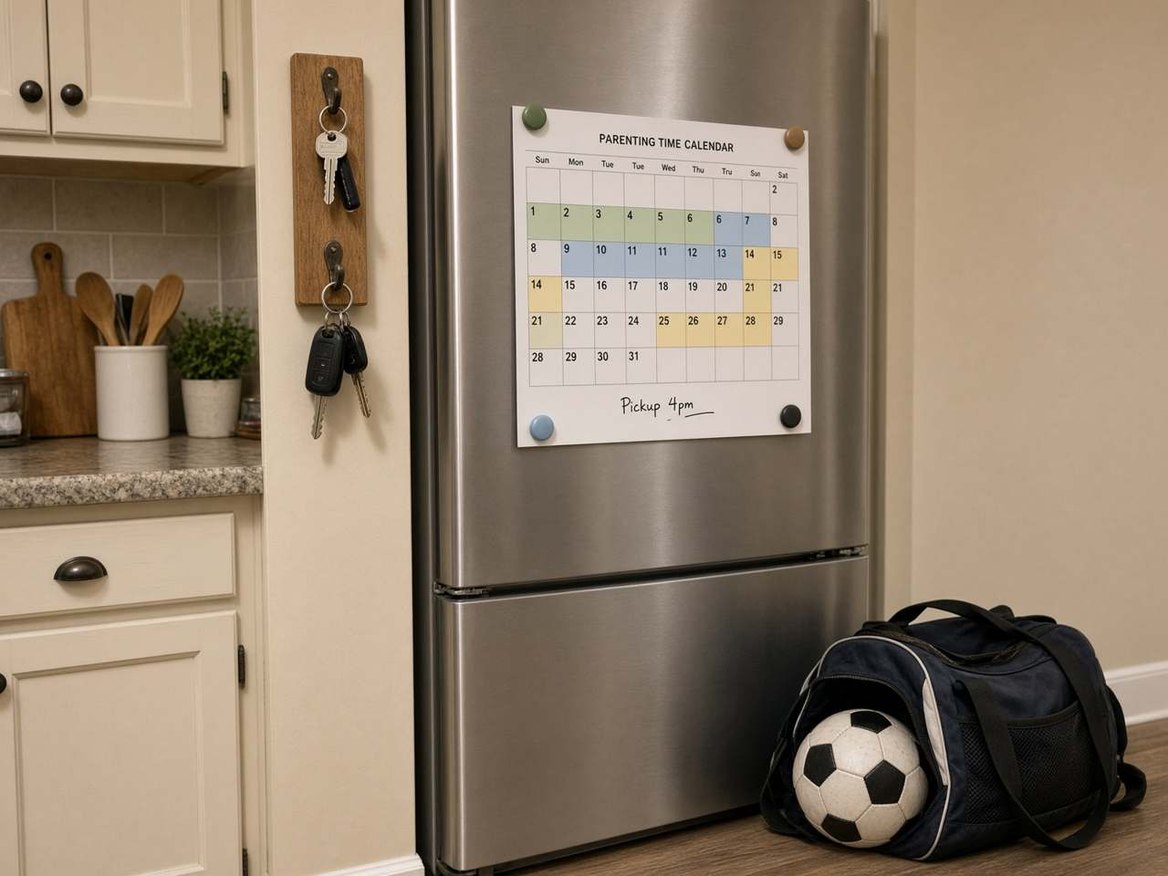
Parenting-time calculator: from schedule to overnights.
Tick one of the common Colorado schedules, or enter your own, add holidays and summer, and get each parent’s overnights a year, the percentage, and the 2026 child support credit those nights earn. The strip under each schedule shows the two-week cycle night by night.
- 01The calculator
- 02The common schedules
- 03How to count
- 04What the nights are worth
- 05Methodology and updates
- →Questions
Talk to us about your case.
303-507-5529One call. A real person picks up, hears you out, and tells you how we would handle what you are facing and what to do first. No phone tree, no sales pitch, no obligation. Your first conversation is with our intake paralegal, who will get you to Aaron fast.
Rather write? Send a short note and during business hours we call you back within the hour.
Updated September 21, 2026Law current through March 1, 2026Reviewed by Aaron Herzberg, Colorado attorney
The common schedules
Colorado parenting plans are built from a handful of rotations. The numbers assume the rotation runs all year; holidays and summer move them.
| Schedule | Nights in a 14-day cycle | Overnights a year | Notes |
|---|---|---|---|
| Alternating weeks | 7 of 14 | 182.5 | Fewest exchanges; a week is long for young children |
| 2-2-3 | 7 of 14 | 182.5 | No more than three nights apart; weekdays alternate each week |
| 2-2-5-5 | 7 of 14 | 182.5 | Fixed weeknights; five-night blocks around the weekends |
| 3-4-4-3 | 7 of 14 | 182.5 | Fixed split of the week; the long half alternates |
| Every other weekend, Fri–Sun | 2 of 14 | 52 | The traditional minimum schedule |
| Every other weekend, Fri–Mon | 3 of 14 | 78 | Adds Sunday night and a Monday school drop-off |
| Every other weekend plus a midweek overnight | 4 of 14 | 104 | A weeknight every week keeps the routine |
| Every other long weekend plus Wednesday | 5 of 14 | 130 | A common step toward equal time |
| Every weekend, Fri–Sun | 4 of 14 | 104 | One parent has every school night |
| Every other Thursday to Monday | 4 of 14 | 104 | Four-night blocks, fewer exchanges |
The counts are the ones the child support calculator uses: whole numbers, except the exact half for equal time.
Choosing among the equal-time rotations
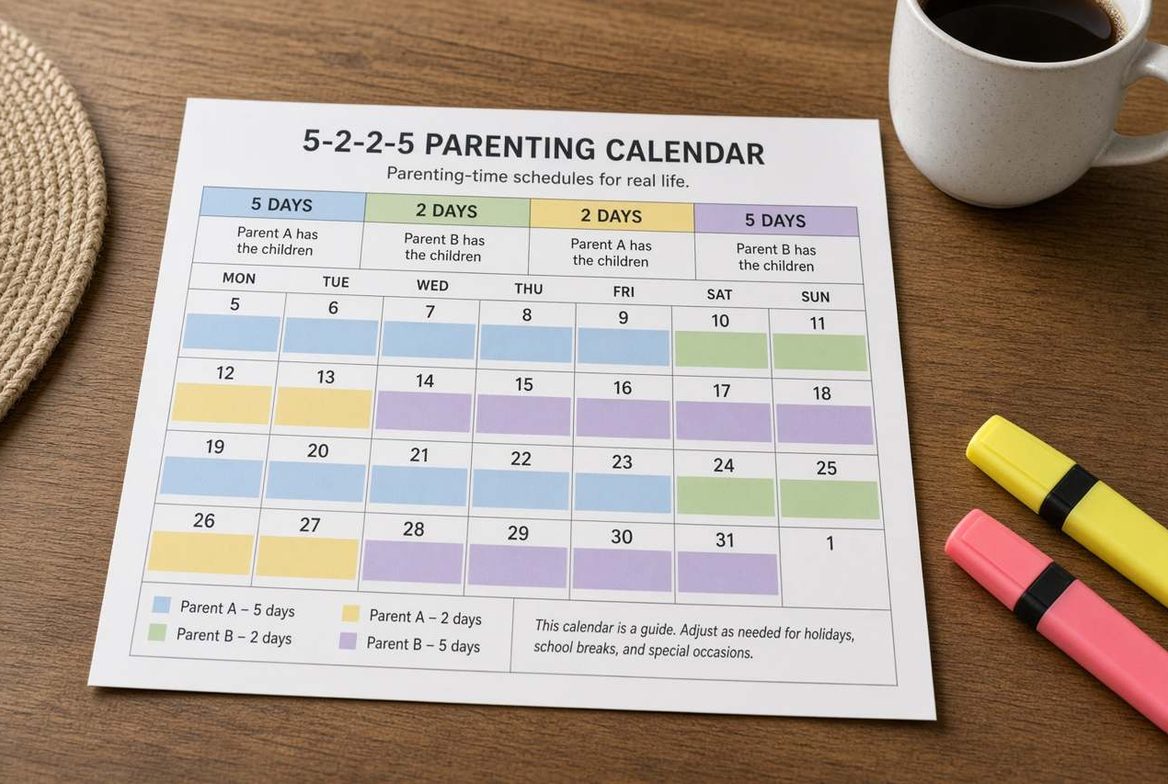
All four equal-time schedules produce 182.5 overnights; they differ in how long a child goes without seeing each parent and how many exchanges happen. Alternating weeks has two exchanges a fortnight and seven-day gaps; 2-2-3 has six exchanges and three-day gaps; 2-2-5-5 has four and five-day gaps, with the same weeknights every week. The parenting time by age page covers what the research says about each stage, and the schedules page walks through the exchange logistics.
How to count
Where the child sleeps. A day that ends with a return before bedtime is not an overnight, however long it was. The court can deviate for a parent who has substantially more daytime than the count reflects.
Most rotations repeat every 14 days. Count that parent’s nights in the cycle, divide by 14 and multiply by 365. Every other weekend Friday to Sunday: 2 ÷ 14 × 365 = 52.1, rounded to 52.
Alternating holidays usually net close to zero. Summer blocks and long breaks for the parent with less time do not; add them as net nights in step two.
Where the children are on different schedules, the worksheet uses the average overnights. The calculator accepts a fractional custom count for that reason.
What the nights are worth
The parenting-time table turns the count into a credit on the child support worksheet. The credit is a share of the combined basic obligation.
| Overnights | Credit | Overnights | Credit |
|---|---|---|---|
| 0 | 0.00% | 146 | 32.32% |
| 26 | 2.12% | 156 | 36.93% |
| 52 | 5.27% | 165 | 41.26% |
| 78 | 9.90% | 183 | 50.25% |
| 92 | 13.19% | 200 | 58.74% |
| 104 | 16.54% | 219 | 67.68% |
| 117 | 20.75% | 240 | 76.35% |
| 130 | 25.58% | 260 | 83.16% |
| 140 | 29.70% | 313 | 94.73% |
Selected rows from C.R.S. 14-10-115(8)(h). The table is symmetric around 182.5 overnights (50%).
Before 2026, the 93rd overnight was the most litigated night in Colorado. Now it is worth 0.26 points more than the 92nd, which is about what it should be.
Questions about counting parenting time
How are overnights counted for Colorado child support?
By where the child sleeps. The statute defines shared physical care by the number of overnights each parent has in a year, and the 2026 parenting-time table converts that number into a credit percentage (C.R.S. 14-10-115(3)(h), (8)(h)). Count the regular rotation over its cycle, multiply out to a year, then add or subtract holidays, breaks and summer blocks that depart from the rotation. Where the children have different schedules the worksheet uses the average.
How many overnights is every other weekend?
Friday and Saturday nights every other week is 52 a year; adding Sunday night with a Monday morning school drop-off makes it 78. Adding a midweek overnight every week to the Friday-to-Sunday pattern gives 104; every other long weekend Friday to Monday plus a Wednesday every week gives 130. Holidays and summer blocks are on top of those figures and usually add 10 to 40 nights for the parent with less time.
What is 182.5 overnights?
Half of 365. Equal-time schedules such as alternating weeks, 2-2-3, 2-2-5-5 and 3-4-4-3 give each parent 182.5 overnights on average, and the parenting-time table has a row for exactly that number: a 50% credit each. Plans that describe equal time usually count it that way rather than arguing over which parent gets the odd night in a leap year.
What is the 2-2-5-5 schedule?
Each parent has the same two weeknights every week, Monday-Tuesday with one and Wednesday-Thursday with the other, and the weekends alternate, Friday through Sunday. The result is two-night and five-night blocks: five nights when a parent’s fixed weeknights run into that parent’s weekend. It is popular with school-age children because the weeknights never change.
What is 2-2-3?
Two nights with one parent, two with the other, then three with the first; the next week the pattern flips. Each parent has the children every other weekend and no one goes more than three nights without seeing them, which suits younger children. It requires more exchanges than 2-2-5-5 and the weekdays alternate each week.
Does the credit change child support much?
Yes, and gradually. Since March 1, 2026 every overnight earns a credit, so there is no longer a cliff at 93 nights. At 52 overnights the credit is 5.27% of the basic obligation; at 104 it is 16.54%; at 130 it is 25.58%; at equal time it is 50%. The child support calculator on this site applies the table and shows the result; the link on the results panel carries your overnights straight into it.
Do holidays count?
Every night counts, wherever it falls. Most plans allocate holidays and school breaks separately from the regular rotation and alternate them by year, which often nets to roughly even. Where it does not, for example summer blocks for a parent with a school-year schedule, add the net nights in step two. Count nights, not days: a holiday spent from morning to evening with a return before bedtime is not an overnight.
Can the court deviate from the overnight count?
Yes. The guideline factors listed for deviation include a parent who spends substantially more time with the child than the overnight count reflects, and extraordinary costs of parenting time, such as long-distance travel (C.R.S. 14-10-115(8)(e)). A parent with the children every day after school but few overnights can ask for a deviation; the court must make findings if it grants one.
What if the parents live far apart?
Long-distance plans usually give the away parent blocks of time: several weeks in summer, alternating major holidays, and sometimes long weekends during the school year. Tick the school-year-and-summer option and enter the summer weeks, holiday nights and any regular weekend pattern. The relocation page covers how those plans are decided.
Where do I find the common schedules explained?
The parenting-time schedules page walks through each rotation, its exchange points and the ages it tends to suit, and the parenting-time-by-age page summarises the research. The parenting plan page covers the clauses that make a schedule work: exchanges, holidays, right of first refusal, travel and communication.
From the blog.
In a hard-fought Colorado custody case the judge can appoint an attorney whose only client is the child's best interests. What a CLR does, how it differs from a…
Sept 18, 2026The SLAT Trap: When the Estate Plan Meets the DivorceSpousal Lifetime Access Trusts move wealth out of the taxable estate, with the marriage as the access mechanism. In a divorce, the donor loses the access,…
Sept 17, 2026Can You File for Divorce in Another State If You Live in Colorado?Where a divorce can be filed, where the money can be decided, and where the children's case belongs are three different questions. Colorado's 91-day domicile…
The schedule is for the children. The count is for the worksheet.
A consultation is a working session, in person in Greenwood Village or by video: bring the pay stubs, the returns and the parenting plan, and we run the numbers the way a judge will see them. Your note reaches my office directly; during business hours we call you back within the hour, run the conflicts check, and set the meeting.
Talk to us about your case.
303-507-5529One call. A real person picks up, hears you out, and tells you how we would handle what you are facing and what to do first. No phone tree, no sales pitch, no obligation. Your first conversation is with our intake paralegal, who will get you to Aaron fast.
Rather write? Send a short note and during business hours we call you back within the hour.