365
Overnights to allocate
JDF 1113 asks for each parent’s count, and since March 2026 every overnight moves child support.
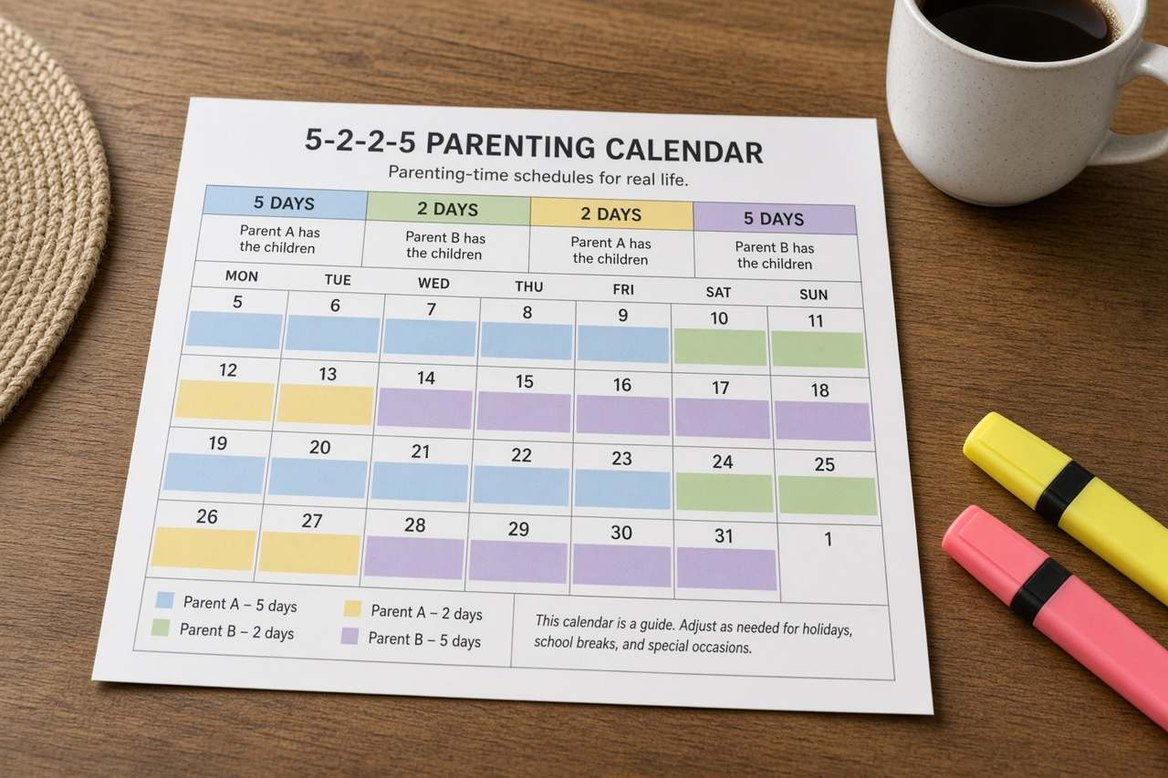
The state form, JDF 1113, is ten pages of boxes: a schedule, a holiday table and a few rules. The hard weeks are decided by what it leaves out. Here is the plan clause by clause: the overnight arithmetic, holidays and religious calendars, and the terms that settle most disputes before they start, from first refusal to passports, tie-breakers and taxes.
Talk to us about your case.
303-507-5529One call. A real person picks up, hears you out, and tells you how we would handle what you are facing and what to do first. No phone tree, no sales pitch, no obligation. Your first conversation is with our intake paralegal, who will get you to Aaron fast.
Rather write? Send a short note and during business hours we call you back within the hour.
A parenting plan is two documents: a calendar, and the rules for every week the calendar did not anticipate.
Colorado does not require a particular plan. The statute says the parents “may submit” one; if they do not, or the court does not approve theirs, the court writes one (C.R.S. § 14-10-124(7)). When parenting time is contested, the plan “must be as specific as possible to clearly address the needs of the family as well as the current and future needs of the aging child.” It may cover decision-making, “a practical schedule of parenting time for the child, including holidays and school vacations,” exchanges, communication, and “any other orders in the best interests of the child.”
The Judicial Branch’s form, JDF 1113 (revised December 18, 2025), covers the basics. It is silent on most of what produces motions: a right of first refusal, what non-disparagement means, the child’s phone, passports, a tie-breaker, most holidays outside the Christian calendar. Its tax paragraph does not match the statute as rewritten in 2025. I draft from the form and add the clauses below, stated as of September 2026. For the patterns themselves, see Parenting-Time Schedules; for what suits a child’s age, Parenting Time by Age.

JDF 1113 asks for each parent’s count, and since March 2026 every overnight moves child support.
Every other weekend plus a weekly midweek overnight is 104 overnights a year, 28.5 percent. Count before you agree.
Plus three blank lines. The table takes priority over the regular schedule unless a holiday is left blank.
For a child’s passport under sixteen, both parents sign, absent notarized consent, sole custody or an order authorizing one.
Colorado counts parenting time in overnights out of 365. The count decides the majority-time parent, the child support credit and, for taxes, the custodial parent. The patterns are drawn and compared on Parenting-Time Schedules; here is the arithmetic.
| Schedule | The pattern | Overnights a year | Share | 2026 credit |
|---|---|---|---|---|
| Alternating weeks (7-7) | A week each, same exchange day | 182.5 each | 50% | 50% each |
| 2-2-3 | Two nights, two, then three; flips weekly | 182.5 each | 50% | 50% each |
| 2-2-5-5 (= 5-2-2-5) | Fixed weekday pairs; weekends alternate | 182.5 each | 50% | 50% each |
| 3-4-4-3 | Three nights, then four; swaps weekly | 182.5 each | 50% | 50% each |
| 4-3; alternate Thu–Mon plus every Wed | Six of every fourteen nights | 156 / 209 | 43% (“60/40”) | 36.93% / 63.07% |
| Alternate Fri–Mon a.m. plus every Wed | Five of fourteen | 130 / 235 | 36% | 25.58% / 74.42% |
| Alternate Fri–Sun plus every Wed; every weekend Fri–Sun; alternate Thu–Mon a.m. | Four of fourteen | 104 / 261 | 28.5% (“70/30”) | 16.54% / 83.46% |
| Alternate Fri–Mon a.m.; or Fri–Sun plus an off-week Wed | Three of fourteen | 78 / 287 | 21% (“80/20”) | 9.90% / 90.10% |
| Alternate Fri–Sun, midweek dinner only | Two of fourteen | 52 / 313 | 14% | 5.27% / 94.73% |
| Long distance (Indiana’s model, age 5+) | Seven summer weeks, seven days of winter break, all of spring break | About 65 / 300 | 18% | 7.36% / 92.64% |
| Nesting | The children stay; the parents rotate in and out | As the rotation used | — | — |
Averages over a fourteen-night rotation; a calendar year gives one parent an extra night (two in a leap year). Credit is the percentage the 2026 parenting-time table assigns to each parent’s overnights (C.R.S. § 14-10-115(8)(h)), applied to the combined basic obligation. No fourteen-day rotation produces 60/40 or 70/30; write nights, not percentages.
2-2-5-5 and 5-2-2-5 are the same rotation from different starting days; 2-2-3 is not, because its weekdays rotate. Every other weekend plus a weekly midweek overnight is 104 overnights, not 156. Equal time is 182 or 183: plans alternate the extra night by year, and in 2028, a leap year, each parent can have 183. Nesting is counted by the rotation used; I know of no outcome research specific to it. Run any proposal through the Colorado parenting-time calculator before anyone signs; the rest of the worksheet is on Child Support.
JDF 1113’s holiday section opens with its rule: “This schedule will take priority over Sections 10 and 11 unless a holiday is left blank” (the school-year and summer schedules). For each holiday the parents enter “Even Years,” “Odd Years” or “All Years.”
| On the form | What it lists | What most plans add |
|---|---|---|
| a) School breaks and cultural holidays | Spring Break; Mother’s Day; Father’s Day; Halloween; Thanksgiving Break; Winter Break Week 1; Winter Break Week 2; Children’s Birthdays | Fall break; each parent’s birthday |
| b) State holidays | Memorial Day Weekend; Independence Day; Labor Day Weekend | New Year’s Day; Martin Luther King Jr. Day; Presidents’ Day; Juneteenth; Cabrini Day; Veterans Day |
| c) Religious and other holidays | Easter; Christmas Eve; Christmas Day; three blank lines | Every other religious holiday the family keeps |
| d)–e) Other arrangements; rules | Free text; “talk to a mediator or file papers with the court” | Start and end times, the lost-weekend rule, holiday travel, make-up time |
The state’s legal holidays are listed in C.R.S. § 24-11-101(1), but whether the children are off is the school’s decision; define breaks by the calendar of the school the child attends.
The day or the weekend is split between the parents, and the split need not be equal.
The children are with one parent on a holiday in even years and with the other parent in odd years.
The children always spend a particular holiday with one parent, in exchange for another: Christmas for one, Passover for the other.
With Friday-to-Monday weekends in a 2-2-5-5 plan, most Monday holidays take care of themselves.

Define each holiday by the hour it starts and ends, and say what happens to the regular weekend it displaces.
Winter break. The form’s default is week one and week two, alternating by year. Many Colorado plans split at noon on December 25 or on December 26, so each parent has Christmas Eve or Christmas morning in alternate years; Indiana gives the parent without Christmas “Noon to 9:00 P.M. on Christmas Day.” Mind the weekdays: December 24 and 25 fall Thursday–Friday in 2026, Friday–Saturday in 2027, Sunday–Monday in 2028.
Thanksgiving, breaks, summer. Indiana runs Thanksgiving from 6 p.m. Wednesday to 6 p.m. Sunday, alternating; others split Thursday. Spring and fall breaks usually alternate by year. Summer blocks need a notice deadline: a common clause gives one parent first choice by April 1 in even years and the other by April 15, reversing in odd years.
Days that belong to one parent. Most plans put the children with the mother every Mother’s Day and with the father every Father’s Day; two mothers or two fathers name the days or split one. Each parent’s birthday goes to that parent; the child’s alternates or is shared. Halloween is usually an evening (6 to 9 p.m. in Indiana). Say whether Monday holidays attach to the weekend.
The lost weekend. A holiday that lands on the other parent’s weekend takes it, and JDF 1113 says nothing about what follows. Indiana does: “If a parent misses a regular weekend because it is the other parent’s holiday, it will be lost. If a parent receives two consecutive weekends because of a holiday, that parent shall have the third weekend also. Regular alternating weekends shall continue throughout the year.” Decide whether displaced time is lost or made up, and that the rotation never resets.
Easter moves, and Orthodox Easter often falls on a different Sunday: April 5 and April 12 in 2026; March 28 and May 2 in 2027; both April 16 in 2028. Say which Easter the plan means.
Jewish holidays follow the lunisolar Hebrew calendar: the same Hebrew date each year, while the Gregorian date drifts, usually about eleven days earlier from one year to the next and later again when a leap month is added. Rosh Hashanah began September 12 in 2026, begins October 2 in 2027, and returns to September 21 in 2028. Each begins at sundown the evening before, so a plan that says only “Rosh Hashanah” invites a dispute over the first evening. Define holidays by name with times (4 p.m. the day before until 7 p.m. the last day, say), name the controlling calendar, and say one seder or two.
| Begins at sundown on | 2026 | 2027 | 2028 |
|---|---|---|---|
| Rosh Hashanah | Fri., Sept. 11 | Fri., Oct. 1 | Wed., Sept. 20 |
| Yom Kippur (Kol Nidre) | Sun., Sept. 20 | Sun., Oct. 10 | Fri., Sept. 29 |
| Passover, first seder | Wed., Apr. 1 (through Apr. 9) | Wed., Apr. 21 (through Apr. 29) | Mon., Apr. 10 (through Apr. 18) |
| Hanukkah, first candle | Fri., Dec. 4 | Fri., Dec. 24 | Tue., Dec. 12 |
Evening dates from the Hebcal calendar (Diaspora schedule), checked September 2026. Collisions: Passover 2026 spans Easter (April 5); Passover 2028 spans both Easters (April 16); Hanukkah 2027 begins on Christmas Eve.
Common splits. Rosh Hashanah to one parent and Yom Kippur to the other, alternating; one seder each; Hanukkah’s nights divided four and four, or the regular schedule plus one designated night. Indiana’s model divides the holidays a family keeps “over a two-year period in as equal a manner as possible.” Eid al-Fitr, Eid al-Adha, Lunar New Year and Diwali drift too; define them by name, with the calendar or authority that fixes the date.
A right of first refusal requires a parent who cannot personally care for the child during his or her time to offer that time to the other parent before calling a sitter. Colorado has no statute on it, whatever some national websites say; it is exactly what the plan says.
A model. Indiana’s guideline is the clearest published version: before using anyone but a parent or a responsible household family member, the parent needing child care “shall first offer the other parent the opportunity for additional parenting time,” if practical; “The other parent is under no obligation to provide the child care,” and any care given “shall be done at no cost and without affecting child support.” Its commentary leaves the trigger to the parents.
The Colorado case. In 2007 the Court of Appeals read a first-refusal clause in light of the plan as a whole, and upheld an order letting a father deployed overseas leave the children with their stepmother instead of first offering the time to their mother (In re Marriage of DePalma, 176 P.3d 829 (Colo. App. 2007)). Deployment now has its own act (C.R.S. § 14-13.7-101 et seq.); the drafting lesson is to say who counts as “the parent.”
| Trigger | Suits | Watch for |
|---|---|---|
| Four hours | Young children; cooperative parents living minutes apart | Every errand becomes an exchange |
| Eight to twelve hours | Long workdays and evening shifts | Whether regular shifts count |
| An overnight | The most common trigger in plans I see | Sleepovers and camps; exclude them |
| Twenty-four to forty-eight hours | Travel-heavy jobs; high conflict | Few offers arise, which may be the point |
No rule sets any number of hours; these are drafting conventions.
These three clauses govern most of what parents actually do to each other between hearings. Each is enforceable only if it is specific.
Indiana’s model: “Parents shall at all times avoid speaking negatively about each other in or near the presence of the child, and they shall firmly discourage such conduct by relatives or friends,” and “A child shall never be used by one parent to spy or report on the other.” Agreed clauses like that are routine. A court-ordered limit on a parent’s speech is different. In In re Marriage of Teruel De Torres, 2025 COA 96, a dispute over what the parents could call their child in public, the Court of Appeals held that such a restriction must meet the “demanding” standard of In re Marriage of Newell, 192 P.3d 529 (Colo. App. 2008): harm to the child that is “substantial” and “demonstrated in detail,” and narrow tailoring that considers whether the speech is uttered in front of the child, whether it substantially harms the child rather than third parties, and whether the order is so vague that a parent could be held in contempt without notice. The division did not decide whether non-disparagement orders generally are constitutional.
Enforcement. Contempt, for “disobedience or resistance” to a lawful order (C.R.C.P. 107(a)(1)); a parenting-time motion, where the court may enter “any other order that may promote the best interests of the child” (C.R.S. § 14-10-129.5(2)(h)); and, most often, evidence under the factor that asks whether each parent supports the child’s relationship with the other (C.R.S. § 14-10-124(1.5)(a)(VI)).
The statute expects a plan to say how each parent reaches the child during the other’s time (C.R.S. § 14-10-124(7)(d)–(e)). JDF 1113 offers “reasonable phone contact with the children during the children’s normal waking hours,” which works until it does not. Name a window (7 to 7:30 each evening, say) and bar interference and listening in. Indiana’s commentary adds: “A parent may restrict access from a telephone, tablet, or other device used to communicate with the other parent as punishment for a child, but such punishment shall not prevent communications with the other parent.” For a child’s phone: who owns and pays for it, that it travels with the child, which controls and location sharing both parents accept, and that neither uses it to monitor the other home. Between parents, metro judges routinely require a co-parenting app.
The plan should set the exchange procedure, “including the location of the exchanges and the party or parties responsible for the child’s transportation” (C.R.S. § 14-10-124(7)(c)). The best exchange is one the parents never attend: one drops the child at school, the other picks up. Otherwise, a named place, a time, a grace period, the receiving parent staying in the car, no late-night handoffs, and, where needed, a third party for parents who cannot be civil to each other at the door. A police-station lobby or a supervised exchange center works where the parents need a witness; after a domestic-violence finding the court may require exchanges “in a protected setting” (C.R.S. § 14-10-124(1.6)(a)(II)). Transportation between homes, including an accompanying parent for a child under twelve, is divided in proportion to income by agreement or order (C.R.S. § 14-10-115(11)(a)(II)).
Before the decree, the automatic injunction bars either parent from removing the children from Colorado without the other’s consent or a court order (C.R.S. § 14-10-107(4)(b)(I)(C)). After it, the plan governs.

Notice, an itinerary, a way to reach the child, and the documents: four things every travel clause needs.
JDF 1113’s travel box is one sentence: “The Parties agree to tell each other about plans for overnight and out-of-state travel with the children and to provide contact information.” A working clause adds a notice period (fourteen days domestic, thirty international, are common), an itinerary with flight numbers and times, hotels, where the child will be staying and telephone numbers, calls during the trip, who holds the passports, and, abroad, “a notarized consent to travel form.”
Passports. For a child under sixteen, federal rules require that “both parents or each of the minor’s legal guardians, if any,” sign the application, for a first passport or a renewal (22 C.F.R. § 51.28(a)(2)). One parent may apply alone with the other’s notarized consent, or with an order “specifically authorizing the applying parent or legal guardian to obtain a passport for the minor” (§ 51.28(a)(3)(ii)(D)). An order for joint legal custody, or one requiring both parents’ permission for important decisions, is read as requiring both (§ 51.28(a)(3)(ii)(F)). If one parent should be able to renew alone, the plan must say so in those terms. Non-Hague countries and safeguards: Interstate & International Custody.
The statute sets the notice for a move that changes the child’s ties to the other parent: “The party who is intending to relocate with the child to a residence that substantially changes the geographical ties between the child and the other party shall provide the other party with written notice as soon as practicable of his or her intent to relocate, the location where the party intends to reside, the reason for the relocation, and a proposed revised parenting time plan. A court hearing on any modification of parenting time due to an intent to relocate shall be given a priority on the court’s docket” (C.R.S. § 14-10-129(1)(a)(II)). JDF 1113 paraphrases it more broadly: the parties “must file a new parenting plan and get the court’s permission to move a significant distance.” A plan can add a fixed notice period (sixty or ninety days) and a trigger, such as a set distance or a change of school. The standards for the move: Relocation & Move-Away.
Decision-making is allocated jointly, to one parent, or issue by issue (C.R.S. § 14-10-124(1.5)(b)), and the parent with decision-making responsibility “may determine the child’s upbringing, including his or her education, health care, and religious training” (C.R.S. § 14-10-130(1)).
The categories. JDF 1113 lists school and education; medical, dental and mental health; religious activities; extracurricular and recreational activities; the passport; and two blank lines. It also has the box that causes more trouble than any other: “For School attendance, children’s residence is with.” Families with teenagers should add counseling, a driver’s license, jobs and elective procedures. Either parent may get emergency medical care without violating the order (C.R.S. § 14-10-124(6)), and after a domestic-violence finding mutual decision-making over the abused parent’s objection needs specific findings (C.R.S. § 14-10-124(1.5)(c)). How the court allocates it: Parental Responsibilities.
Tie-breakers. Joint decision-making with no tie-breaker sends every disagreement to court. The Court of Appeals has held that a trial court may break a deadlock between joint decision-makers, and that the parent named for school-residence purposes does not get a tie-breaking vote from that designation (In re Marriage of Thomas, 2021 COA 123). Better by agreement: final say on a subject to one parent after good-faith consultation, or a named decision-maker. The Court of Appeals has also said that a parent without religious decision-making may still share his or her own faith with the child unless substantial harm is shown in detail (In re Marriage of McSoud, 131 P.3d 1208 (Colo. App. 2006)), and it has applied the endangerment standard to a dispute over vaccination (In re Marriage of Crouch, 2021 COA 3).
| Process | What it does | The rule |
|---|---|---|
| Mediation | A neutral helps the parents agree; nothing is imposed. | The court may order it (C.R.S. § 14-10-124(8)), but not where a party claims abuse by the other and is unwilling to mediate, “at any time and regardless of prior participation” (C.R.S. § 13-22-311(1)). |
| Parenting coordinator | A neutral who helps the parents carry out the plan and resolve disputes. A coordinator facilitates; binding decisions belong to a decision-maker. | Without agreement, only on findings that the parents have failed to implement the plan and that mediation failed or is inappropriate; terms of two years at most (C.R.S. § 14-10-128.1). |
| Decision-maker | A neutral with binding authority to resolve disputes about implementing or clarifying existing orders, including parenting time and specific decisions. | Only with both parents’ written consent. Decisions are written, signed and effective at once; a de novo hearing must be sought within thirty-five days, and a parent who asks and loses substantially pays the fees unless that is manifestly unjust (C.R.S. § 14-10-128.3). |
| Arbitration | An arbitrator decides the disputes the parents submit. | With all parties’ consent; written awards, effective at once, with a de novo hearing on a motion within thirty-five days (C.R.S. § 14-10-128.5). |
Joint decision-making without a tie-breaker is a standing appointment with the court.
Small clauses, large arguments. Each is optional under the statute and routine in a plan that works.
| Clause | What to write | Law and models |
|---|---|---|
| The child’s belongings | Clothing, medication, school materials and sports gear travel with the child and come back; nothing is withheld as leverage; duplicate basics in each home. | Indiana: send “an appropriate and adequate supply of clean clothing,” returned clean. |
| New partners | A mutual waiting period before a new partner meets the children; no discipline by a new partner; any limit on overnight guests tied to the children’s welfare, and mutual. | “The court shall not consider conduct of a party that does not affect that party’s relationship to the child” (C.R.S. § 14-10-124(2)). |
| Alcohol, drugs, testing | The test (remote breath device, urine, hair), how often, who pays, what a missed test means, the consequence of a positive, and a date the term ends. | After a domestic-violence finding the court may bar use “during parenting time or for twenty-four hours prior” (C.R.S. § 14-10-124(1.6)(a)(V)). A ban on using medical marijuana while parenting was held a modification, not a restriction (In re Marriage of Parr & Lyman, 240 P.3d 509 (Colo. App. 2010)); whether imposed testing is a restriction under Dale (2026) is open. |
| School and medical records | Each parent gets records directly; both are listed as contacts with the school and every provider; report cards go to both. | Access “shall not be denied to any party allocated parental responsibilities, unless otherwise ordered by the court for good cause shown” (C.R.S. § 14-10-123.8). Under FERPA a school gives either parent full rights unless it has an order that “specifically revokes these rights” (34 C.F.R. § 99.4). |
| Activities | Consent for activities that fall in the other parent’s time, who drives, how costs are split (by income or a set percentage), and a yearly cap. | Indiana’s commentary: parenting time “should not be used as an excuse to deny the child’s participation in school related activities.” JDF 1113 makes activities a decision category. |
JDF 1113 tells parents without an agreement to “follow Colorado law, which is based on your contributions to the children.” The statute, as rewritten effective May 31, 2025, does not say that. The court “may allocate an income tax dependency exemption and the resulting tax benefit for a child and require the party who has the child in the party’s physical custody for more than fifty percent of the calendar year to provide the other party a properly executed declaration” releasing the claim, with findings if the allocation is contested (C.R.S. § 14-10-115(12)(a)). It weighs the parents’ resources, the effect on each parent’s ability to provide for the child, whether either would actually benefit, and premium tax credits; “The filing status as head of household is not impacted by this designation” (C.R.S. § 14-10-115(12)(b)). It may condition the claim on paying ordered support for that year (C.R.S. § 14-10-115(12)(c)), and a parent wrongly denied the benefit may recover it on a motion within three years (C.R.S. § 14-10-115(12)(d)).
The federal rules. The IRS custodial parent is the one with whom the child sleeps “the greater number of nights during the calendar year”; with equal nights, “the parent with the higher adjusted gross income” (26 C.F.R. § 1.152-4(d)(1), (4)). The release, on Form 8332 or its equivalent, “must be an unconditional release,” and it is not unconditional if it requires the other parent to meet “an obligation such as the payment of support” (§ 1.152-4(e)(1)(i)); a substitute must be a document executed for that sole purpose (§ 1.152-4(e)(1)(ii)). So the plan puts the support condition on the duty to deliver a signed form each year, never in the form, and the plan itself is not the release. Per the IRS’s Publication 504, the release moves the child tax credit and the credit for other dependents, not the earned income or dependent-care credits.
Support does not end when the paying parent dies: “When a parent obligated to pay support dies, the amount of support may be modified, revoked, or commuted to a lump-sum payment, to the extent just and appropriate in the circumstances” (C.R.S. § 14-10-122(3)). Insurance makes that real, and Colorado courts have approved orders requiring it. The clause names the amount (often declining as the children age), the beneficiary (usually a trust or custodian), annual proof, and what happens on a lapse; the maintenance statute’s factors for insurance orders are a sensible checklist (C.R.S. § 14-10-114(6)(b)).
A schedule can be modified whenever that “would serve the best interests of the child” (C.R.S. § 14-10-129(1)(a)(I)); changing the majority-time parent or decision-making takes more, with two-year limits that run from a prior motion, not the decree (C.R.S. § 14-10-129(1.5); C.R.S. § 14-10-131(1)). The better tool is the step-up the researchers recommend, “forecast in advance” so the plan grows “without the need to return to family court” (McIntosh, Pruett & Kelly, 2014, Family Court Review). Tie each step to a date, an age or a milestone, and have the court find at entry that the sequence serves the child; a future change entered without that finding is open to attack. For what no one can forecast, add a review trigger (kindergarten, age twelve, high school) that sends the parents to mediation. See Parenting Time by Age and Modifying Custody.
For denied time the court may order make-up time “of the same type and duration of parenting time as that which was denied,” within six months (a year if it cannot be made up sooner), “at the time and in the manner chosen by the aggrieved parent if it is in the best interests of the child” (C.R.S. § 14-10-129.5(2)(d)), a fine of up to $100 per incident (C.R.S. § 14-10-129.5(2)(e.5)), and, mandatorily, fees against a parent who failed to provide or exercise court-ordered time (C.R.S. § 14-10-129.5(4)). A plan can set its own procedure for time lost to illness or a delayed flight, and should say, as Indiana does, that make-up time “is not an opportunity to deny the other parent of scheduled holidays or special days.” More: Enforcement & Contempt.
Six things. Not legal advice for your case; the gaps I have watched turn into motions for thirty years.

Sixty-forty and seventy-thirty are labels. The plan, the support worksheet and the IRS all count overnights.
Start and end times, which Easter, one seder or two, and what happens to the weekend a holiday displaces.
First refusal, travel notice, the child’s phone, make-up time. The regular week is the easy part.
Joint decision-making without one sends every school and medical disagreement to court.
A clause that reaches what the child sees and hears is enforceable. One that reaches everything invites a fight over the clause itself.
Condition the duty to sign Form 8332 on support; never write a condition into the release.
Colorado requires JDF 1113.
Parents may submit a plan, and the court writes one if they do not. The form is a convenience.
Every other weekend plus a midweek overnight is 60/40.
It is 104 overnights, about 28.5 percent. Reaching 156 takes six nights in every fourteen.
2-2-5-5 and 2-2-3 are the same schedule.
2-2-5-5 fixes the weekdays; 2-2-3 rotates them every week. It is 2-2-5-5 and 5-2-2-5 that are the same.
Colorado law gives a right of first refusal.
No statute does. It exists only if the plan creates it, on the terms the plan sets.
The parent with more than half the nights always claims the child.
The court can allocate the exemption and order a release, conditioning the duty to sign it.
A non-disparagement order can bar anything a parent says.
A court-ordered speech restriction must be narrowly tailored to substantial harm to the child, shown in detail.
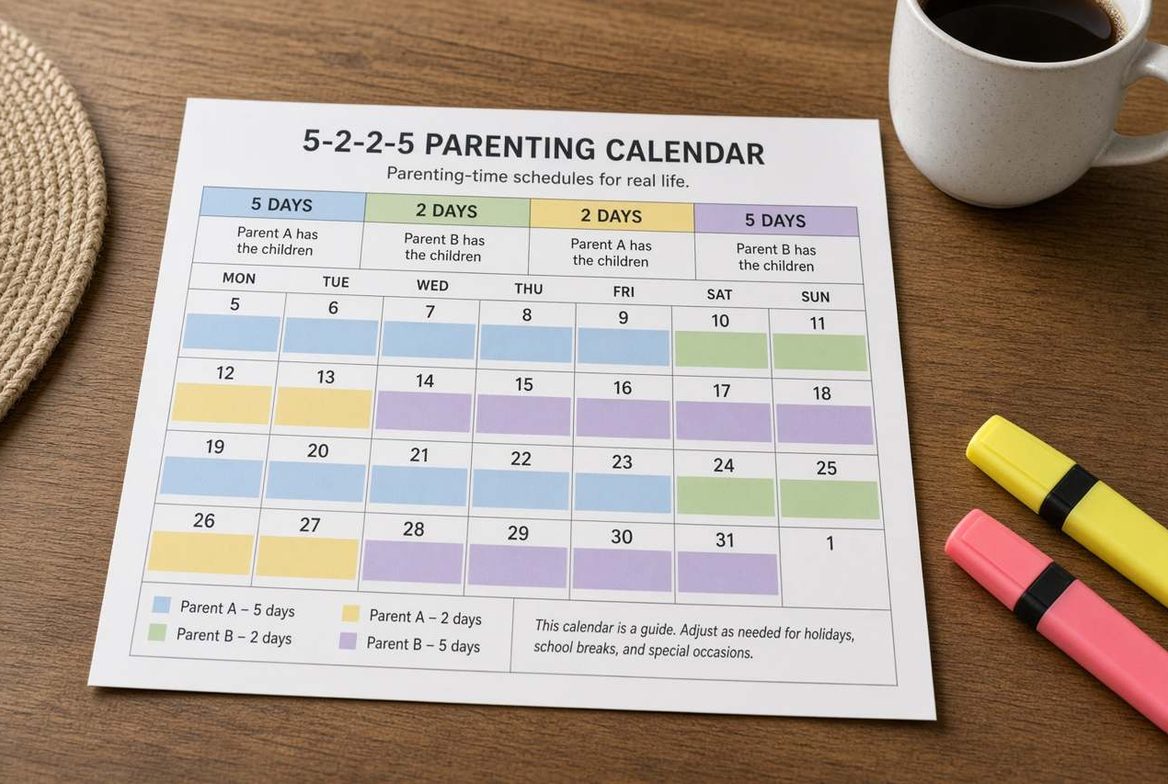
The schedule is the easy part. The plan is the exceptions, written down before anyone needs them.
Start with a confidential conversation: send me the plan you have →
Colorado has a statute built for withheld parenting time: a verified motion under C.R.S. § 14-10-129.5, decided on the papers within thirty-five days, with make-up time of the same kind and length as the time lost, attorney fees the court must award against the parent who withheld or failed to exercise the time, and contempt as one remedy among several. Make-up time, not jail, is usually the point. A single withheld weekend supports make-up time and fees under this statute even where it would not support contempt.
The parenting-time enforcement motion →Enforcement of Orders →Contempt of Court →
No. Colorado’s statute says the parents may submit a parenting plan, and if they do not, or the court does not approve theirs, the court writes one. JDF 1113 is the Judicial Branch’s form, last revised in December 2025, and it covers the basics: decision-making, the school-year and summer schedules, a holiday table, travel, phone contact and support. Many families need more: a right of first refusal, holidays defined by the hour, passport authority, a tie-breaker. Those can be attached to the form or drafted as a full plan.
Yes. They are the same fourteen-day rotation described from different starting days: each parent has the same two weekday nights every week and the weekends alternate, so the longest stretch away from either parent is five nights. It is not the same as 2-2-3, where the weekday nights rotate every week and the longest stretch is three nights. All three give each parent 182 or 183 overnights a year.
No fourteen-day rotation produces exactly seventy-thirty. What people usually mean is four overnights in every fourteen, which is about 104 a year, or 28.5 percent: for example, every other weekend Friday to Sunday plus a midweek overnight every week. Sixty-forty usually means six nights in fourteen, about 156 a year, and eighty-twenty means three in fourteen, about 78. Write the plan in nights, because the child support credit and the tax rules count nights.
Whoever the plan says, and the plan should say it by the hour. The state form divides winter break into week one and week two, alternating by year. Many Colorado plans instead split the break at noon on December 25 or on December 26, so each parent has Christmas Eve or Christmas morning in alternate years; some give the other parent a few hours on Christmas Day. Say whether the holiday displaces the regular weekend, and whether displaced time is lost or made up.
It is on the state form, JDF 1113, among the school breaks and cultural holidays, so parents can allocate it by even and odd years or give it to one parent every year. If they leave it blank, the regular schedule applies. Plans that include it usually give a few evening hours for trick-or-treating rather than the whole day, and say where the exchange happens. The children’s birthdays are on the form too.
No. Colorado has no statute on the right of first refusal; it exists only if the parenting plan creates it, and only on the terms the plan sets. A good clause names the trigger (four hours, an overnight, twenty-four hours), who counts as a parent for the clause, what is excluded, how the offer is made and answered, and who drives. The Court of Appeals has read such a clause in light of the plan as a whole rather than word by word.
As long as the plan does, unless the plan ends it sooner. Many plans narrow it or end it once the children are old enough to stay home alone. The trigger matters more than the term: a four-hour trigger suits young children and parents who live close together; an overnight or twenty-four-hour trigger suits parents with demanding jobs or a high level of conflict, where every offer is another contact.
A specific one, yes: by contempt or a parenting-time enforcement motion, and violations are evidence against the violating parent in any later custody dispute. A court-ordered restriction on a parent’s speech has limits. In 2025 the Court of Appeals required harm to the child that is substantial and demonstrated in detail, and a restriction narrowly tailored by asking whether the speech happens in front of the child and whether the order is clear enough to follow. Clauses tied to what the child sees and hears hold up best.
For a child under sixteen, only in limited cases. Federal rules require both parents to sign the application, for a first passport or a renewal, unless the other parent gives notarized consent, or the applying parent has sole legal custody without travel limits or a court order specifically authorizing that parent to obtain the passport. An order for joint decision-making is read as requiring both parents. If one parent should be able to apply alone, the plan or a separate order must say so in those terms.
For federal purposes the custodial parent is the one with more overnights in the calendar year; with exactly equal nights, it is the parent with the higher adjusted gross income. An equal plan gives one parent 183 nights in a 365-day year, so plans usually alternate that night, or the claim, by year. Colorado courts can allocate the exemption and order the custodial parent to sign a release, but the release itself must be unconditional; a condition such as being current on support belongs in the order to sign it.
Yes. Child support does not end automatically when the paying parent dies; the court can modify it or commute it to a lump sum. Life insurance makes that obligation real. The clause names the amount, often declining as the children get older, the beneficiary or trustee, proof of coverage each year, and what happens if the policy lapses. Parents can agree to it, and Colorado courts have approved orders requiring it.
Only within limits. The court may not consider conduct that does not affect a parent’s relationship with the child, so broad morality clauses are hard to justify. What works is a mutual term: neither parent introduces a new partner until the relationship has lasted a stated time, and no new partner disciplines the children. A limit on overnight guests should be tied to the children’s welfare and apply to both parents.
The next page in this chapter, the pages that belong with it, and the blog posts on the same question.
In a hard-fought Colorado custody case the judge can appoint an attorney whose only client is the child's best interests. What a CLR does, how it differs from a…
Sept 18, 2026The SLAT Trap: When the Estate Plan Meets the DivorceSpousal Lifetime Access Trusts move wealth out of the taxable estate, with the marriage as the access mechanism. In a divorce, the donor loses the access,…
Sept 17, 2026Can You File for Divorce in Another State If You Live in Colorado?Where a divorce can be filed, where the money can be decided, and where the children's case belongs are three different questions. Colorado's 91-day domicile…
A consultation is a working session, in person in Greenwood Village or by video: we read your draft plan, or the one you have, clause by clause, and I tell you what is missing, what will not hold up, and what I would write instead. Your note reaches my office directly; during business hours we call you back within the hour, run the conflicts check, and set the meeting.
Talk to us about your case.
303-507-5529One call. A real person picks up, hears you out, and tells you how we would handle what you are facing and what to do first. No phone tree, no sales pitch, no obligation. Your first conversation is with our intake paralegal, who will get you to Aaron fast.
Rather write? Send a short note and during business hours we call you back within the hour.