$2,200
Child tax credit per child, 2026
Refundable up to $1,700. A signed Form 8332 moves it to the other parent; head-of-household status never moves.

A divorce moves money without taxing it, which is why the tax decides who got the better deal. December 31 fixes the filing status, nights decide the children’s credits, § 1041 hands every built-in gain to the spouse who takes the asset, and a QDRO is the only penalty-free exit from a 401(k) before 59½. The federal and Colorado rules for 2026, worked in numbers.
Talk to us about your case.
303-507-5529One call. A real person picks up, hears you out, and tells you how we would handle what you are facing and what to do first. No phone tree, no sales pitch, no obligation. Your first conversation is with our intake paralegal, who will get you to Aaron fast.
Rather write? Send a short note and during business hours we call you back within the hour.
Almost nothing in a divorce is taxed on the day it is signed. That is why the tax decides who got the better deal.
Transfers between spouses are tax-free. Maintenance under a post-2018 decree is neither deducted nor reported. A QDRO moves retirement money without a tax bill. Nobody pays at signing. The tax arrives later, on the sale of the stock, the withdrawal from the 401(k), the sale of the house after the exclusion has lapsed, and it lands on whoever took the asset. The divorce year adds rules of its own: the filing status fixed on December 31, the children’s credits handed out by nights, and the joint return that leaves both spouses liable for all of it.
I hold an LL.M. in Taxation from Georgetown, I have cross-examined dozens of forensic accountants, and I have built, run and sold companies. The Tax Strategy page is the short version, how I price a settlement; this is the long one. Updated September 2026 for tax year 2026, after the July 2025 federal law (Public Law 119-21) made the individual rates permanent and rewrote the child credits, and after Colorado began limiting deductions at $300,000 of income. The examples are illustrations with stated assumptions; your CPA runs your numbers.

Refundable up to $1,700. A signed Form 8332 moves it to the other parent; head-of-household status never moves.
Incident to the divorce, under § 1041. The basis carries over, and every dollar of built-in gain goes with it.
A $300,000 401(k) withdrawn at once in 2026 by a single Colorado filer earning $120,000 nets $193,571. The same $300,000 in cash is $300,000.
To elect relief from a joint return under § 6015(b) or (c), counted from the IRS’s first collection activity against you.
Marital status is fixed at the close of the taxable year, and a person legally separated under a decree of divorce or of separate maintenance is not considered married (§ 7703(a)). A decree entered on December 30 makes both spouses unmarried for the whole year; one entered on January 2 leaves them married for the year before.
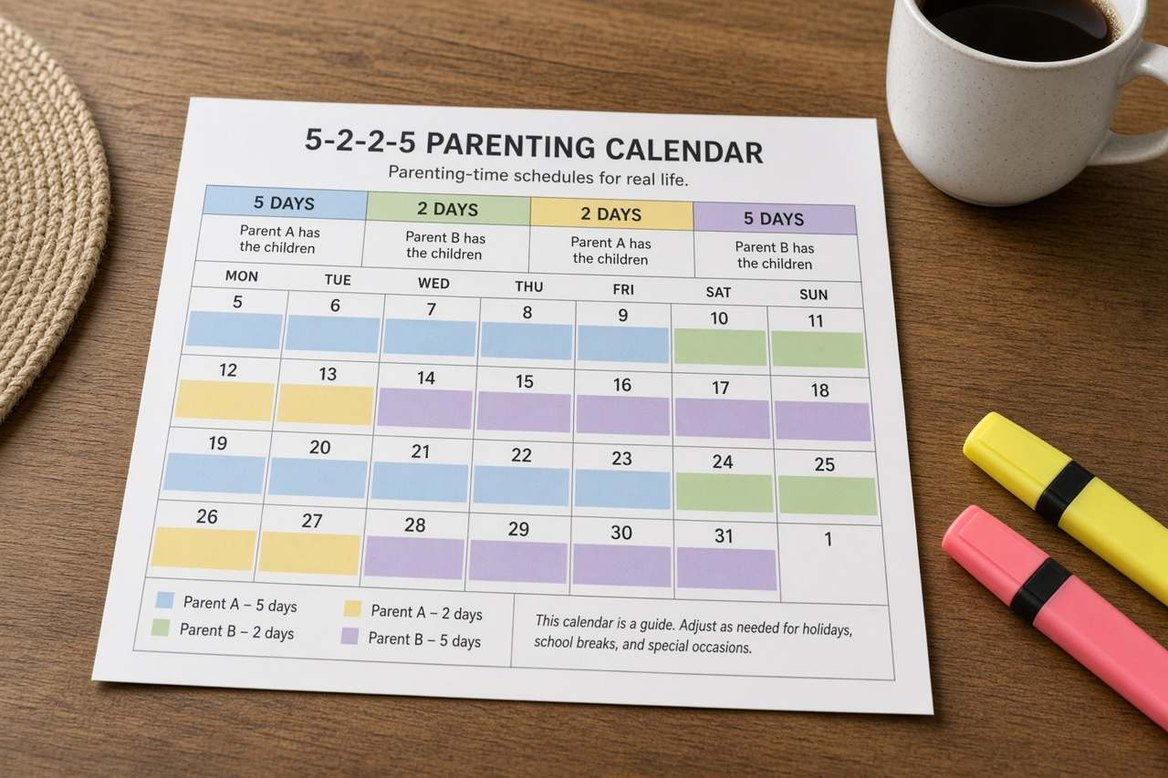
Married on December 31 means joint or separate returns, unless a parent is “considered unmarried” and files as head of household.
Joint. Usually the lowest combined tax, and the most dangerous signature in the case: the liability is joint and several (§ 6013(d)(3)), and Colorado holds both spouses liable for the full amount even if a later decree says otherwise. The Colorado return must match the federal choice.
Separate. Higher rates for most couples, half the AMT exemption, generally no child-care credit unless the spouses lived apart, no earned income credit unless the separated-spouse rule applies, and no standard deduction if the other spouse itemizes. For 2026, also no $6,000 senior deduction, a $20,200 state-and-local-tax cap instead of $40,400, and no premium tax credit, with exceptions for abuse and abandonment.
Considered unmarried. A married parent may file as head of household only if every element is met (§ 7703(b)): a separate return; a home that for more than half the year was the principal home of a child the parent can claim (or could, but for a signed release); more than half the cost of that home paid by the parent; and the other spouse absent for the entire last six months of the year. A spouse who moves out in July misses it for that year.
Head of household, and split nights. The status needs an unmarried (or considered unmarried) parent paying more than half the cost of a home that was a qualifying child’s principal home for more than half the year (§ 2(b)), and a Form 8332 cannot move it. With one child, the parent with more nights qualifies; on exactly equal nights the parent with the higher adjusted gross income is treated as custodial. With two or more, each parent can qualify through a different child. Nights actually spent control, not labels.
| Two children; Parent A earns $95,000, Parent B $55,000 | Parent A | Parent B | Total federal tax |
|---|---|---|---|
| Married filing jointly (taxable income $117,800; tax $15,340 less $4,400 of child tax credit) | — | — | $10,940 |
| Divorced, or considered unmarried: each files as head of household with one child | $6,288 | $1,148 | $7,436 |
| A files as head of household with both children; B files single | $4,088 | $4,420 | $8,508 |
| Still married and living together: separate returns, one child each | $9,870 | $2,220 | $12,090, with no child-care credit and no earned income credit |
2026 federal tax after the child tax credit; wages only, standard deduction. Parent A alone owes $12,070 as single against $8,488 as head of household: the status is worth $3,582. Illustrations, not a return.
The date on the decree is a tax decision. Make it on purpose.
The code hands out the children’s tax benefits by nights. The custodial parent is the one with whom the child resides for the greater number of nights in the year; on equal nights, the parent with the higher adjusted gross income (Treas. Reg. § 1.152-4(d)). The other parent claims the child only with a signed release.
Only the custodial parent’s signed, unconditional release, usually Form 8332, moves the child to the other parent’s return.
The rule. For parents who are divorced, separated, or apart for the last six months of the year, with the child in their custody for more than half the year, the child is treated as the noncustodial parent’s if the custodial parent signs a written declaration not to claim the child and the other parent attaches it (§ 152(e)). A release conditioned on anything, including payment of support, is not unconditional, and a decree or separation agreement cannot serve as the release. A revocation works no earlier than the year after notice.
How I draft it. The form must be unconditional; the court’s order to deliver it need not be. The decree requires a one-year Form 8332, delivered by a set date each year, if that year’s support was paid.
| Moves to the noncustodial parent with a signed release | Stays with the custodial parent, by nights |
|---|---|
| The child tax credit ($2,200 per child in 2026, refundable up to $1,700) and the $500 credit for other dependents | Head-of-household status, tested “without regard to section 152(e)” (§ 2(b)) |
| Education credits; tuition the other parent pays under the decree is treated as paid by the child | The earned income credit (§ 32(c)(3)(A)) |
| The child’s place in that parent’s premium-tax-credit household | The child and dependent care credit (§ 21(e)(5)) and the dependent-care FSA exclusion |
| Both parents: the medical expenses each actually pays for the child (§ 213(d)(5)) | Both parents: the same |
The child tax credit phases out above $200,000 of AGI ($400,000 joint); the child and the claiming parent need Social Security numbers (on a joint return, one spouse is enough).
Since May 31, 2025: listed factors, conditions on current support, and fees for a wrongful claim.
Under C.R.S. § 14-10-115(12), as rewritten by House Bill 25-1159, the court may allocate the benefit and order the majority-time parent to sign the release, with findings if contested, weighing each parent’s resources, the effect on each parent’s ability to provide for the child, whether either would actually benefit, and the effect on either parent’s premium tax credit; head of household is expressly unaffected. A wrongful claim or a refused release can cost the lost benefit plus fees, on a motion within three years of the return.

Only the parent the child lives with may claim it, at 50 percent stepping down to 35 and 20 as income rises.
From 2026 the rate is 50 percent, reduced (not below 35 percent) by one point per $2,000 of AGI over $15,000, then (not below 20 percent) by one point per $2,000 ($4,000 joint) over $75,000 ($150,000 joint), on expenses up to $3,000 for one child or $6,000 for two or more, less any dependent-care FSA exclusion (now up to $7,500). It is nonrefundable. On the Colorado worksheet the credit is subtracted from actual child-care costs (C.R.S. § 14-10-115(9)(b)), so a bigger credit leaves less to share.
| Adjusted gross income (single or head of household unless noted) | Children | Rate | Largest credit |
|---|---|---|---|
| $30,000 | One | 42% | $1,260 |
| $60,000 | One | 35% | $1,050 |
| $90,000 | Two | 27% | $1,620 |
| $100,000 | One | 22% | $660 |
| $110,000 or more | Two | 20% | $1,200 |
| $200,000, joint return | Two | 22% | $1,320 |
2026; the largest credit assumes expenses at the cap and enough tax to use a nonrefundable credit.
The court orders coverage; the children’s premium is split on the worksheet; each parent deducts what that parent pays.
The order and the worksheet. Every support order provides for the children’s medical needs by ordering one parent or both to provide coverage (C.R.S. § 14-10-115(10)); a parent whose spouse carries it still gets the credit. Only the children’s share of the premium is added and divided by income, with the paying parent credited. The court may decline coverage that would produce an order of $50 or less or cost five percent or more of gross income. Extraordinary medical expenses are shared by income; proof is due by July 1 of the next year, or the claim is generally waived.
The return, and a disagreement. Each parent deducts what that parent paid, above 7.5 percent of AGI. For marketplace coverage the child counts in the household of the parent who claims the child. If the parents cannot agree who carries coverage, the court decides, weighing the effect on each parent’s premium tax credit.
Under any divorce or separation instrument executed after December 31, 2018, and any older one modified afterward if the modification expressly adopts the change, maintenance is neither deductible by the payor nor income to the recipient. Under an older, unmodified order it is still deductible and taxable.
Not on the state return; in the guideline amount and on the child support worksheet.
The state return. No adjustment. Colorado taxable income starts from federal taxable income (C.R.S. § 39-22-104): a pre-2019 deduction flows through, and post-2018 maintenance is neither deducted nor included.
The guideline. For a marriage of three years or more and combined income of $240,000 a year or less, the advisory amount is 40 percent of the parties’ combined monthly adjusted gross income minus the lower earner’s, then 80 percent of that where combined monthly income is $10,000 or less, and 75 percent where it is over $10,000 and not over $20,000 (C.R.S. § 14-10-114(3)(b)(I)).
The child support worksheet. Nondeductible maintenance paid between the parents is multiplied by 1.25 where their combined monthly adjusted gross income is $10,000 or less, or by 1.33 above that, then subtracted from the payor’s income and added to the recipient’s (C.R.S. § 14-10-115(3)(a)(II); C.R.S. § 14-10-115(5)(a)(I.5)). The multiplier is a rebuttable presumption.
Older orders. The 2017 act is not itself a substantial and continuing change of circumstances for modifying an order entered before it took effect (C.R.S. § 14-10-114(5)(c)). A modification that adopts the new tax treatment must say so expressly.
| Step | Amount |
|---|---|
| Combined monthly adjusted gross income (H $9,000; W $3,000) | $12,000 |
| 40 percent of the combined figure, less W’s $3,000 | $1,800 |
| Combined income is over $10,000, so 75 percent | $1,350 a month of guideline maintenance |
| On the child support worksheet, $1,350 × 1.33 | $1,795.50 added to W’s income and subtracted from H’s |
The guideline is advisory, and the term comes from the statute’s table. Run both on the Maintenance Calculator; Spousal Maintenance covers how the court decides.
Maintenance under a post-2018 order is after-tax money on both sides. Every trade of maintenance for property is priced that way.
No gain or loss is recognized on a transfer of property to a spouse, or to a former spouse if the transfer is incident to the divorce (§ 1041(a)). The recipient is treated as receiving a gift and takes the transferor’s adjusted basis (§ 1041(b)). The transfer is free; the built-in gain moves with the asset.
A transfer incident to the divorce is tax-free, and the recipient takes over the basis and the gain inside it.
The window. Incident to the divorce means within one year after the marriage ends, or related to its ending (§ 1041(c)). The temporary regulations treat a transfer under the decree within six years as related; a later one is presumed unrelated unless legal or business impediments or a valuation dispute held it up (Temp. Treas. Reg. § 1.1041-1T, A-7).
Basis carries over, up or down. The recipient takes the transferor’s basis whether it is below or above the asset’s value (A-11). The exceptions are a nonresident-alien spouse, a trust whose liabilities exceed basis, and some redemptions of closely held stock (Treas. Reg. § 1.1041-2). The federal district court in Colorado held in 1973 that a division of property in a Colorado divorce is not a taxable event (Imel v. United States, 375 F. Supp. 1102 (D. Colo. 1973), aff’d, 523 F.2d 853 (10th Cir. 1975)).
| The asset, $300,000 on the balance sheet | What happens to it | After tax |
|---|---|---|
| Cash, or a qualified Roth IRA | Nothing | $300,000 |
| Brokerage account, basis $100,000, sold within the year | $30,000 federal capital-gains tax at 15%; $4,560 net investment income tax; $9,464 Colorado tax, including the high-income deduction addback | $255,976 |
| Home equity: value $800,000, mortgage $500,000, basis $450,000, sold | 6% selling costs; $250,000 exclusion; $52,000 of taxable gain | $241,912 in cash |
| 401(k), withdrawn gradually | 24% federal plus 4.4% Colorado on each dollar ($220,800 at 22% plus 4.4%) | $214,800 |
| 401(k), withdrawn as one lump sum | $92,564 federal plus $13,864 Colorado | $193,571 |
| The same lump sum before 59½, not through a QDRO | Plus the 10% additional tax | $163,571 |
One spouse, 2026, single, $120,000 of wages, Colorado resident at 4.40%. The brokerage and lump-sum rows push AGI over $300,000 and trigger Colorado’s deduction addback. Illustrations with stated assumptions.

Discretionary, and refused when the tax depends on a sale or withdrawal nobody has shown will happen.
A trial court may, in its discretion, consider tax consequences; the central question is whether the property will actually be sold (In re Marriage of Finer, 920 P.2d 325 (Colo. App. 1996)). In re Marriage of Bayer, 687 P.2d 537 (Colo. App. 1984) refused a reduction for the tax on an early withdrawal that rested on hypothetical actions wholly within the husband’s control; in In re Marriage of Grubb, 721 P.2d 1194 (Colo. App. 1986), rev’d on other grounds, 745 P.2d 661 (Colo. 1987) the tax on a pension was speculative. No Colorado rule requires tax-affecting.
At a hearing it is won with evidence of an imminent sale, a withdrawal the spouse must make to live, or mismatched currencies, proved with a rate. In a settlement every asset is priced after tax, because the spouses know who will sell what and when.
A $300,000 401(k) and $300,000 in cash are two different assets. The balance sheet shows them as one.
Gain on the sale of a principal residence is excluded up to $250,000, or $500,000 on a joint return, if the home was owned and used as the principal residence for periods totaling two years in the five years ending on the sale (§ 121). The limits are not indexed. Three divorce rules decide who keeps how much.

Two of five years owned and used; $500,000 only jointly; use under the decree counts for the spouse who left.
The joint $500,000. On a joint return, if either spouse meets the ownership test, both meet the use test, and neither used the exclusion in the prior two years (§ 121(b)). After the divorce each former spouse has $250,000, and only by meeting the tests.
Ownership tacks; use under the decree counts. A spouse who receives the house counts the transferor’s ownership (§ 121(d)(3)(A)), but use is personal. A spouse is treated as using the house during any period of ownership while the other spouse or former spouse is granted use of it under a divorce or separation instrument (§ 121(d)(3)(B)). One sentence granting use keeps the absent owner’s exclusion alive.
Partial exclusion. The IRS treats divorce or legal separation as an unforeseeable event, so a forced early sale may qualify for a partial exclusion (Pub. 523).
| Scenario | Taxable gain | Federal, investment-income and Colorado tax |
|---|---|---|
| (a) Sold while married, on a joint return for the year of sale; both meet the use test; other wages $250,000 | $74,000 | $18,497 |
| (b) Kept by one spouse, sold later as a single filer with $150,000 of wages | $324,000 | $73,932 |
| (c) Co-owned after the decree, which grants W use; each sells a half later as a single filer with $125,000 of wages | $37,000 each | $14,356 total |
| (d) As in (c), but H moved out in August 2024, the decree says nothing about use, and the sale closes in October 2029: H fails the use test | H $287,000; W $37,000 | $71,576 total |
Bought in 2012 for $400,000, $60,000 of improvements (basis $460,000), sold for $1,100,000 with 6% selling costs: a $574,000 gain. 2026 federal rates, the 3.8% net investment income tax, Colorado at 4.40%. Illustrations.
The rule of thumb. A spouse who moved out after living there two years keeps the exclusion for about three years, and indefinitely while an owner if the decree grants the other spouse use. Colorado taxes the gain at its flat rate, and a large sale can trigger the $300,000 deduction addback. The appraisal, the buyout and the equalization payment: The House, the Buyout & the Equalization Payment.
A pre-tax 401(k) dollar, a Roth dollar and a bank dollar are different currencies. Every pre-tax dollar is ordinary income when it comes out; a qualified Roth distribution (the five-year period plus 59½, disability, death or a first home) is tax-free; a taxable account is worth its value less the tax on its gain. Required minimum distributions begin at 73, or 75 for those reaching 74 after 2032.

Under a QDRO the former spouse is taxed but owes no penalty; roll to an IRA first and the penalty is back.
Who is taxed. A spouse or former spouse who is the alternate payee under a qualified domestic relations order is treated as the distributee and pays the tax (§ 402(e)(1)(A)); a payment to a child is taxed to the participant. Governmental, church and 457(b) plan payments under a domestic relations order are treated the same way (§ 414(p)(11)), which reaches PERA, the Thrift Savings Plan and FERS.
The penalty exception. A distribution to an alternate payee under a QDRO is exempt from the 10 percent additional tax (§ 72(t)(2)(C)), but not a distribution from an IRA (§ 72(t)(3)(A)).
IRAs move by the decree. An IRA transferred to a spouse or former spouse under a divorce or separation instrument is not a taxable transfer (§ 408(d)(6)). The instrument named is a decree or a written instrument incident to one, so the transfer is made after the decree, not under temporary orders, by retitling or a trustee-to-trustee transfer (Pub. 590-A). An IRA divided by withdrawal is taxed to the owner who withdrew it.
Roth records, and abuse. How the Roth five-year clock runs after a divorce transfer is not squarely settled; keep the original owner’s records. Under SECURE 2.0 a victim of domestic abuse by a spouse, including economic abuse, may take a penalty-free distribution within a year, limited to $10,000 (indexed) or half the vested balance, and repay it (§ 72(t)(2)(K)); defined benefit plans are excluded.
| A 45-year-old former spouse needs $50,000; 22% federal, 4.4% Colorado | Net from $50,000 withdrawn | Withdrawal needed to net $50,000 |
|---|---|---|
| Paid in cash from the 401(k) under the QDRO: no 10% penalty | $36,800 | $67,935 |
| Rolled to an IRA first, then withdrawn: the 10% penalty applies | $31,800 | $78,616 |
Take the cash under the QDRO, then roll the rest. A cash payment that could have been rolled over carries 20% mandatory federal withholding unless it is rolled directly to an IRA; the withholding is a prepayment, not the tax, and Colorado withholding is separate.
Why not dollar for dollar. In the $300,000 table above the 401(k) nets $193,571 to $220,800 against $300,000 of cash. Price pre-tax dollars at an agreed rate, or divide each account in kind. On the house page a $52,500 equalization payment at face value becomes $85,260 tax-affected, and paying $85,260 of after-tax value from a 401(k) takes $113,680 of pre-tax dollars at 25 percent. The orders, plan by plan: QDROs & Dividing Retirement Plans.
Three assets whose tax turns on facts the balance sheet does not show: the basis of each lot, the gap between taxable income and cash, and the event that taxes stock compensation.

Character sets the rate; basis carries over, so each lot is divided in kind.
Character. Interest, non-qualified dividends and short-term gains are ordinary income. Qualified dividends and gains on assets held more than a year are taxed at 0, 15 or 20 percent: in 2026, 0 percent on taxable income up to $49,450 single, $66,200 head of household and $98,900 joint; 15 percent up to $545,500, $579,600 and $613,700; 20 percent above. The 3.8 percent net investment income tax reaches the lesser of investment income or modified AGI over $200,000 (single or head of household), $250,000 (joint) or $125,000 (separate).
Basis and lots. Basis and holding period carry over. Adequately identified shares are sold at their own basis; otherwise the first bought are the first sold (Pub. 550). I divide an account in kind, lot by lot, so each spouse takes a proportional share of high-basis and low-basis lots. A loss is disallowed as a wash sale if the seller’s spouse buys substantially identical stock inside the window, and loss carryforwards from joint years follow the spouse whose sales produced them; the agreement lists them.
For support. Unrealized gains in an investment account are not income (In re Marriage of Schaefer, 2022 COA 112), and for property received in the division only later appreciation counts (In re Marriage of Upson, 991 P.2d 341 (Colo. App. 1999)).
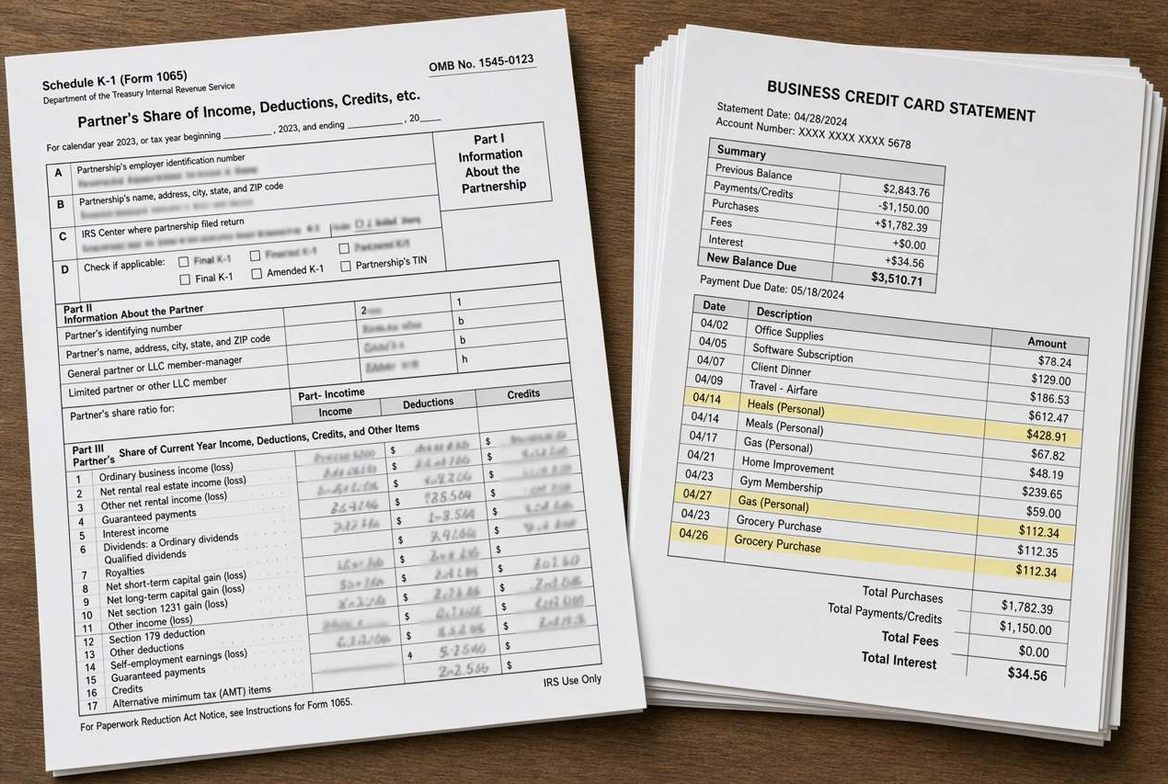
Pass-through profit is taxed whether or not distributed; for support Colorado asks what the owner controls.
Phantom income and perks. A partner or S corporation shareholder is taxed on the K-1 whether or not a dollar is distributed. For support Colorado counts the entity’s income, though a passive minority investor may be limited to cash distributed (C.R.S. § 14-10-115(5)(a)(I)(W)). Significant perks that reduce personal living expenses are income, and so is money drawn for personal use but deducted as a business expense (C.R.S. § 14-10-115(5)(a)(I)(X), (O)).
Depreciation and salary. For support, the accelerated component of depreciation is not an expense (C.R.S. § 14-10-115(5)(a)(III)(B)), and since 2025 the court may use straight-line depreciation for child support, a sentence the maintenance statute lacks. With 100 percent bonus depreciation now permanent, the add-back is often the largest number in the case. The IRS requires an S corporation to pay its owner-employee reasonable compensation, judged partly by what comparable businesses pay, before distributions.
Controllable cash flow. In the HVAC example on Business Valuation, $420,000 of reported income becomes about $741,600 of income for support: the $120,000 salary, the $420,000 K-1, $48,600 of perks, $43,000 paid to a family member who did no work and $110,000 of accelerated depreciation, before any decision on a one-time settlement. Above-market rent paid to the owner’s own LLC is not added back; that rent is already the owner’s income.
A sale. Stock is generally capital gain. In an asset sale, equipment recapture is ordinary income, unrecaptured gain on buildings is taxed at up to 25 percent, goodwill is capital gain, and installment-sale recapture is taxed in the year of sale (§ 453(i)).
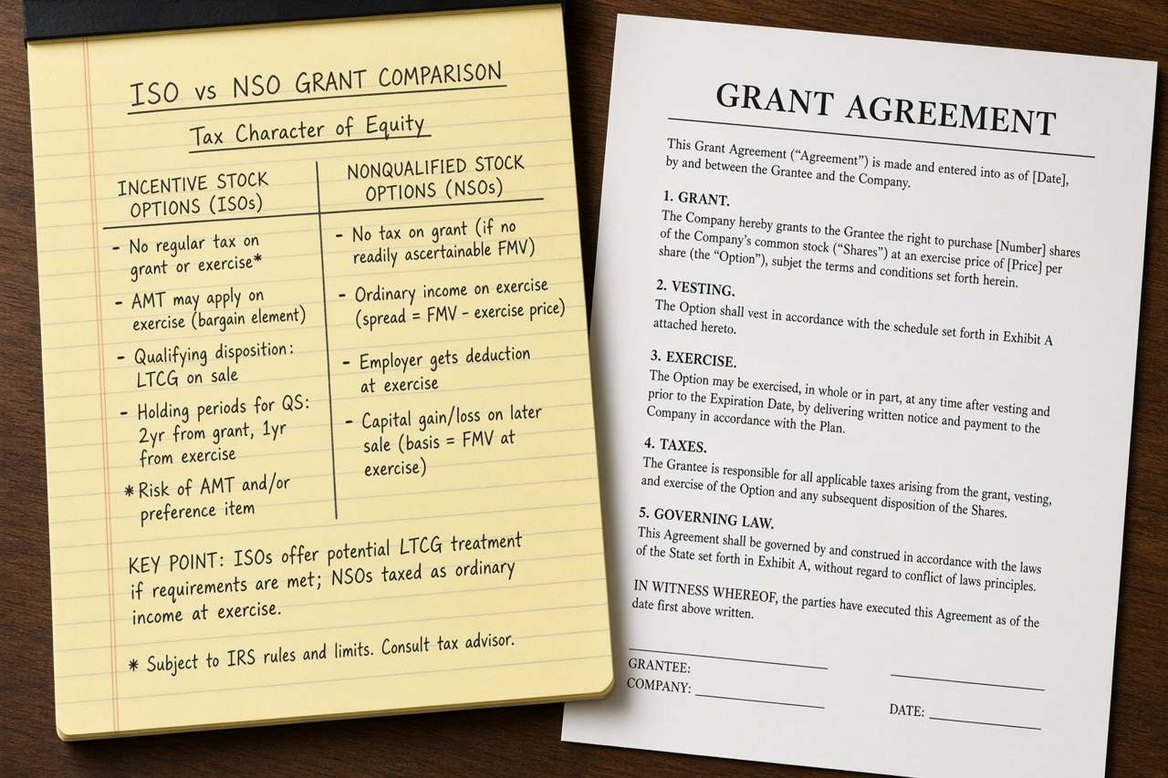
Transferred options and deferred pay are taxed to the former spouse when exercised or paid.
The events. Nonqualified options (NSOs) are ordinary income at exercise (§ 83); incentive stock options (ISOs) produce no regular tax at exercise but an alternative-minimum-tax preference; restricted stock units (RSUs) are ordinary income at vesting.
The transfer. Under Revenue Ruling 2002-22, an employee who transfers nonstatutory options or nonqualified deferred compensation to a former spouse incident to divorce includes nothing on the transfer; the former spouse includes the income on exercise or payment. Social Security and Medicare tax stay with the employee spouse (Rev. Rul. 2004-60). An ISO transferred in a divorce stops being a statutory option that day (Treas. Reg. § 1.421-1(b)(2)).
Colorado. An option granted for past services may be marital when granted; one for future services becomes marital as the services are performed (In re Marriage of Miller, 915 P.2d 1314 (Colo. 1996)). Equity Compensation works the grants one by one.
If a joint return is made, the liability for the tax is joint and several (§ 6013(d)(3)). The IRS may collect the whole balance from either spouse, and a decree assigning the debt to one of them binds the spouses, not the IRS. There are three forms of relief, each with its own showing and clock, and a fourth procedure often confused with them.
| Relief | What you must show | Deadline |
|---|---|---|
| Innocent spouse, § 6015(b) | An understatement attributable to the other spouse’s erroneous items; that you did not know, and had no reason to know, of it when you signed; and that holding you liable would be inequitable. | Elect within two years after the IRS begins collection activities against you |
| Separation of liability, § 6015(c) | You are divorced or legally separated, or lived apart for the 12 months before electing; the deficiency is then allocated between you. Barred by your actual knowledge of the item or a fraudulent transfer scheme; transfers under a divorce decree escape the presumption against last-year transfers. | The same two years |
| Equitable relief, § 6015(f) | Relief from an understatement or unpaid balance when (b) and (c) fail. Rev. Proc. 2013-34 sets threshold conditions, streamlined relief (no longer married, economic hardship, no knowledge) and factors in which abuse or financial control can outweigh knowledge. | Unpaid tax: while the IRS can still collect; paid tax: within the refund period |
| Injured spouse, Form 8379 | Not relief from liability. It recovers your share of a joint refund taken to pay the other spouse’s separate past-due debt. | — |
Relief under § 6015 is requested on Form 8857. Colorado grants comparable relief from the joint state liability after the IRS grants federal relief (C.R.S. § 39-22-107.5). An agreement with an open joint year allocates the tax or refund on each joint return, requires cooperation in any audit, and includes a hold-harmless; none of that binds the IRS, and all of it binds the other spouse.
Miscellaneous itemized deductions are permanently disallowed (§ 67(h)). Fees for a property settlement are added to the basis of the property received (Pub. 504).
File a new Form W-4 when the filing status changes. A recipient of maintenance under a pre-2019 order may need estimated payments; nobody withholds on it.
No penalty at 90% of this year’s tax or 100% of last year’s; 110% above $150,000 of AGI ($75,000 filing separately) (§ 6654(d)).
For the safe harbor, last year’s joint tax is allocated in proportion to the tax each spouse would have owed on a separate return (Treas. Reg. § 1.6654-2(e)(1)).
| Colorado item | The rule | What it means in a divorce |
|---|---|---|
| Rate | 4.40% flat. A temporary cut for 2026 happens only if a TABOR surplus above the statutory thresholds is certified, on an estimate due by October 1 (C.R.S. § 39-22-627). | Use 4.40% until the 2026 rate is known. |
| High-income deduction limit, new for 2026 | With federal AGI of $300,000 or more, add back all but $1,000 (single) or $2,000 (joint) of the federal standard or itemized deduction (C.R.S. § 39-22-104(3)(p.7)). Addbacks also apply to large itemized deductions, the § 199A deduction at high incomes, and, from 2026, the federal overtime deduction. | A house sale, a bonus or a lump-sum withdrawal in the divorce year can cross the line. |
| Pension and annuity subtraction | Up to $20,000 per person at 55 to 64 and $24,000 at 65 and older. Payments under a divorce settlement or decree from a qualifying pension may qualify, but the Department of Revenue says the decree must expressly state the amount of the benefit allocated to the recipient; a lump sum standing in for future payments generally does not qualify. | State the allocated amount in the decree, in dollars or by a formula stated there, or the former spouse can lose the subtraction. |
| Status, maintenance, refunds | Status must match the federal return; no maintenance adjustment; TABOR refunds vary by year and may be zero. | The decree allocates any refund on a joint return. |
| Property tax | The senior and disabled-veteran exemption covers 50% of the first $200,000 of actual value; an occupying spouse of an owner of record counts as an owner-occupier (C.R.S. § 39-3-203; C.R.S. § 39-3-202(2)(a)(II)(A)). | The spouse who keeps the home confirms with the assessor how the married years count. |
As of September 2026, from the 2026 Colorado Revised Statutes and the Department of Revenue’s published guidance.
From Rev. Proc. 2025-32 and the Code as amended by Public Law 119-21 (July 4, 2025), which made the seven individual rates permanent. The IRS publications cited are the 2025 editions, current in September 2026.
| Rate | Single | Head of household | Married filing jointly | Married filing separately |
|---|---|---|---|---|
| 10% | up to $12,400 | up to $17,700 | up to $24,800 | up to $12,400 |
| 12% | $50,400 | $67,450 | $100,800 | $50,400 |
| 22% | $105,700 | $105,700 | $211,400 | $105,700 |
| 24% | $201,775 | $201,750 | $403,550 | $201,775 |
| 32% | $256,225 | $256,200 | $512,450 | $256,225 |
| 35% | $640,600 | $640,600 | $768,700 | $384,350 |
| 37% | above | above | above | above |
Taxable income at the top of each bracket, 2026.
| Item | 2026 |
|---|---|
| Standard deduction | $16,100 single or separate; $24,150 head of household; $32,200 joint; plus $1,650 for age or blindness ($2,050 if unmarried) |
| Senior deduction (2025–2028) | $6,000 per person 65 or older, phased out above $75,000 of modified AGI ($150,000 joint); a married taxpayer must file jointly |
| Long-term gains and qualified dividends | 0% on taxable income to $49,450 single, $66,200 head of household, $98,900 joint, $49,450 separate; 15% to $545,500, $579,600, $613,700 and $306,850; 20% above |
| Net investment income tax | 3.8% above modified AGI of $200,000 single or head of household, $250,000 joint, $125,000 separate; not indexed |
| Child tax credit | $2,200 per child, refundable up to $1,700; phase-out from $200,000 ($400,000 joint); $500 for other dependents |
| Child and dependent care credit | 50% of expenses, stepping down to 35% and then 20% as AGI rises; expense caps $3,000 and $6,000; dependent-care FSA $7,500 |
| Home-sale exclusion (§ 121) | $250,000; $500,000 on a joint return; not indexed |
| Gift tax annual exclusion | $19,000 per recipient; $194,000 to a spouse who is not a U.S. citizen |
| Estate and gift basic exclusion | $15,000,000, indexed after 2026 |
| Colorado | 4.40% flat unless a TABOR surplus triggers a cut; deduction addback at AGI of $300,000 or more |
Figures as of September 2026. Re-check before relying on any of them for a return.
Six things, in the order they come up. Not tax advice on your return; the mistakes I have watched for thirty years.

Cash, a Roth, a brokerage account, a 401(k) and home equity are five currencies. The settlement is negotiated on what each spouse keeps.
December 31 fixes the filing status for the whole year.
It makes you liable for every dollar on it, and the decree cannot change that for the IRS.
The decree cannot be the release. A one-year form, delivered when support is current, is enforceable and satisfies the IRS.
The penalty exception covers the plan distribution, not an IRA.
Use of the house for § 121, the pension amount for Colorado’s subtraction, refunds, estimates, carryforwards, and for a child born 2025 through 2028, who controls the new § 530A children’s account.
The transfer in the divorce triggers capital-gains tax.
Not at the transfer. The tax comes later, to the spouse who took the asset, on the carried-over basis.
Whoever the decree names claims the children.
The IRS goes by nights. The other parent needs a signed release; a decree cannot serve as one.
A signed 8332 gives the other parent head of household too.
Head of household, the earned income credit and the child-care credit stay with the parent the child lives with.
Maintenance is deductible.
Not under an instrument executed after 2018. It is paid in after-tax dollars and received tax-free.
An IRA can be tapped penalty-free for the divorce.
The QDRO exception does not reach IRAs. Early cash comes from the 401(k) under the QDRO, or it pays the 10 percent.
My attorney fees are deductible.
Not since 2018, and now permanently. Fees for a property settlement go into the basis of the property received.

A settlement is signed in pre-tax dollars and lived in after-tax ones. The difference is the negotiation.
Start with a confidential conversation: tell me what is on the table →
Yes. For federal tax purposes marital status is determined on the last day of the year, and a person divorced under a final decree is not considered married. A decree entered by December 31 makes both spouses unmarried for all of that year, so each files as single or, with a qualifying child, as head of household. A decree entered on January 2 leaves the spouses married for the year before, with a choice between a joint return and separate returns unless one of them qualifies as considered unmarried. The date on the decree is worth choosing on purpose.
Yes, if you are considered unmarried, which takes all of these: you file a separate return; your home was the main home of your child for more than half the year, and you can claim the child or could but for a release you signed; you paid more than half the cost of keeping up the home; and your spouse did not live in the home at any time during the last six months of the year. A spouse who moved out in July was there during the last six months, so for that year the answer is married filing separately.
The IRS counts nights. The parent with more nights in the calendar year is the custodial parent; if the nights are exactly equal, the parent with the higher adjusted gross income is. With two or more children, each parent can file as head of household if a different child lives with each of them for more than half the year. The child tax credit can move to the other parent with a signed Form 8332; head of household, the earned income credit and the child-care credit cannot. A Colorado court can allocate the benefit and condition it on support being current.
Under any divorce or separation instrument executed after 2018, no: the payor gets no federal deduction and the recipient reports no income, and Colorado follows because its income tax starts from federal taxable income. An older order is still deductible and taxable unless it was modified and the modification expressly adopted the new rules. Colorado’s guideline cuts the calculated amount to 80 or 75 percent, and the child support worksheet multiplies nondeductible maintenance by 1.25 or 1.33, to account for the deduction that no longer exists.
Not at the transfer. No gain or loss is recognized on a transfer between spouses, or to a former spouse if it is incident to the divorce, and the recipient takes the transferor’s basis. That means you receive the built-in gain as well. A $300,000 brokerage account with a $100,000 basis nets about $256,000 if it is sold in 2026 by a single Colorado filer earning $120,000, after federal capital-gains tax, the net investment income tax and Colorado tax. Price the asset after tax before you accept it.
Yes, if it is paid to you from the plan under the QDRO. A distribution to an alternate payee under a qualified domestic relations order is exempt from the 10 percent additional tax, although ordinary income tax applies. The exemption does not apply to IRAs, so if you roll your share into an IRA first and then withdraw it before 59 and a half, the penalty is back. In the worked example on this page, $50,000 withdrawn nets $36,800 under the QDRO and $31,800 from an IRA.
The $500,000 exclusion requires a joint return, so after the divorce each of you has up to $250,000, and each must meet the two-out-of-five-year ownership and use tests. A spouse who moved out keeps meeting the use test only if the decree or a written separation agreement grants the other spouse use of the house. Without that sentence, a spouse who moved out loses the exclusion about three years after leaving. In the worked example the difference is $14,356 of tax against $71,576.
On a joint return, yes. The liability on a joint return is joint and several, and the IRS is not bound by a decree that assigns the debt to your former spouse. Relief comes through innocent spouse relief, separation of liability for divorced or separated spouses, or equitable relief, all requested on Form 8857. The first two must be elected within two years after the IRS begins collection activity against you. Colorado grants comparable relief from the state liability once the IRS has granted yours.
No. Miscellaneous itemized deductions, where these fees used to go, are permanently disallowed. The IRS says you cannot deduct fees for getting the divorce, for tax advice in connection with it, for getting maintenance, or for appraisers, actuaries and accountants. Fees paid for a property settlement can be added to the basis of the property you receive, which reduces the gain when you sell it. Keep the invoices that show what the fees were for.
For marketplace coverage the child counts in the tax household of the parent who claims the child as a dependent, so a signed release moves the child into the other parent’s premium tax credit calculation. The enhanced credits expired after 2025 and the cap on repaying excess advance credit is gone for 2026, so a parent who received too much advance credit in the separation year repays all of it. Since 2025, Colorado’s allocation statute requires the court to weigh the effect on each parent’s credit.
Possibly. The Colorado Department of Revenue says payments under a divorce settlement or decree that come from a qualifying pension or annuity may qualify, up to $20,000 a year from ages 55 to 64 and $24,000 at 65 and older. But the decree must expressly state the amount of the benefit allocated to you, and a lump sum standing in for future payments generally does not qualify. Check the decree’s wording before it is signed, not when the first payment arrives.
Beginning with 2026, a taxpayer whose federal adjusted gross income is $300,000 or more adds back all but $1,000 (single) or $2,000 (joint) of the federal standard or itemized deduction on the Colorado return. In a divorce year it matters because one-time events, such as a house sale, a bonus, a stock sale or a lump-sum retirement withdrawal, can push income over the line. Colorado’s rate is 4.40 percent unless a certified TABOR surplus triggers a temporary cut for the year.
The next page in this chapter, the pages that belong with it, and the blog posts on the same question.
In a hard-fought Colorado custody case the judge can appoint an attorney whose only client is the child's best interests. What a CLR does, how it differs from a…
Sept 18, 2026The SLAT Trap: When the Estate Plan Meets the DivorceSpousal Lifetime Access Trusts move wealth out of the taxable estate, with the marriage as the access mechanism. In a divorce, the donor loses the access,…
Sept 17, 2026Can You File for Divorce in Another State If You Live in Colorado?Where a divorce can be filed, where the money can be decided, and where the children's case belongs are three different questions. Colorado's 91-day domicile…
A consultation is a working session, in person in Greenwood Village or by video: bring the last three returns and the proposal on the table, and I will show you what each asset is worth to you after tax, which tax sentences the decree needs, and what to ask your CPA. Your note reaches my office directly; during business hours we call you back within the hour, run the conflicts check, and set the meeting.
Talk to us about your case.
303-507-5529One call. A real person picks up, hears you out, and tells you how we would handle what you are facing and what to do first. No phone tree, no sales pitch, no obligation. Your first conversation is with our intake paralegal, who will get you to Aaron fast.
Rather write? Send a short note and during business hours we call you back within the hour.