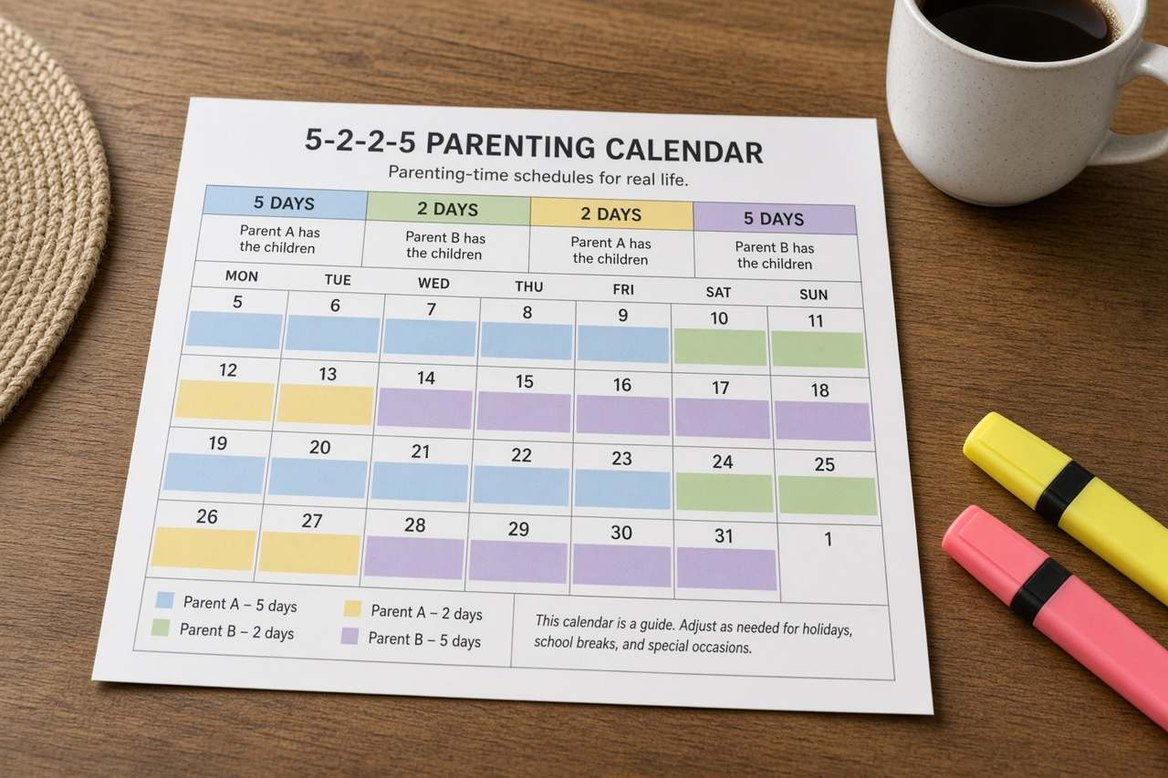
Parenting-time schedules, compared.
Alternating weeks, 5-2-2-5, 2-2-3, every other weekend with a midweek overnight. Each common schedule fits a different age, distance and work life, and since March 2026 each one produces a different child support number. The right schedule is engineered for the child you have, then written so it holds up on a Tuesday in February.
- 01Three patterns, three rhythms
- 02Four patterns, four rhythms
- 03When one home is the base
- 04What tends to work at each stage
- 05The schedule that overrides the schedule
- 06What makes a schedule work in practice
- 07The trade-offs
- →What people ask first
Talk to us about your case.
303-507-5529One call. A real person picks up, hears you out, and tells you how we would handle what you are facing and what to do first. No phone tree, no sales pitch, no obligation. Your first conversation is with our intake paralegal, who will get you to Aaron fast.
Rather write? Send a short note and during business hours we call you back within the hour.
Overnights, and why 182 matters.
Colorado schedules are counted in overnights per year, out of 365. Equal time is 182 or 183 overnights each, and plans alternate the extra night by year. The count feeds the child-support worksheet directly: since March 2026 each parent’s overnights produce a proportional credit, so there is no longer a cliff where a few extra nights change the number dramatically. It also decides which parent has the majority of time, which controls the rules for relocation and later modifications. A schedule is written three times in the plan: the school-year pattern, the summer pattern, and the holiday schedule that overrides both.

Three patterns, three rhythms.
A full week with each parent, exchanged on the same day each week, usually at school. The simplest schedule to run and the easiest for older children to keep in their heads; seven days away is long for a young child, so families often add a midweek dinner.
Parent A has Monday and Tuesday, Parent B has Wednesday and Thursday, and the weekends alternate. Fixed weekdays, real weekends, a five-day maximum gap; two exchanges a week.
Every other weekend plus a midweek visit, or the extended-weekend version from Thursday after school to Monday morning, which adds school nights and moves exchanges to school. The traditional answer when the parents live far apart or one works nights or travels.
Four patterns, four rhythms.

Alternating weeks (7-7). The children spend a full week with each parent, exchanging on the same day each week — usually after school on Friday or Monday so the school is the exchange. It is the simplest schedule to run and the easiest for older children to keep in their heads, and it gives each parent long stretches of ordinary life. The cost is seven days away from the other parent, which is long for a young child; families often add a midweek dinner or overnight with the off-duty parent to shorten the gap.
2-2-5-5. Parent A has Monday and Tuesday every week, Parent B has Wednesday and Thursday every week, and the weekends — Friday through Sunday — alternate. Each parent gets a fixed pair of school nights, which makes activities and homework routines predictable, and the longest gap is five days. It is the most popular equal schedule for school-age children in the south-metro courts, in my experience, because it combines fixed weekdays with a real weekend.
3-4-4-3. Parent A has Monday through Wednesday, Parent B has Thursday through Sunday, and the following week they swap the four-day block. The longest gap is four days and the schedule averages out weekly, but the exchange day moves every week, which is harder for younger children and for parents with rigid work schedules.
2-2-3. Two nights with A, two with B, three with A; the next week the pattern flips. No child is away from either parent for more than three nights, which is why it is the usual recommendation for toddlers and preschoolers. The price is frequent exchanges — three a week — and a pattern that reverses weekly, so it needs a shared calendar and parents who can hand off without friction. Most families move from 2-2-3 to 2-2-5-5 or alternating weeks as the children reach school age.
When one home is the base.
Every other weekend plus a midweek visit. The children live primarily with one parent and spend alternating weekends with the other, typically Friday after school to Sunday evening, plus a midweek dinner or overnight. It yields roughly four to six overnights a month for the non-primary parent and is the traditional answer when the parents live far apart, when one parent’s work involves travel or nights, or when a parent is stepping back into a child’s life. The extended-weekend variant — Thursday after school to Monday morning — adds two school nights every other week and moves the exchanges to school, which is why I draft it more often than the Friday-to-Sunday version.
4-3. One parent has four fixed nights every week, the other three. It is a stable, weekly-repeating schedule that gives the minority-time parent a real share of school life — and it is a common landing point when a family wants near-equal time but the geography or work schedules make 50-50 unrealistic.
Summers reversed. Many unequal school-year plans flip in the summer, or give the non-primary parent extended blocks of two to four weeks with advance notice. The summer schedule is its own section of the plan and should be drafted as carefully as the school year.
What tends to work at each stage.
| Age | What tends to work | Why |
|---|---|---|
| Infants and toddlers | Frequent, shorter contacts, building toward 2-2-3 as overnights are introduced | Attachment forms through frequent contact; long gaps are hard at this age |
| Preschool | 2-2-3 or 2-2-5-5 | No more than three or five nights away; predictable pairs of days |
| School age | 2-2-5-5, 3-4-4-3, or alternating weeks with a midweek visit | School becomes the exchange point; homework and activities need fixed weekdays |
| Teenagers | Alternating weeks, often with flexibility written in | Older children manage longer blocks and have their own schedules; rigid plans produce conflict |
The schedule that overrides the schedule.
Holidays are allocated separately and take priority over the regular pattern. The usual Colorado plan alternates each holiday by even and odd years so that both parents get every holiday every other year: New Year’s, Martin Luther King Day, Presidents’ Day, spring break, Easter or Passover, Memorial Day, the Fourth of July, Labor Day, fall break, Halloween, Thanksgiving, and winter break, which is commonly split at a midpoint so each parent has Christmas Eve and Christmas Day or the New Year in alternating years. Mother’s Day and Father’s Day go to that parent every year; the child’s birthday alternates or is shared; each parent’s birthday goes to that parent. Religious holidays are listed by name where they matter to the family. A well-drafted plan also says how a holiday is defined — from what time to what time — what happens when a holiday falls on a parent’s regular time, and whether a holiday weekend attaches to the holiday.
What makes a schedule work in practice.

Exchanges. The best exchange is one the parents never attend: drop-off at school in the morning by one parent, pickup in the afternoon by the other. Where a direct exchange is unavoidable, the plan names the place, the time, who drives, and a grace period. Right of first refusal. A plan term, not a statute, under which a parent who cannot care for the children for a stated period must offer the time to the other parent before using a sitter or relative; the threshold — four hours, an overnight, a weekend — is negotiated, and set too low it turns every business dinner into a dispute. Make-up time. Defined in advance, not negotiated after the fact. Contact during the other parent’s time. A stated window for calls or video, reasonable in length, that neither parent uses to run the other household. Travel. Notice periods, itineraries, and passports. The calendar. A shared co-parenting application the court can read, so that the schedule, the changes, and the messages are in one place. For parents whose work makes the standard patterns unrealistic, how I draft around a real calendar: Custody for Executives & Business Owners.
The trade-offs.
| Schedule | Strengths | Weaknesses |
|---|---|---|
| Alternating weeks | Simple; long stretches of normal life; fewest exchanges | Seven days apart; hard for young children |
| 2-2-5-5 | Fixed weekdays; real weekends; five-day maximum gap | Two exchanges a week; needs the same-day handoffs every week |
| 3-4-4-3 | Four-day maximum gap; weekly balance | Exchange days move; harder to memorize |
| 2-2-3 | Three-day maximum gap; ideal for young children | Three exchanges a week; pattern flips weekly |
| Every other weekend + midweek | Stable home base; works at a distance | Little school-week involvement for one parent; fewer overnights |
| Extended weekends (Thu–Mon) | School-based exchanges; school nights for both parents | Still unequal; Monday-morning logistics |
| 4-3 | Weekly repeat; near-equal | One parent always has the shorter block |
What decides it.

Four things decide which schedule a family should have: the distance between the homes and the school, the parents’ work schedules as they actually are rather than as they might become, the children’s ages, and the level of conflict between the parents — high-conflict families need fewer exchanges and more precision, not more flexibility. The court decides under the best-interests factors, and a CFI or PRE will usually recommend a specific pattern; a parent who proposes a realistic, detailed schedule generally does better than one who asks for “50-50” in the abstract. My own practice is to draft the school-year, summer, and holiday schedules as a single calendar the client can look at for the next twelve months, and to build in the step-ups — from 2-2-3 to 2-2-5-5, from supervised to unsupervised — so that the plan grows with the children instead of being litigated every two years. The vocabulary behind all of this: Colorado Custody Terms.
I draft the school-year, summer and holiday schedules as a single calendar the client can look at, with the mechanics that make it work: exchanges at school, a right of first refusal set at a sensible threshold, make-up time defined in advance.
What I tell every parent choosing a schedule.
Five things, before you pick one.
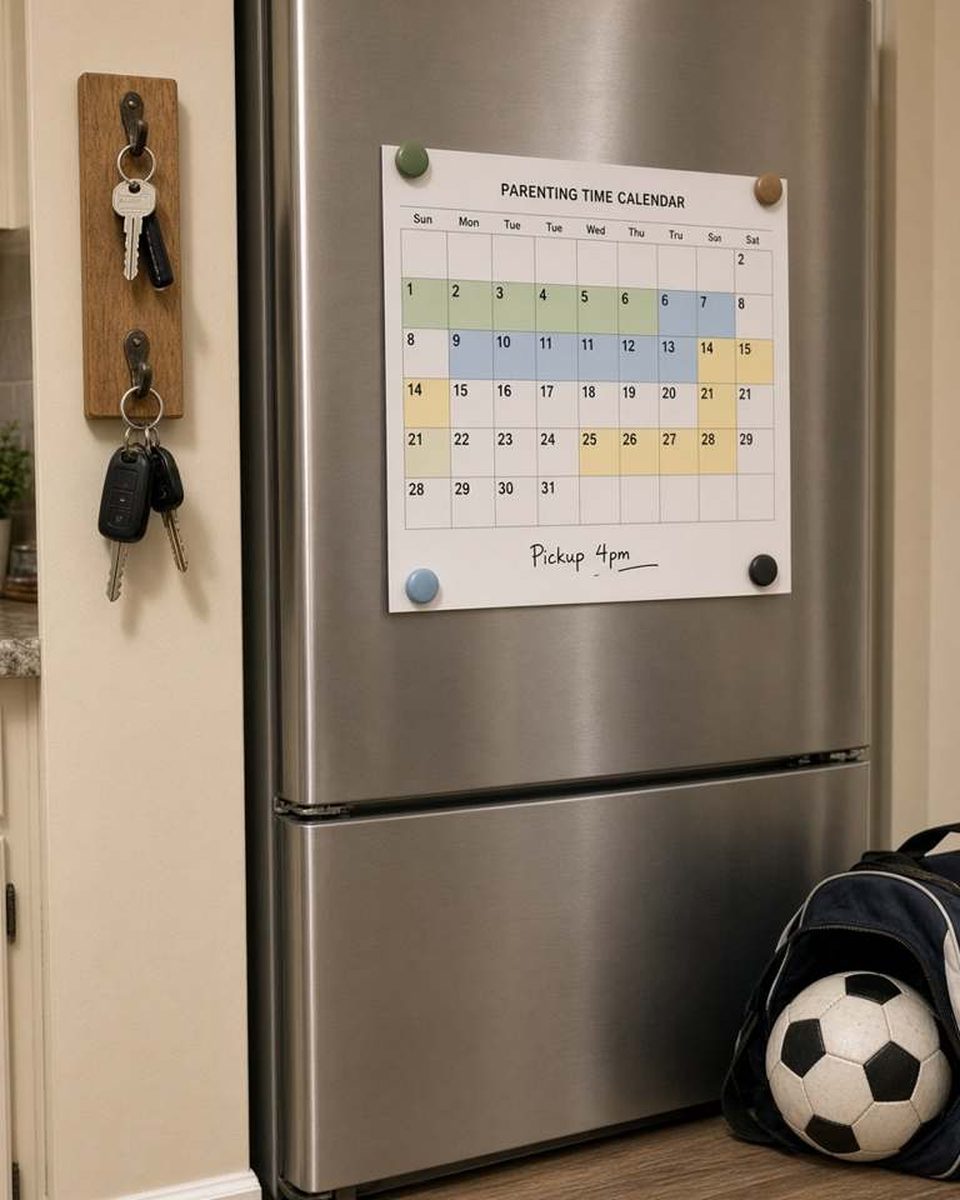
- Age first.
A toddler and a teenager need different rhythms. A schedule that works at nine can be wrong at three, and the plan should say how it changes.
- Distance second.
Equal time works when both homes are near the school. Forty minutes apart, the midweek overnight becomes a car ride, not a home.
- Count the overnights.
Every overnight moves the support number now. Run the calculation on each option before anyone agrees.
- Write the exceptions.
Holidays, summer, travel, illness, the right of first refusal. The base schedule is easy; the exceptions are the plan.
- Plan the transitions.
Exchanges at school, not at doorsteps. Fewer hand-offs, fewer arguments.
Custody is shaped by the first orders. The first month decides most of it.
Start with a confidential conversation: tell me what is at stake →
The other parent is not following the schedule? That is enforcement, not modification.
Colorado has a statute built for withheld parenting time: a verified motion under C.R.S. § 14-10-129.5, decided on the papers within thirty-five days, with make-up time of the same kind and length as the time lost, attorney fees the court must award against the parent who withheld or failed to exercise the time, and contempt as one remedy among several. Make-up time, not jail, is usually the point. A single withheld weekend supports make-up time and fees under this statute even where it would not support contempt.
The parenting-time enforcement motion →Enforcement of Orders →Contempt of Court →
The questions parents ask about schedules.
What is the most common 50-50 schedule in the Denver metro courts?
In my experience, 2-2-5-5 for school-age children: Parent A has Monday and Tuesday every week, Parent B has Wednesday and Thursday, and the weekends alternate. Each parent gets fixed school nights, which makes homework and activities predictable, and the longest gap is five days. Alternating weeks is simpler and suits older children; 2-2-3 suits toddlers and preschoolers who should not be away from either parent more than three nights.
Why does everyone talk about overnights?
Because Colorado counts schedules in overnights per year, out of 365, and the count does two things. It decides which parent has the children a majority of the time, a label with consequences for school, support and later modifications. And since March 2026 it feeds the child-support worksheet directly: each parent’s overnights produce a proportional credit, so there is no longer a cliff where a few extra nights change the number dramatically. Run the calculation on each option before anyone agrees.
What schedule works for a toddler?
Frequent, shorter contacts, building toward 2-2-3 as overnights are introduced: two nights with one parent, two with the other, three with the first, flipping the next week. No child is away from either parent for more than three nights. The price is three exchanges a week and a pattern that reverses weekly, so it needs a shared calendar and parents who can hand off without friction. Most families move to 2-2-5-5 or alternating weeks as the child reaches school age, and the plan should say when.
We live forty minutes apart. Can we still do equal time?
Usually not well. Equal time works when both homes are near the school; at forty minutes the midweek overnight becomes a car ride rather than a home. The traditional answers at a distance are every other weekend plus a midweek visit, or the extended-weekend version from Thursday after school to Monday morning, often with summers reversed or extended blocks for the non-primary parent.
How are holidays handled?
Separately, and they override the regular pattern. The usual Colorado plan alternates each holiday by even and odd years so both parents get every holiday every other year, with winter break commonly split at a stated date and time, and the holiday schedule is drafted as its own section along with the summer schedule and travel rules.
What is a right of first refusal, and should our plan have one?
A plan term, not a statute, under which a parent who cannot care for the children for a stated period must offer the time to the other parent before using a sitter or a relative. Set at a sensible threshold it adds parent time; set at a few hours it turns every business dinner into a dispute. High-conflict families need fewer exchanges and more precision, and the threshold is drafted with that in mind.
Where should exchanges happen?
At school, whenever possible: one parent drops off in the morning, the other picks up in the afternoon, and the parents never meet. Where a direct exchange is unavoidable, the plan names the place, the time, who drives and a grace period. Fewer hand-offs, fewer arguments.
Can the schedule change as the children get older?
Yes, and the plan should say how. A schedule that works at nine can be wrong at three or at fifteen. Step-ups written into the plan avoid a motion later; where the plan is silent, parenting time can be modified whenever it serves the child’s best interests, with a higher showing and a two-year wait where the change would move the child’s majority residence.
Where to go next.
The next page in this chapter, the pages that belong with it, and the blog posts on the same question.
- Modifying CustodyAfter the decreeChanging a schedule that no longer fits
- Modifying Child SupportAfter the decreeEvery overnight moves the number
- Relocation & Move-AwayAfter the decreeThe long-distance schedule
- The Parenting Plan, Clause by ClauseSchedules, holidays, right of first refusal, non-disparagement, the clauses that matter
From the blog, on this topic
In a hard-fought Colorado custody case the judge can appoint an attorney whose only client is the child's best interests. What a CLR does, how it differs from a…
Sept 17, 2026Can You File for Divorce in Another State If You Live in Colorado?Where a divorce can be filed, where the money can be decided, and where the children's case belongs are three different questions. Colorado's 91-day domicile…
Sept 16, 2026Colorado's New Child Support Law: What Changed on March 1, 2026Colorado rebuilt child support on March 1, 2026: a schedule that now runs to $40,000 a month, a credit for every overnight in place of the 93-night cliff, a…
The schedule is engineered for your child’s life. Let’s draw it on a calendar.
A consultation is a working session, in person in Greenwood Village or by video: we go through your situation and I tell you what I would do. Your note reaches my office directly; during business hours we call you back within the hour, run the conflicts check, and set the meeting.
Talk to us about your case.
303-507-5529One call. A real person picks up, hears you out, and tells you how we would handle what you are facing and what to do first. No phone tree, no sales pitch, no obligation. Your first conversation is with our intake paralegal, who will get you to Aaron fast.
Rather write? Send a short note and during business hours we call you back within the hour.