
Parenting time, engineered for real life.
Parenting time is the schedule: where the child sleeps, how holidays run, who drives to the exchange. Colorado builds it from the child’s life, not from a percentage, and since March 2026 every overnight moves the child support number. The schedule and the support are negotiated with each other in view.
- 01Three things that decide the schedule
- 02Drafted like a settlement agreement
- 03Travel, multiple homes, and the details…
- 04Moving with a child is its own legal…
- →Co-parenting apps
- →What people ask first
- →Parental Responsibilities
- →Modifications
Talk to us about your case.
303-507-5529One call. A real person picks up, hears you out, and tells you how we would handle what you are facing and what to do first. No phone tree, no sales pitch, no obligation. Your first conversation is with our intake paralegal, who will get you to Aaron fast.
Rather write? Send a short note and during business hours we call you back within the hour.
Count the overnights before you agree to them.
Every overnight moves child support since March 1, 2026. Pick the schedule, add the holidays and the summer, and read the count and the credit it earns before the schedule goes into the plan.
Open the parenting-time calculator →Stability is measured from the child’s seat.
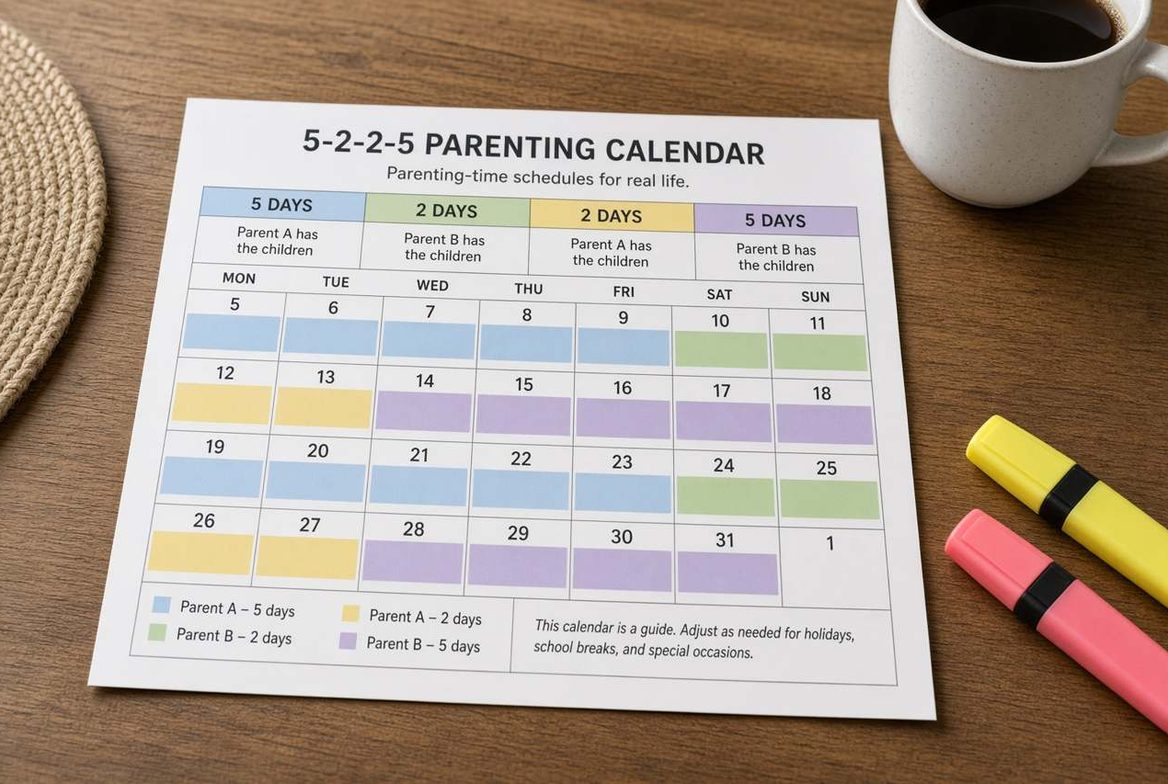
School calendars, activities, friendships, sleep — the things that make a schedule work are the child's, not the parents'. Alternating weeks, 5-2-2-5 rotations, school-year/summer splits: the named structures are starting points, and the right one depends on ages, distance between homes, and how the family actually functions. Equal time that exhausts a child isn't stability; it's arithmetic.
A parenting schedule is a piece of drafting your family will live inside for years; vague orders create annual litigation, precise ones prevent it. Equal time that exhausts a child is not stability; it is arithmetic.

Three things that decide the schedule.
Courts commonly land on substantial time with both parents when geography and circumstances allow, but the structure is built from school, work, distance and the child’s needs, not from symmetry between the parents.
Travel-heavy careers, a second home in the mountains, private-school calendars, holidays with real traditions on both sides: good orders anticipate exchange logistics, travel notice, passports, make-up time, and a right of first refusal drafted at a threshold that does not turn every business dinner into a dispute.
When a parent wants to relocate with the child, Colorado applies a distinct analysis under C.R.S. § 14-10-129, different during the initial case and after final orders, and these are among the hardest motions in family law. If a move is on your horizon, it belongs in the plan now.
Drafted like a settlement agreement.

I draft schedules the way I draft settlement agreements: precisely, because precision is what keeps you out of court later. The school-year pattern, the summer pattern and the holiday schedule are written as one calendar the family can actually read, and the common patterns are compared on the parenting schedules page.
Travel, multiple homes, and the details that prevent friction.

The families I represent rarely have simple logistics: travel-heavy careers, a second home in the mountains, private-school calendars that don't match the district's, holidays with real traditions on both sides. Good orders anticipate all of it — exchange logistics, travel notice, passports, make-up time — and include the clauses that prevent years of low-grade conflict, like a well-drafted right of first refusal (whether a parent must offer the other parent the time before a sitter gets it). The drafting detail is the dispute prevention.
Moving with a child is its own legal standard.
When a parent wants to move with the child — for work, family, or a fresh start — Colorado applies a distinct analysis under C.R.S. § 14-10-129, and the analysis differs depending on whether the move arises during the initial case or after final orders exist — either way centered on the child's best interests and the statutory relocation factors. These are among the hardest motions in family law, with little middle ground. If a move is even on your horizon, that conversation should happen before the plans harden — not after.
The co-parenting apps: OurFamilyWizard and TalkingParents.
Judges in the Denver-metro districts, parenting plans and decision-makers routinely require that all non-emergency communication between parents go through a co-parenting application, and they usually name one of these two or let the parents choose between them. Both do the same basic thing: every message is timestamped, marked when it is read, and cannot be edited or deleted, so the record of what was said, when, and by whom is kept by a third party neither parent controls. Here is what each does, what it costs, and how the record is used in court.

OurFamilyWizard
ourfamilywizard.com →- Documented messaging: timestamps record when each message was received and read; messages are stored unalterably.
- ToneMeter and a writing assistant that flag hostile or emotional phrasing before a message is sent.
- A shared parenting calendar with color-coded time, holiday scheduling and yes/no trade requests.
- An expense ledger with receipts, stated splits (50/50, 80/20) and in-app payments; a running balance.
- Documented in-app calls, an information bank for medical, school and insurance records, and a login history.
Records are exported as certified reports. Free professional accounts let your lawyer, a child and family investigator or a parenting coordinator view the activity and download the records directly, which removes any argument about what was produced.
As of September 2026: a paid subscription for each parent, billed annually, about $110 a year for the basic plan; about $150 for the most-used plan, with 45 minutes of calls a month, the writing assistant, expense tracking and GPS check-ins; about $216 for unlimited calls, storage and certified records; about $300 with call recording and transcription. One parent may pay for both. Free or discounted subscriptions for parents in financial need, and a military rate.

TalkingParents
talkingparents.com →- Secure messaging with timestamps and read status; every message and call is permanently saved and cannot be edited or deleted.
- Accountable Calling: calls placed through the app, documented, with minutes that scale by plan.
- A shared calendar, an information library, and Accountable Payments for reimbursements between parents.
- Vault storage for documents, photos and video; a personal journal that the other parent cannot see.
- A sentiment scanner and writing assist on the top plan.
Unlimited PDF records on every plan, and a printed, certified records package for a hearing, included on the top plan and available for a fee on the others. The records carry the timestamps and read status the court needs.
As of September 2026: a paid subscription (the free tier ended March 30, 2026), $7 a month for messaging, calendar, information library, 30 minutes of calls and unlimited PDF records; $16 for more calling and storage; $32 for unlimited calls, the sentiment scanner, priority support and one printed records package. Eight percent off when paid annually. Fee waivers for parents who qualify on financial-hardship or domestic-violence grounds.
How the record is used as evidence.
- Get it into the order. A parenting plan or temporary order that requires the app is what makes going around it a violation. Without the clause, texts and voicemails continue and the record is fragmentary.
- Write every message for the judge. They will read it. Short, factual, about the child, no adjectives. The tone tools exist because one heated paragraph outweighs a year of good ones.
- Never go around it. A parent who texts, calls or emails outside the app after the order has undercut the record and given the other side an exhibit. Emergencies are the exception the plan defines.
- Use the calendar and the ledger. An exchange requested and declined in the calendar, or a reimbursement posted with a receipt and never paid, is the exhibit in an enforcement or contempt motion. Screenshots of a text thread are not.
- Export the record, do not photograph it. A certified or PDF record with timestamps and read status is produced by the app, not by a phone; the other parent’s own messages come in as statements of a party, and the app’s records address authentication.
- Give the professionals access. A CFI or PRE who can read the app sees the whole pattern rather than the excerpts each parent chooses; so does a decision-maker. That transparency is itself persuasive.
How it gets into your order.
A parenting-plan clause, agreed or ordered, along these lines:
All non-emergency communication between the parents concerning the children shall occur through a co-parenting application (OurFamilyWizard or TalkingParents). Each parent shall maintain an active subscription, check the application at least once daily, and respond to a request within forty-eight hours. Emergencies concerning a child’s health or safety may be communicated by telephone and shall be confirmed in the application.
The clause also names who pays, what counts as an emergency, whether new partners may be given access, and that the record is admissible for enforcement and modification. In a high-conflict case I ask for it at temporary orders, so that the record exists for the permanent-orders hearing rather than beginning after it. Neither app makes anyone a better co-parent; both make the record of who was.
Features and prices are as stated on the companies’ own sites in September 2026 and change; confirm before subscribing. OurFamilyWizard and TalkingParents are trademarks of their owners, used here to identify the products. I have no relationship with either company and receive nothing from either.
What I tell every parent about the schedule.
Five things, before you agree to one.

- Start from the child’s week.
School, activities, both parents’ work, how far apart the homes are. A percentage is the result, not the plan.
- Write the exchanges down.
Where, when, who drives, what happens when someone is late. The unwritten parts are the ones that get litigated.
- Holidays and summer, before the first one arrives.
Priority years, travel notice, the right of first refusal if you want one. Decide it in the plan, not in December.
- Every overnight moves the number.
Run the support calculation on each schedule under discussion before anyone agrees to it.
- Live the schedule you are asking for.
The status quo is evidence. If you want the Tuesday overnights, do the Tuesday overnights now.
Custody is shaped by the first orders. The first month decides most of it.
Start with a confidential conversation: tell me what is at stake →
The other parent is not following the schedule? That is enforcement, not modification.
Colorado has a statute built for withheld parenting time: a verified motion under C.R.S. § 14-10-129.5, decided on the papers within thirty-five days, with make-up time of the same kind and length as the time lost, attorney fees the court must award against the parent who withheld or failed to exercise the time, and contempt as one remedy among several. Make-up time, not jail, is usually the point. A single withheld weekend supports make-up time and fees under this statute even where it would not support contempt.
The parenting-time enforcement motion →Enforcement of Orders →Contempt of Court →
Scheduling questions I hear weekly.
What schedule will the court order?
The one your facts support. Courts commonly land on substantial time with both parents when geography and circumstances allow — but the specific structure is built from school, work, distance, and the child’s needs. I draft schedules the way I draft settlement agreements: precisely, because precision is what keeps you out of court later.
Can I move out of state with my kids?
Not unilaterally once a case or orders exist. Relocation requires either agreement or a court’s decision under a demanding analysis. Talk to me before making commitments — the sequencing of a relocation request affects its odds.
The other parent keeps missing their time. Can I withhold it?
No — and don’t. Parenting time and child support are separate obligations; self-help on either undermines you. Document the pattern and address it properly: through modification if the schedule no longer reflects reality, or enforcement if it’s defiance.
Where to go next.
The next page in this chapter, the pages that belong with it, and the blog posts on the same question.
From the blog, on this topic
Colorado replaced custody with the allocation of parental responsibilities, split into parenting time and decision-making. How each half works, joint versus sole…
Sept 18, 2026Child's Legal Representative in Colorado: A Lawyer for Your ChildIn a hard-fought Colorado custody case the judge can appoint an attorney whose only client is the child's best interests. What a CLR does, how it differs from a…
Sept 17, 2026Can You File for Divorce in Another State If You Live in Colorado?Where a divorce can be filed, where the money can be decided, and where the children's case belongs are three different questions. Colorado's 91-day domicile…
Bring the calendar as it actually runs. We’ll build the schedule from it.
A consultation is a working session, in person in Greenwood Village or by video: we go through your situation and I tell you what I would do. Your note reaches my office directly; during business hours we call you back within the hour, run the conflicts check, and set the meeting.
Talk to us about your case.
303-507-5529One call. A real person picks up, hears you out, and tells you how we would handle what you are facing and what to do first. No phone tree, no sales pitch, no obligation. Your first conversation is with our intake paralegal, who will get you to Aaron fast.
Rather write? Send a short note and during business hours we call you back within the hour.