8%
Interest on unpaid maintenance
The judgment rate, compounded annually, from each installment’s due date, as the Judicial Branch’s forms apply it.
Spousal maintenance is enforced under the same statute as child support: each missed payment is a final judgment when due, collected by income assignment, garnishment, lien or contempt. It earns eight percent, not ten. The county will rarely collect it for you. And delay can cost a recipient the principal itself, which is never true of child support.
Talk to us about your case.
303-507-5529One call. A real person picks up, hears you out, and tells you how we would handle what you are facing and what to do first. No phone tree, no sales pitch, no obligation. Your first conversation is with our intake paralegal, who will get you to Aaron fast.
Rather write? Send a short note and during business hours we call you back within the hour.
Maintenance is a promise with a due date. Each one the payor misses becomes a judgment the same day.
Spousal maintenance, Colorado’s word for alimony, is enforced under the same statute as child support: every installment becomes a final money judgment when it is due and not paid, enforceable without further action by the court. The income assignment that collects child support collects maintenance too, and so does the continuing garnishment. Contempt is available, and it is not imprisonment for debt. What surprises recipients is where maintenance differs. The county child support office generally will not enforce it once the children’s support has ended, so enforcement is usually private. Unpaid maintenance earns eight percent, not child support’s ten. And the Court of Appeals has held that delay can cost a maintenance recipient the principal itself.
What surprises payors is how little room there is. A payor whose income fell, who retired, or who believes the former spouse is living with someone new cannot simply pay less. Maintenance is modified only from the date a motion is filed, and every short payment before that is a judgment with interest. When maintenance ends, by death, remarriage, the end of the term or an order, it ends going forward; installments already missed remain. Bankruptcy does not touch it. This page, current as of September 2026, covers each rule, which statute sets the interest, and what a recipient or payor should do the week something changes. How maintenance is set is on the Spousal Maintenance page; how it is changed, on Ending or Reducing Maintenance.
The judgment rate, compounded annually, from each installment’s due date, as the Judicial Branch’s forms apply it.
Each installment is enforceable for twenty years, but delay can cost the principal of maintenance, not only the interest.
Maintenance is modified only from the date a motion is filed. A payment skipped before that is a judgment.
The statute that makes child support self-executing covers maintenance in the same sentence.
Unpaid maintenance is a final judgment on its due date. It cannot be modified retroactively, and the recipient can enforce it without asking the court first.
In any case in which “child support, maintenance when combined with child support, or maintenance is ordered, a payment becomes a final money judgment” when it is due and not paid, and it may be enforced as other judgments without further action by the court (C.R.S. § 14-10-122(1)(c)). The judgment is entitled to full faith and credit in every state. To use it for a lien or a garnishment, the recipient files a verified entry of support judgment in the existing case, the same form used for child support (JDF 1813), stating the period and the total; there is no filing fee, and the filing revives the installments it covers. The steps are on the Child Support Arrears page.
No retroactive change. Maintenance may be modified only as to installments accruing after a motion to modify is filed, and only on changed circumstances so substantial and continuing as to make the terms unfair (C.R.S. § 14-10-122(1)(a)); in no instance before the filing date (C.R.S. § 14-10-122(1)(d)). The Court of Appeals has held that a court may not abate maintenance that has already accrued. Some decrees go further: a separation agreement can limit or preclude modification of maintenance (C.R.S. § 14-10-112(6)), and then even a motion may not change it.
Temporary maintenance too. Orders entered while the case was pending are enforced the same way. The Supreme Court’s decision in In re Marriage of Nussbeck, 974 P.2d 493 (Colo. 1999) arose from unpaid temporary maintenance and child support, and it held that entering a judgment for the arrears does not take contempt off the table.
For child support, the twenty-year limit is close to the whole story. For maintenance it is not.
Each maintenance installment can be enforced for twenty years from its due date, and a verified entry filed within that time revives it (C.R.S. § 13-52-102(2)(a)). The Supreme Court held long ago that alimony and support installments are judgments enforceable for the entire period of the statute of limitations. For child support, laches cannot bar the principal, because the money belongs to the child. Maintenance belongs to the former spouse, and that difference matters.
In In re Marriage of Kann, 2017 COA 94 a former wife waited twenty-six years to enforce maintenance. The Court of Appeals held that laches can bar maintenance interest, because “only the recipient spouse benefits” from it. It then held that laches can bar the principal of maintenance arrears too: the policy that protects child support does not apply to spousal maintenance, and the twenty-year statute “does not preclude maintenance arrearages from mounting to exorbitant levels.” Laches still requires the payor to prove that the recipient knew the facts, delayed unreasonably, and that the payor relied on the delay to his or her prejudice. The lesson is plain. A recipient who lets arrears build for years, without a demand, a verified entry or a motion, is building the other side’s defense.
A dated letter or message stating the amount owed. It answers the knowledge-and-delay argument before it starts.
It fixes the number, revives the installments, and supports a lien. No filing fee.
In every county where the payor owns or may own real estate. A sale or refinance has to deal with it.
If there is an employer, the income assignment collects the current payment and, with a garnishment, the arrears.
For maintenance, time is not neutral. The Court of Appeals has held that delay can cost the recipient the principal, not only the interest.
Unpaid maintenance earns interest, but not under the statute that sets the child support rate.
Not the child support statute. The ten-percent rate in C.R.S. § 14-14-106 belongs to the Child Support Enforcement Procedures Act, and its 2021 text speaks of “child support arrearages.” When the legislature described interest in the notice for a statutory support lien, it named two statutes, interest “pursuant to sections 14-14-106 and 5-12-101” (C.R.S. § 14-10-122(1.5)(f)), which reads most naturally as one rate for child support and the general rate for everything else.
Eight percent, compounded annually. Each unpaid maintenance installment is a judgment on its due date, and Colorado’s judgment-interest statute allows interest on a judgment, where no other rate is specified, at eight percent a year compounded annually (C.R.S. § 5-12-102(4)); the general legal rate is the same (C.R.S. § 5-12-101). The Judicial Branch’s instructions, its self-help page and its legal help center all apply eight percent to maintenance. No published appellate decision I have found decides the rate. One question is open: whether maintenance that came due before July 1, 2021 could be argued to carry the old child support rate, because the pre-2021 statute spoke of “any arrearages.” No court has decided it, and I would not build a claim on it.
The good-cause reduction is a child support rule. The 2021 amendment that lets a court disallow interest for good cause is written for child support arrearages. For maintenance, the payor’s defense to interest is laches, as in Kann. The recipient may always waive it.
| A maintenance ledger | Figure |
|---|---|
| Principal: $2,500 due on the first of each month of 2024, none paid | $30,000.00 |
| Interest to December 31, 2026 at eight percent, compounded on each installment’s anniversary | $6,508.00 |
| on the January 2024 installment, three full years | $649.28 |
| on the December 2024 installment, two years and thirty days | $435.17 |
| Total owed on December 31, 2026 | $36,508.00 |
For comparison, $10,000 unpaid for three years at eight percent compounded annually earns $2,597.12 in interest; at child support’s ten percent it would earn $3,310.00. Computed the same way as the examples on the Child Support Arrears page.
Most of the machinery that collects child support collects maintenance. The county’s administrative tools mostly do not.
Priority, the county, and retirement income. Each changes how a maintenance case is collected.
The income assignment. The statute is titled “Income assignments for child support or maintenance,” and it applies to maintenance whether or not combined with child support: ordered immediately, activated on notice to the employer, open to objection only for a mistake of fact within fourteen days (C.R.S. § 14-14-111.5). The difference is priority. When one paycheck carries several assignments, current child support comes first, then medical support and child support arrears; an assignment for maintenance only comes fourth. A payor with a child support order in a second family may leave little for a maintenance-only assignment.
The Registry. Maintenance runs through the Family Support Registry when the court orders it or when it is paid by income assignment (C.R.S. § 26-13-114(1)(c)), and a payor the court has directed to pay maintenance through the Registry pays a minimal per-transaction processing fee set annually by rule. Its record is the proof of what was paid, though the statute that makes the record prima facie evidence of contempt speaks of child support and maintenance combined with child support, not maintenance alone.
Garnishment and liens. A continuing garnishment reaches each paycheck for maintenance arrears (C.R.S. § 14-14-105(1)), within the support caps: fifty or sixty percent of disposable earnings, fifty-five or sixty-five for arrears more than twelve weeks old. The broader definition of earnings that reaches pensions and workers’ compensation is written for child support judgments, so I do not assume a pension can be garnished for maintenance-only arrears; other routes to retirement money, such as a domestic relations order, are a question for the particular plan. A recorded transcript of the judgment is a lien on Colorado real estate for six years, renewable by revival.
The county, mostly not. The county child support office’s application says it will not enforce spousal maintenance once the current child support order ends, unless the children still live with the recipient, the maintenance was ordered in the same case, and past-due child support remains. A recipient of maintenance alone should expect to enforce it through the court.
| Tool | Does it reach maintenance? | Authority |
|---|---|---|
| Income assignment | Yes, on notice to the employer; fourth priority when it is for maintenance only | C.R.S. § 14-14-111.5 |
| Verified entry and transcript lien | Yes; the same form as child support (JDF 1813); the lien runs six years, renewable | C.R.S. § 14-10-122(1)(c); C.R.S. § 13-52-102(1) |
| Continuing garnishment | Yes, within the support caps; pensions and workers’ compensation are a closer question | C.R.S. § 14-14-105(1); C.R.S. § 13-54-104(3) |
| Contempt | Yes; not imprisonment for debt | C.R.C.P. 107 |
| County license suspension, passport denial, tax intercepts | Generally no; child support tools, used for maintenance only inside a county child support case | C.R.S. § 26-13-123 |
| An order from another state | Registered and enforced here; only the issuing state may modify it | C.R.S. § 14-5-211 |
Contempt enforces maintenance as it enforces child support, and the constitution’s bar on imprisonment for debt does not stand in the way.
Not imprisonment for debt. The Colorado Constitution forbids imprisonment for debt. The Supreme Court held more than a century ago that committing a spouse for contempt for refusing to pay a judgment for separate maintenance is not imprisonment for debt, and it later upheld jail for failing to pay alimony and fees: the sanction is for disobeying the court’s order, not for owing money. A judgment for the arrears does not use up contempt; the two remedies are cumulative.
What has to be proved. For remedial contempt: the order, the payor’s knowledge of it, the nonpayment, and a present ability to pay, by a preponderance of the evidence. The payor carries the burden of proving inability, and willfulness is not required. The court must set a purge condition the payor can meet, for unpaid maintenance usually a payment of a stated amount by a stated date. For punitive contempt: a willful refusal proved beyond a reasonable doubt, with the protections of a criminal case. The process, from the verified motion (JDF 1816) to the personal service the Supreme Court now requires, is on the Contempt of Court page.
When contempt fits. Where the payor is salaried, the income assignment collects faster, with no hearing. Contempt fits the payor the assignment cannot reach: the business owner who controls his own pay, the payor who retired early or quit, the payor with assets but no wages, and the payor who has simply stopped. Ability to pay decides it, and bank records, business records and the payor’s own spending are the proof; post-judgment discovery under C.R.C.P. 69 gets them.
Four events end the obligation to pay future maintenance. None of them erases what was already owed.
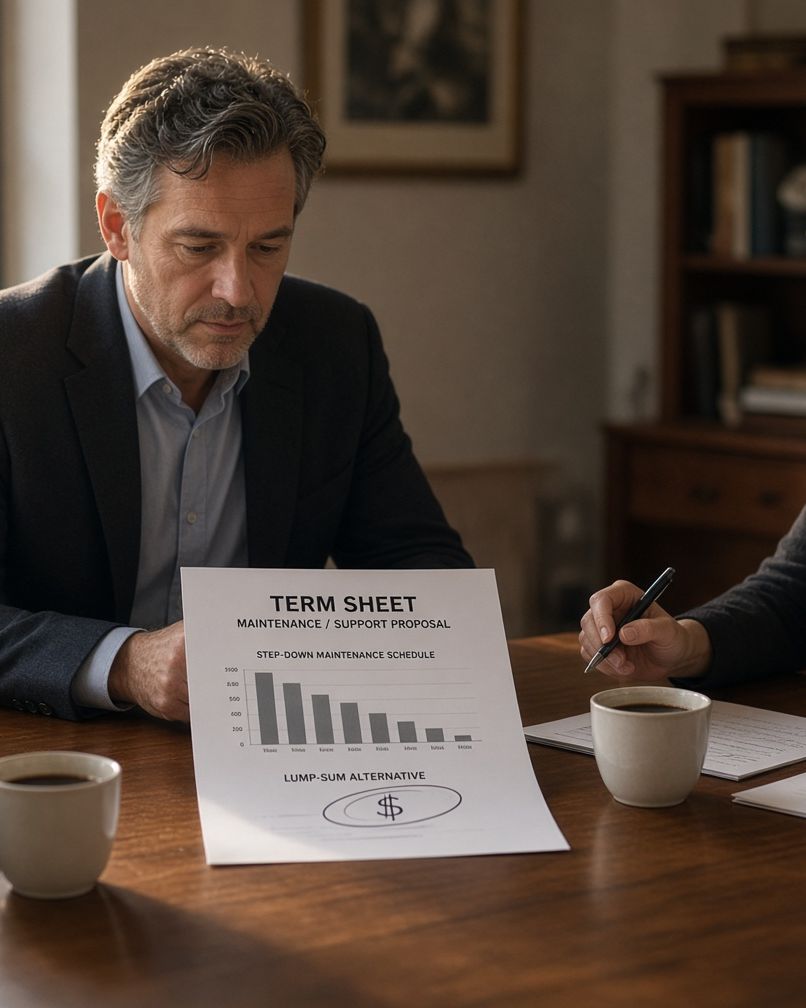
Death, the end of the term, the recipient’s remarriage or civil union, or an order ends future maintenance, unless the agreement or decree says otherwise. Installments already due remain judgments.
Unless otherwise agreed in writing or expressly provided in the decree, “the obligation to pay future maintenance is terminated upon the earlier of” the death of either party; the end of the term, unless a motion to modify is filed before it expires; the remarriage or civil union of the recipient; or a court order terminating maintenance (C.R.S. § 14-10-122(2)(a)). The word that matters is future. Installments already due are final judgments, and nothing in the termination statute undoes them. That is my reading of the statute’s structure; I have found no Colorado appellate decision that says it in so many words, and none that holds otherwise.
Remarriage. The Supreme Court has held that remarriage includes a common-law marriage, and that annulling the later marriage does not automatically revive maintenance. Whether an agreement keeps maintenance going after remarriage depends on its words, and the Court of Appeals is divided: one division has required an express provision, and a 2025 division held that continuation may be shown expressly or by clear implication.
Death. If the payor dies, the arrears are a claim against the estate, and Colorado’s nonclaim statute bars claims not presented within one year after the death at the latest, or sooner if the estate gives notice to creditors; a recorded lien is preserved (C.R.S. § 15-12-803). If the recipient dies, the recipient’s estate can collect what was owed. A court may require security for maintenance, including life insurance on the payor, weighing age and insurability, cost, the amount and term, and the payor’s other obligations (C.R.S. § 14-10-114(6)).
Retirement and cohabitation are not on the list. A payor who retires at full retirement age gets a rebuttable presumption that the retirement is in good faith (C.R.S. § 14-10-122(2)(b)), but it is a presumption in a modification case: the payor still has to file, and any reduction reaches back no further than the filing date. See Ending or Reducing Maintenance.
| Event | Future maintenance | Arrears already owed |
|---|---|---|
| Death of either party | Ends future maintenance unless a writing continues it after death expressly or by clear implication; a general clause binding heirs is not enough, the Court of Appeals has held | Unpaid installments are a claim against the payor’s estate, subject to the nonclaim deadline; a recipient’s estate can collect them |
| End of the term | Ends future maintenance, unless a motion to modify is filed before the term expires | Unpaid installments remain judgments |
| Remarriage or civil union of the recipient | Ends future maintenance unless the agreement or decree provides otherwise; includes a common-law marriage | Unpaid installments remain judgments |
| A court order | Ends or reduces maintenance from the date the order says, no earlier than the filing of the motion | Everything due before that date remains owed |
| Cohabitation | Not a termination event; a ground for a motion to modify | Every short payment before an order is a judgment |
| Retirement | Not a termination event; at full retirement age, a rebuttable presumption of good faith in a modification | Every short payment before an order is a judgment |
The most common maintenance arrears case is not a payor who stopped. It is a payor who decided to pay less.
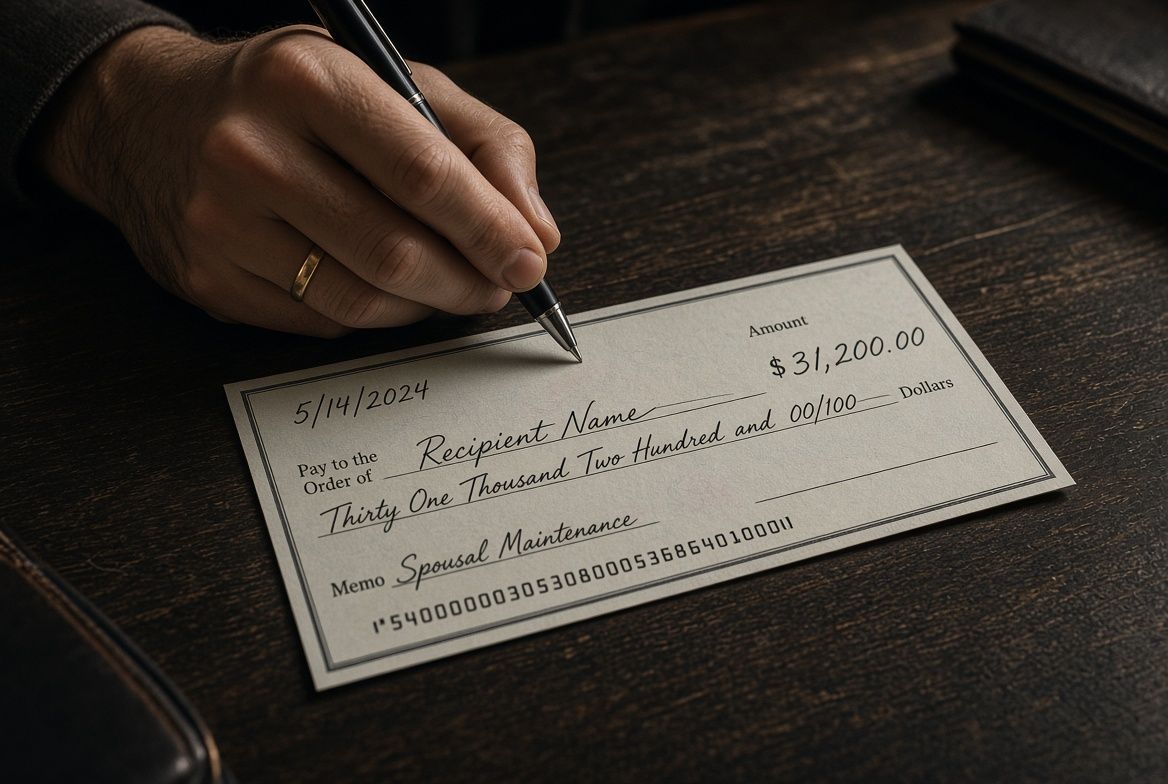
A payor who cuts the payment without an order creates a judgment for every shortfall, with interest, and no court can erase it later.
The reasons are usually real. The business had a bad year, the payor retired, the former spouse moved in with someone. None of them changes the order until a court does, and the court can reach back only to the date the motion was filed. Every short payment in between is a support judgment the day it is due.
The arithmetic. A payor ordered to pay $4,000 a month pays $2,500 from March 2025 through April 2026 and files a motion in May. Even if the court reduces maintenance to $2,500 from the filing date, the fourteen months before it are judgments: $21,000 in principal, and about $1,630 in interest by September 1, 2026 at eight percent. The recipient can collect all of it by income assignment, garnishment, lien or contempt.
For the payor, the rule is to file the week the change happens and to keep paying the ordered amount while the motion is pending, or as much as possible, with the records that show why. For the recipient, accepting reduced payments for years without objection is how a laches defense is built. A written demand, a verified entry or a motion keeps the record clean.
A payor who pays less on his own has not modified anything. He has created a judgment for the difference, with interest.
Maintenance survives bankruptcy. What it was called in the decree can matter when one side files.
Maintenance survives. A debt to a former spouse “in the nature of alimony, maintenance, or support” is a domestic support obligation “without regard to whether such debt is expressly so designated,” and it is excepted from discharge (11 U.S.C. §§ 101(14A), 523(a)(5)), in chapter 13 as in chapter 7 (11 U.S.C. § 1328(a)(2)). The automatic stay does not stop withholding of income for a domestic support obligation (11 U.S.C. § 362(b)(2)).
Property settlements are different. A debt to a former spouse under a property division, such as an equalization payment, is not dischargeable in chapter 7 (11 U.S.C. § 523(a)(15)), but the chapter 13 discharge does not list that exception, so it can be discharged there. Because the bankruptcy court looks at the substance of an obligation rather than its label, how a payment was structured in the decree can decide which rule applies. That is a drafting question at the settlement table, and it matters years later.
Six things, in the order they come up. Not legal advice for your case; the mistakes I have watched for thirty years.
Delay can cost a maintenance recipient the principal, not only the interest. Demand in writing, then file.
It needs no hearing and reaches the paycheck before the payor does. Contempt is for the payor it cannot reach.
Maintenance is a judgment at the judgment rate. A claim at the child support rate invites a fight you do not need.
Unless the maintenance is part of a child support case the county is enforcing, the enforcement is yours.
Every short payment is a judgment. File the motion the week things change.
Death, remarriage and retirement are decided by the agreement’s words and the statute together. Know which applies before it happens.
Alimony stops the day my ex moves in with someone.
Cohabitation is a ground for a motion to modify, not an automatic end.
If my ex remarries, I do not owe what I missed.
Remarriage ends future maintenance. Installments already due remain judgments.
Unpaid alimony earns ten percent, like child support.
Maintenance carries the eight-percent judgment rate, compounded annually.
I have twenty years, so there is no hurry.
For maintenance, the Court of Appeals has held that delay can bar the principal as well as the interest.
Nobody goes to jail over a debt.
Contempt for refusing to pay maintenance is not imprisonment for debt; the sanction is for disobeying the order.
Bankruptcy will clear it.
Maintenance is a domestic support obligation, not dischargeable in chapter 7 or chapter 13.

Maintenance is a promise with a due date. Delay is the one thing that can cost you the principal.
Start with a confidential conversation: tell me what has not been paid →
Each missed payment is already a judgment. If your ex has an employer, activate an income assignment; it goes to the employer with a certified copy of the order and needs no hearing. File a verified entry of support judgment for the unpaid months, record the transcript as a lien on any Colorado real estate, and use a continuing garnishment for the arrears. If your ex is self-employed, retired or hiding income, a contempt motion is the tool. Do not wait: for maintenance, unlike child support, long delay can cost you the principal.
Eight percent a year, compounded annually, from each installment’s due date. Each unpaid installment is a judgment, and the judgment-interest statute sets eight percent where no other rate applies; the Judicial Branch’s forms apply that rate to maintenance. The ten percent that applies to child support comes from a statute written for child support arrearages. No appellate decision squarely decides the maintenance rate, and whether maintenance due before July 1, 2021 could carry the old child support rate has never been decided. The recipient may waive interest.
Each installment can be enforced for twenty years from its due date, and a verified entry filed within that time revives it. But twenty years is not a safe harbor. In 2017 the Court of Appeals held that laches, the defense of unreasonable delay that causes prejudice, can bar maintenance arrears, principal and interest alike, in a case where the former wife waited twenty-six years to enforce. Child support principal is protected from laches because it belongs to the child; maintenance is not.
Yes. The income-assignment statute covers maintenance whether or not it is combined with child support, and the assignment is activated on notice to the employer, without a hearing; the payor can object only for a mistake of fact, within fourteen days. For arrears, a continuing garnishment takes up to fifty or sixty percent of disposable earnings, or fifty-five or sixty-five percent for arrears more than twelve weeks old. A maintenance-only assignment comes fourth in priority, behind current child support, medical support and child support arrears.
Usually not. The county’s application says it will not enforce spousal maintenance once the current child support order ends, unless the children still live with you, the maintenance was ordered in the same case as the child support, and past-due child support remains. A recipient owed maintenance alone should plan to enforce it through the court, with a verified entry, an income assignment, garnishment, liens and, where needed, contempt. The license and passport tools the county uses are, for the most part, child support tools.
Yes, through contempt, if the court finds a present ability to pay. The Colorado Constitution forbids imprisonment for debt, but the Supreme Court held more than a century ago that jailing a spouse for contempt for refusing to pay maintenance is not imprisonment for debt; the sanction is for disobeying the order. Remedial jail must come with a purge condition the payor can meet, usually a payment. Punitive jail requires proof beyond a reasonable doubt of a willful refusal, and the right to a jury before any sentence longer than six months.
Yes. The recipient’s remarriage or civil union ends the obligation to pay future maintenance, unless the agreement or the decree says otherwise. Installments that came due before the remarriage and went unpaid are final judgments, and the termination statute speaks only of future maintenance. Check the agreement’s words first, then see that the income assignment is ended in writing, and expect the unpaid balance from before the remarriage to be collected with interest.
If the payor dies, future maintenance ends unless the agreement says otherwise, but the arrears do not disappear. They are a claim against the payor’s estate, and Colorado’s nonclaim statute bars claims not presented within one year after the death at the latest, or sooner if the estate gives notice to creditors. A recorded lien is preserved. If the recipient dies, the recipient’s estate can collect what was owed. A court can require life insurance to secure maintenance for exactly this reason.
No. Maintenance can be modified only from the date a motion is filed, and only on changed circumstances so substantial and continuing that the terms have become unfair. Every payment you shorten before a court rules is a judgment for the difference, with interest at eight percent, and it can be collected by garnishment, lien or contempt. File the motion the week your income changes, keep paying what you can, and document why.
No. Maintenance is a domestic support obligation under the Bankruptcy Code, whatever the decree calls it, and it is excepted from discharge in chapter 7 and chapter 13. The automatic stay does not stop an income assignment for it. A property-settlement debt to a former spouse, such as an equalization payment, is treated differently: it survives a chapter 7 discharge but can be discharged in chapter 13. The bankruptcy court looks at what the obligation really is, not only at its label.
Cohabitation does not end maintenance automatically. Only death, the recipient’s remarriage or civil union, the end of the term, or a court order ends future maintenance, unless the agreement provides otherwise. A payor who believes cohabitation has changed the recipient’s circumstances must file a motion to modify, and any reduction reaches back no earlier than the filing date. Every short payment before that is a judgment you can collect, with interest.
The next page in this chapter, the pages that belong with it, and the blog posts on the same question.
In a hard-fought Colorado custody case the judge can appoint an attorney whose only client is the child's best interests. What a CLR does, how it differs from a…
Sept 18, 2026The SLAT Trap: When the Estate Plan Meets the DivorceSpousal Lifetime Access Trusts move wealth out of the taxable estate, with the marriage as the access mechanism. In a divorce, the donor loses the access,…
Sept 17, 2026Can You File for Divorce in Another State If You Live in Colorado?Where a divorce can be filed, where the money can be decided, and where the children's case belongs are three different questions. Colorado's 91-day domicile…
A consultation is a working session, in person in Greenwood Village or by video: we read the decree and the agreement, go through the payment record, and I tell you what is owed with interest, which tools will collect it, and what I would file first. If you are the one paying, I tell you what the order allows and what a motion can change. Your note reaches my office directly; during business hours we call you back within the hour, run the conflicts check, and set the meeting.
Talk to us about your case.
303-507-5529One call. A real person picks up, hears you out, and tells you how we would handle what you are facing and what to do first. No phone tree, no sales pitch, no obligation. Your first conversation is with our intake paralegal, who will get you to Aaron fast.
Rather write? Send a short note and during business hours we call you back within the hour.