Practice Area · Equity
Stock options and RSUs in divorce.
Equity compensation is where a divorce's property analysis and tax analysis collide. Two grants with the same paper value can be worth very different amounts after tax — and most divisions never notice.
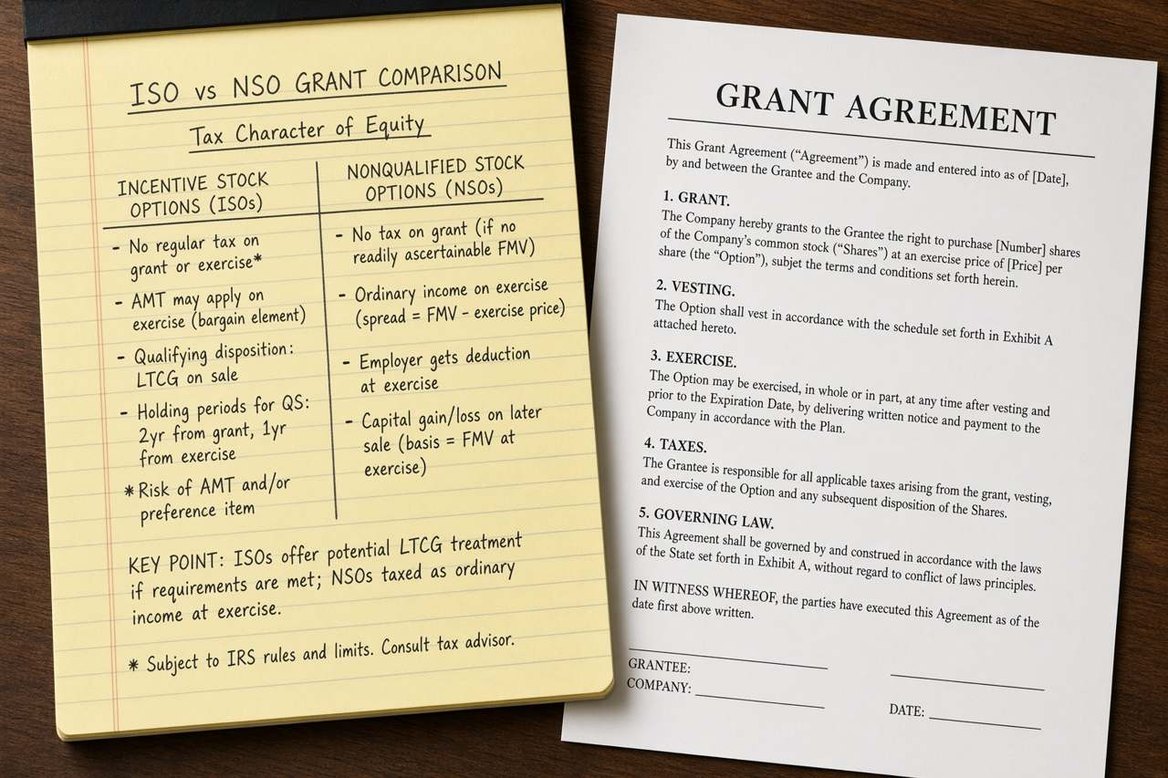
Not All Equity Is Equal
The tax character changes the real value.
RSUs are taxed as ordinary income at vesting. Nonqualified options are taxed at exercise; incentive stock options carry their own rules and their own traps. Which means a settlement trading “$500,000 of your RSUs” for “$500,000 of brokerage stock” is not an even trade — one side just accepted an embedded tax bill the other escaped. I tax-effect every equity position before it goes on the settlement board, because the after-tax number is the only real one.
Division Mechanics
Restrictions mean structure, not transfer.
Most plans prohibit transferring options or unvested shares to a former spouse — so the division happens by structure instead: the employee spouse holds the awards and delivers the other's share if, as, and when value is realized, with the order specifying vesting allocations, exercise decisions, tax withholding, and what happens on termination or a change of control. Vague orders here generate years of accounting disputes. Precise ones make the division self-executing — and precise is how I draft them.
Common Questions
Asked by people with vesting schedules.
Are my unvested RSUs even marital property?
Frequently in part. Awards granted for work during the marriage carry a marital component even if they vest later, while awards for purely future service may not become marital until an enforceable right accrues; the apportionment turns on each grant's purpose and timing. The grant agreements — not the brokerage summary — answer this.
My company hasn't gone public. What are my options worth?
That's a valuation question wearing an equity costume: recent rounds, 409A valuations, preferences, and dilution all matter, and honest answers carry ranges. What you should never do is settle at face value on private paper no one has actually priced.
Can my ex end up owning shares in my company?
Rarely, and usually by drafting failure. Plans typically forbid it, and good orders don't attempt it — they divide value through the employee spouse, keeping the cap table clean and your employer out of it.

The rest of this chapter.
Closely held businesses, professional practices, executive and equity compensation, trusts, real estate, and the tracing that decides what is marital and what is not.
- Business Valuationthe number that decides the case→
- High-Asset Divorcecomplex estates, disclosure, and the five-year rule→
- Business Owner Divorcekeeping the company you built→
- Complex Financial Divorcevalue, characterize, tax-effect — then divide→
- Property Divisionequitable, not automatic 50/50→
- Separate Propertya records-management discipline→
- Spousal Maintenancethe formula, published with a worked example→
- Executive Compensationproperty or income — the line worth arguing→
- Stock Options & RSUstax character changes real valueYou are here
- Trust Intereststhe instrument, not the balance, decides→
- Real Estatevalue, equity, and after-tax proceeds differ→
- Retirement AssetsQDROs, and three different currencies→
- Professional Practicesgoodwill, licensure, and buyouts→
- Tax Strategythe settlement that matters is the after-tax one→
- Hidden Assets & Forensic Discoverythe disclosure duty, and the five-year hammer→
- Cryptocurrency & Digital Assetsfindable, valuable, divisible→
- Married to the Business Ownerleveling the information field→
- Income Determinationwhat “income” means when you own the company→
Engagement
The after-tax number is the only real number. Let's find yours.
A consultation is a scheduled working session — in person in Greenwood Village or by video — in which we go through your situation and I tell you what I would do. It is a paid meeting, not a free call and not a sales pitch; my assistant quotes the consultation fee when you schedule. There is no chatbot here: the contact form and the phone both reach my office, my assistant reviews every inquiry personally, and the meeting goes on my calendar. Please hold the confidential details until we have run a conflicts check.